How Much Chicken Per Person? Whole, Pieces, Boneless
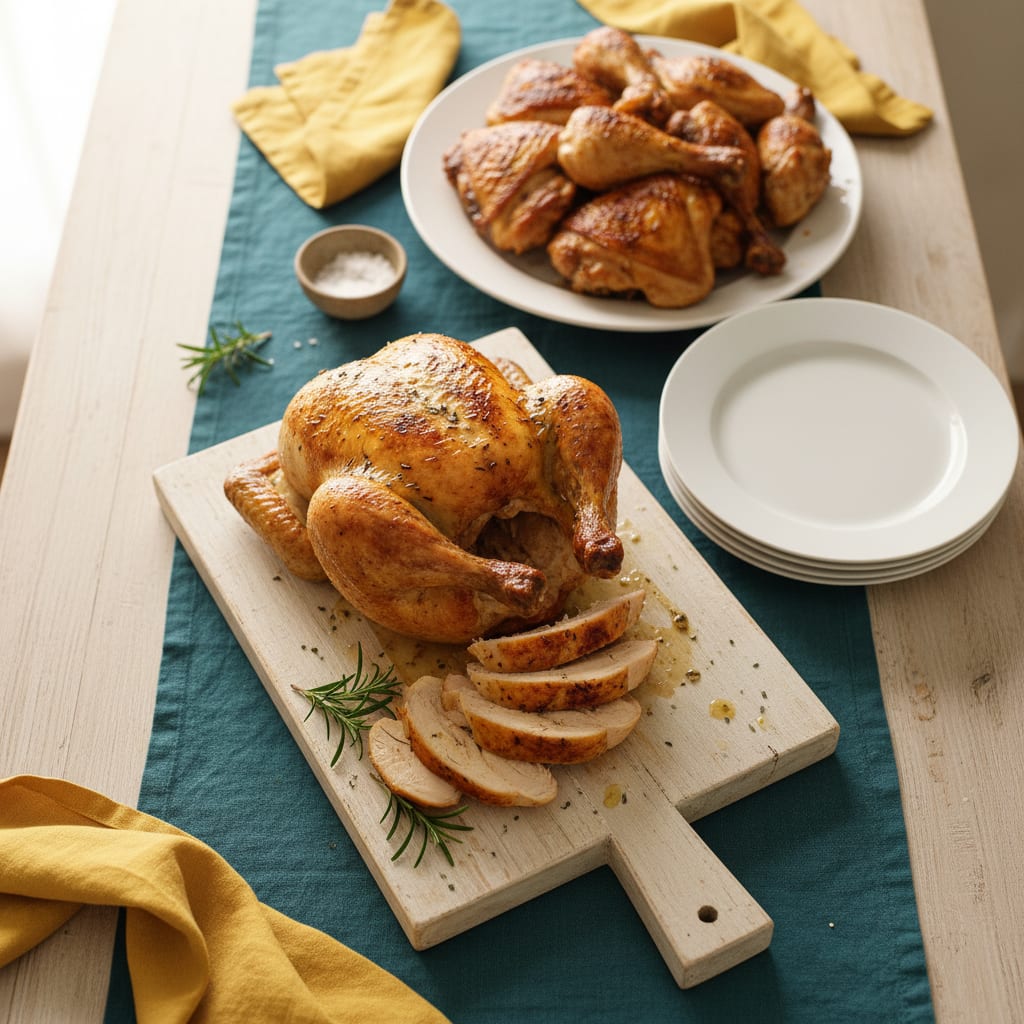
Buy about 1 lb of whole chicken, 10 to 12 oz of bone-in pieces, or 6 to 8 oz of boneless chicken per adult. Three very different numbers for the same dinner, and the reason is simple: a whole chicken is only about 60% meat. The other 40% is skin and bone that you pay for, carry home and do not serve. Get that one figure into your head and every other chicken quantity question answers itself.
The chart
| Guests | Whole birds | Bone-in pieces | Boneless breast or thigh |
|---|---|---|---|
| 4 | One 4 lb bird | 3 lb | 1.75 lb |
| 6 | One 6 lb bird, or a 4 lb bird plus 4 thighs | 4.5 lb | 2.75 lb |
| 8 | Two 4 lb birds | 6 lb | 3.5 lb |
| 10 | Two 5 lb birds | 7.5 lb | 4.5 lb |
| 12 | Three 4 lb birds | 9 lb | 5 lb |
| 20 | Five 4 lb birds | 15 lb | 8.5 lb |
| 30 | Seven 4–5 lb birds | 22 lb | 12.5 lb |
| 50 | Twelve 4–5 lb birds | 37 lb | 21 lb |
Bone-in pieces are counted at 11 oz per adult, which is roughly two thighs or drumsticks, or one large breast half. Boneless is counted at 7 oz.
These agree with the figures in our meat quantities per person chart — this page is the arithmetic underneath them.
What you actually get from a whole bird
University of Wisconsin–Madison Extension’s poultry yield write-up gives the number nobody at the butcher counter mentions. A ready-to-cook whole chicken — the thing in the plastic wrap, head, feet and innards already gone — is around 60% meat and 40% skin and bones.
Run a 4 lb bird through that: 2.4 lb of meat, before cooking. Roasting takes roughly a quarter of that away as moisture and rendered fat, which is the same shrink our meat chart uses for every roast. You are left with a little under 1.8 lb of cooked chicken — four generous 7 oz platefuls, or six sensible ones. That is exactly why “a 4 lb bird feeds about 4” is the standing advice, and why it starts to feel tight the moment anyone goes back for seconds.
The same page puts the giblets and neck at roughly 7% of live bird weight, which is worth knowing only because it is the part most people throw out. Simmered with an onion, it is the difference between gravy and brown sauce.
The parts are not equal, and this changes your shopping
Wisconsin’s breakdown of a broiler carcass:
| Part | Share of the carcass |
|---|---|
| Breast | 40% |
| Thigh | 32% |
| Drumstick | 16% |
| Wing | 12% |
| Breast quarter | 26–28% |
| Leg quarter | 24–26% |
Two useful things fall out of that table.
Buying breast means buying the most expensive 40% of the bird and paying for the whole thing. If half the table would be equally happy with thighs, a mixed tray of thighs and drumsticks covers 48% of the carcass at a fraction of the cost per person, and it cooks more forgivingly — which is why nearly every recipe in our dinners from one rotisserie chicken round-up works with dark meat.
Wings are a terrible main and a great starter. At 12% of the carcass, and mostly bone and skin, they yield so little meat that a wings dinner for eight is 6 or 7 lb of wings. Plan them at about 1 lb per adult as a main, or half that as one item on a buffet.
Adjust for who is eating
Start from the chart, then move:
- Buffet or self-serve: add about 15%. People take two pieces when the platter is in front of them and one when someone hands them a plate.
- Lots of sides: drop to the low end. Six ounces of boneless chicken next to rice, salad and bread is plenty; the same six ounces with a small green salad is not.
- Children under about ten: count roughly half an adult. Teenagers count as more than one adult, reliably.
- Bone-in wants a round number of pieces, not a weight. Work out how many pieces each person gets first, then buy that many, then check the weight.
- Leftovers: add a whole extra bird rather than a bit more of everything. A spare roast chicken is the most useful thing in a fridge; a spare half-portion is not.
Cooked chicken, if that is what the recipe wants
Recipes for casseroles, soups and filled things ask for cooked chicken, which is a different unit again — and the safest way to plan it is in weights rather than cups, because a loosely piled cup of shredded chicken and a tightly packed one are not the same amount of dinner.
Boneless chicken loses roughly a quarter of its weight cooking, the same shrink our meat chart applies to any roast. So 1.5 lb of raw boneless gives you a little over 1 lb of cooked meat, and a 4 lb whole bird — 60% meat, minus the shrink — gives about 1.8 lb picked off the bone. That is one family casserole with enough over for a lunchbox, which is the real reason we roast two birds whenever we roast one.
For the poaching method that produces the most shreddable meat, our boiling times for chicken breast covers the temperature and the timing; for the one-pan version where the chicken and the starch cook together and the quantities work themselves out, see one-pot chicken and rice.
FAQ
How many pounds of chicken do I need for 10 people?
About 10 lb of whole chicken (two 5 lb birds), 7.5 lb of bone-in pieces, or 4.25 lb of boneless. Add 15% to any of those if it is a help-yourself buffet.
How much chicken breast per person?
Six to eight ounces of raw boneless breast per adult. Supermarket breasts are often 8 to 10 oz each, so one large breast can genuinely serve one hungry adult or two moderate ones if you slice it.
How many chicken thighs per person?
Two bone-in thighs, or three for big eaters. Boneless thighs run smaller — count on three per adult.
How many people does a 5 lb chicken feed?
Five as a straightforward roast dinner with sides, or four if chicken is the main event and people will want seconds. At 60% meat, a 5 lb bird carries about 3 lb of raw meat.
How much chicken for 20 people on a buffet?
Around 17 lb of bone-in pieces or 10 lb of boneless once the buffet uplift is added. Bone-in is the better buy at this scale: it costs less, it holds heat far longer on a serving platter, and nothing dries out while the queue moves.
✳ More From the Kitchen
Lunchbox & Kids
Easy Dinners
Freezer & Meal Prep