How to Double a Recipe (What Scales, What Breaks)
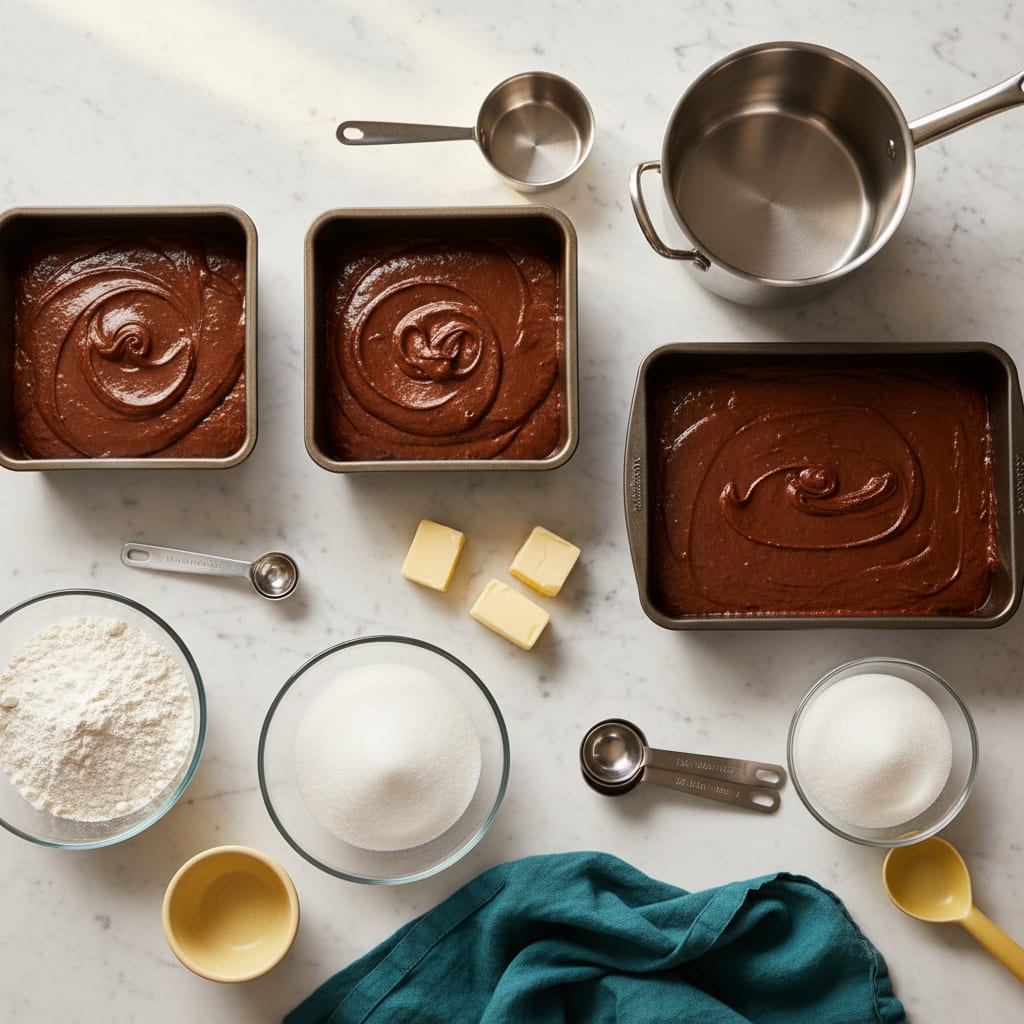
Double everything except salt, spices, leavening, and cooking time. Those four scale by roughly 1.5x, not 2x — and cooking time barely moves at all if you keep the food the same depth. Doubling is mostly arithmetic, but there are about six places where straight multiplication produces something worse than the original. Below is what to multiply, what to hold back, how pan size actually works, and which recipes should be cooked as two separate single batches instead.
The scaling rules at a glance
| Ingredient or variable | Multiply by |
|---|---|
| Meat, vegetables, pasta, grains, dairy | 2x |
| Fat (butter, oil) | 2x |
| Flour, sugar | 2x |
| Salt | 1.5x, then taste at the end |
| Dried spices and herbs | 1.5x |
| Garlic, ginger, chili, hot sauce | 1.5x |
| Vanilla and extracts | 1.5x |
| Baking powder, baking soda, yeast | 1.5x |
| Liquid in braises, soups, and stews | 1.5x |
| Liquid in baked goods | 2x |
| Cooking or baking time | 1x if depth is unchanged |
| Pan area | 2x |
Why salt and spices don’t double
Seasoning is perceived logarithmically — your tongue doesn’t register twice the salt as twice the saltiness, it registers it as far too much. Doubling salt in a doubled batch consistently overshoots.
The safe approach: put in 1.5x, cook, then taste and correct at the end. You can always add salt; you can never take it out. The same is true of anything assertive — cayenne, cumin, smoked paprika, garlic powder, fish sauce. Strong dried spices in particular concentrate as a dish cooks, so the extra volume compounds the problem.
Fresh herbs are the exception. Basil, parsley, and cilantro can double straight across with no risk.
Liquid behaves differently in a bigger pot
A doubled stew in a bigger pot has proportionally less surface area relative to its volume, so it evaporates more slowly. Double the liquid and you get soup where you wanted a braise.
Start with 1.5x the liquid, keep the lid off for the last stretch, and add more only if the pot looks dry. This is exactly the correction we make when scaling our sloppy joe crowd batch — that recipe holds a lot less liquid per pound of beef than the family-size version does.
Baking is the opposite. A cake batter is a closed system; double every wet and dry ingredient exactly, including milk, eggs, and buttermilk.
Leavening is the one that fails loudly
Doubling baking powder or baking soda produces a batter that rises fast, collapses, and tastes faintly metallic and soapy. Use 1.5x. Yeast is the same — bread dough with double the yeast overproofs before the gluten is ready, and you get a coarse crumb and a boozy smell.
For anything delicate — a layer cake, a soufflé, macarons, a pastry cream — the right answer is usually not to double at all. Make two separate batches. It costs an extra ten minutes and removes all the risk.
Pan size is about area, not dimensions
This is where most doubling goes wrong. A pan that’s twice as long is not twice the area if the width changes, and a pan twice as deep bakes completely differently.
Useful equivalents:
- Two 8x8 pans = one 9x13 (roughly). This is the most common doubling swap and it’s close enough to work.
- Two 9-inch rounds ≈ one 9x13.
- A 9x13 doubled = two 9x13s. There’s no standard single pan that’s twice a 9x13; use two.
- Sheet-pan dinners: never crowd. Two half sheet pans on two oven racks, rotated once at the halfway mark, is the whole technique. Piling a doubled batch onto one pan steams the food instead of roasting it, and you lose every browned edge that made the recipe good.
The rule underneath all of these: keep the depth the same and the time barely changes. Double the depth and you can add 50% or more to the cook time, with a dry outside and an underdone middle waiting for you.
Cooking time: mostly unchanged
- Same depth, more pans or a wider pan: same time. Check 5 minutes early anyway, since a fuller oven runs slightly cooler.
- Same pan, more depth: add 25–50% to the time and lower the oven by 25°F so the outside doesn’t overshoot before the center cooks.
- Stovetop: doubled food in a bigger pot takes longer to come up to temperature, not longer to cook. Preheat the pan properly and brown in batches — crowding is the single most common doubled-recipe failure on the stove.
- Slow cooker: a doubled batch in a larger crock runs close to the original time. A doubled batch crammed into the same crock doesn’t work at all; a slow cooker needs to be half to three-quarters full to cook properly.
What to weigh instead of measure
Doubling is where volume measuring falls apart. “Two cups of flour” scooped twice can vary by an ounce or more, and that error doubles with the recipe. A digital kitchen scale with a tare button fixes it: weigh into one bowl, hit zero, weigh the next thing. It also means fewer dishes, which matters more than accuracy on a Wednesday.
For crowd cooking generally, weight-based portions are how the per-person math in our group meal planner and our pasta portion charts stays reliable across headcounts.
Recipes that shouldn’t be doubled
- Anything with a delicate emulsion: hollandaise, custard, homemade mayonnaise. They break at volume.
- Risotto and anything requiring constant attention. Twice the rice doesn’t fit the pan and stirring becomes a workout.
- Recipes that depend on browning in a single layer: seared chicken thighs, smash burgers, roasted vegetables. Double the ingredients but cook in two rounds.
- Fried anything. Twice the food in the same oil drops the temperature and gives you greasy results. More oil, same pot, two batches.
- Recipes already sized for a big vessel. If a stew already fills a 6-quart Dutch oven, doubled means a stockpot — and a stockpot changes the evaporation math entirely.
The general test: if a recipe’s success depends on contact with heat, cook it in two batches. If it depends on time in heat, it doubles fine.
FAQ
Do you double the cooking time when you double a recipe?
No. If the food stays the same depth — two pans instead of one, or a wider pan — the time is essentially unchanged. Only when you double the depth in the same pan does time increase, by roughly 25 to 50%, and you should lower the oven temperature by 25°F.
Do you double the salt when doubling a recipe?
Use about 1.5 times the salt, then taste and adjust at the end. Doubling salt reliably overshoots because seasoning isn’t perceived in a straight line. The same 1.5x rule applies to dried spices, garlic, chili, and extracts.
Can you double baking recipes?
Cookies, brownies, muffins, and quick breads double well — use 1.5x the baking powder or soda and bake in two pans. Delicate cakes, soufflés, and anything with a fragile emulsion are safer as two separate single batches.
What pan do I use when I double a recipe?
Match the area, not the dimensions. Two 8x8 pans roughly equal one 9x13; two 9-inch rounds are about the same. A doubled 9x13 recipe needs two 9x13 pans — no standard single pan is twice that size.
Why did my doubled soup come out watery?
Because liquid doesn’t scale linearly. A bigger pot has less surface area relative to its volume, so less water evaporates. Start with 1.5 times the liquid, simmer with the lid off toward the end, and add more only if the pot looks dry.
✳ More From the Kitchen
Lunchbox & Kids
Freezer & Meal Prep
Freezer & Meal Prep