How Much Brisket Per Person? Raw Weight Math
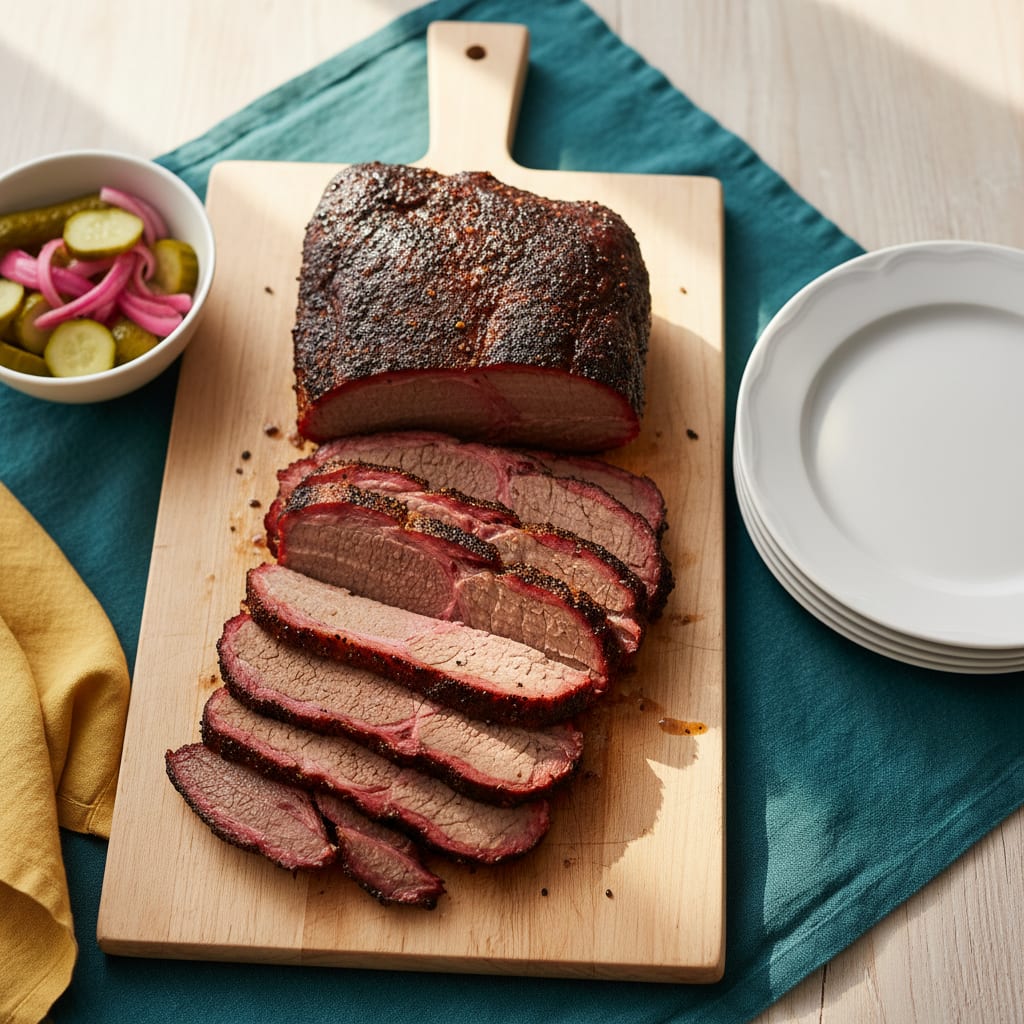
Buy about 1/2 lb of raw brisket per person for a sandwich crowd, and about 2/3 lb per adult for plated servings. The reason those numbers are so much bigger than the portion is shrink: Texas A&M’s meat science department puts it plainly — yields of cooked, trimmed lean are approximately 50% of the raw weight of the brisket. Half of what you carry home is fat cap, connective tissue and moisture that leaves during a twelve-hour cook.
Get that one number wrong and you are twenty portions short at four in the afternoon with nothing to do about it. Here is the math in both directions.
The 50% rule
Every brisket calculation on this page runs off two figures:
- The cooked portion. About 1/4 lb of cooked meat per person on a bun; about 1/3 lb per adult on a plate with sides. These are the same portions we use for pulled pork, because a sandwich is a sandwich whichever slow-cooked meat is in it.
- The yield. Raw weight ÷ 2 = cooked meat, per Texas A&M. Untrimmed packer briskets with a thick fat cap can come in a little under that; a trimmed flat, which has less to lose, does a little better.
So: raw brisket to buy = people × cooked portion × 2.
That is why our meat-per-person chart lists brisket at 1/2 lb raw per adult with “heavy shrink, do not skimp” beside it. That 1/2 lb is the buffet-and-sandwiches figure. A plated brisket dinner where the meat is the point of the meal needs the 2/3 lb column.
The chart
| Guests | Cooked meat, sandwiches | Raw brisket to buy | Cooked meat, plates | Raw brisket to buy |
|---|---|---|---|---|
| 10 | 2.5 lb | 5 lb | 3.5 lb | 7 lb |
| 15 | 3.75 lb | 7.5 lb | 5 lb | 10 lb |
| 20 | 5 lb | 10 lb | 6.5 lb | 13 lb |
| 25 | 6.25 lb | 12.5 lb | 8.25 lb | 16.5 lb |
| 30 | 7.5 lb | 15 lb | 10 lb | 20 lb |
| 40 | 10 lb | 20 lb | 13.25 lb | 26.5 lb |
| 60 | 15 lb | 30 lb | 20 lb | 40 lb |
Children under about ten count as half an adult. Teenagers count as one and a half, and a table of teenagers will beat any chart ever printed.
Packer, flat or point
Which piece you buy changes both the yield and the eating, and the counter labels are not obvious. Texas A&M’s barbecue guidance sets them out:
- Packer-trimmed brisket is usually the entire beef brisket, trimmed as it came off the carcass and still carrying a thick fat cover — which many barbecue cooks want, and which is exactly the weight that disappears in the cooker. This is the one the 50% figure describes best.
- The flat is the leaner half, “considerably leaner, both in fat covering and especially within the muscle itself”. It slices beautifully and dries out fastest. Best yield of the three, least margin for error.
- The point is the forward end and the fattier one, with fat both over and between the muscle fibres. Worst yield, best flavour, and the piece that becomes chopped beef or burnt ends.
If you are cooking for a number, buy the whole packer and use both halves for what they are good at: the flat sliced for plates, the point chopped for the sandwich tray. It also stretches further, because chopped meat piles onto a bun more evenly than slices do.
Sandwiches versus plates
Sandwiches, about 1/4 lb cooked. The bun, the pickles and the slaw do real work, and a quarter pound piled on a soft roll is a proper sandwich. Plan on 1.5 buns per person — there is always a second round. This is the portion for a tailgate or a graduation party, and it sits naturally beside the rest of our tailgate food ideas.
Plates, about 1/3 lb cooked. Sliced brisket on a plate with two sides is the star, and portions creep up when there is no bread carrying the load. Go to 1/2 lb if brisket is the only meat and the sides are light.
Buffet, add about 15%. People serve themselves more generously than a host would, and the first twenty guests through the line take more than the last twenty.
Cooking for the number you bought
Brisket is high in connective tissue, which Texas A&M notes requires long cooking times at low temperatures. Three things that only bite at party scale:
- Two smaller briskets beat one huge one. A 16 lb packer is a hard fit in a domestic oven or a kettle grill, and it cooks unevenly. Two 8 lb pieces finish sooner and give you two shapes to carve from.
- Cook it the day before. Brisket reheats better than almost anything, and it slices far more cleanly cold. Chill it whole, slice it cold against the grain, then warm the slices in their own juices.
- Go by temperature, not the clock. Brisket comes off when the probe slides in without resistance, and getting there can take hours longer than any recipe says. A digital probe thermometer turns “is it done” into a question with an answer, and stops the twenty-guest version of this from becoming an evening of opening the lid.
Whatever the plan, rest it properly and hold it wrapped and warm rather than carving early — the same holding problem, and the same household solutions, as everything in our keeping food warm for a party guide.
Worked examples
A 20-person cookout, brisket sandwiches, three sides. 20 × 1/4 lb = 5 lb cooked, so 10 lb of raw packer brisket, plus 15% for the buffet line — call it a single 12 lb packer. Slice the flat, chop the point, put both on the tray.
A plated dinner for 12. 12 × 1/3 lb = 4 lb cooked, so 8 lb raw. A whole small packer, or a large trimmed flat if you want every slice to look the same.
A 40-person party where brisket is one of two meats. Count it as roughly two-thirds of a portion each: about 7 lb cooked, so 14 lb raw. Two briskets, cooked on two racks.
Family of five with leftovers wanted. A 5 to 6 lb flat. You will eat about half of it, and the rest is tacos, hash and a very good sandwich.
Frequently asked questions
How much brisket per person? About 1/2 lb of raw brisket per person for sandwiches and 2/3 lb for plated servings, which lands at roughly 1/4 lb and 1/3 lb of cooked meat once it has shrunk.
How much brisket do I need for 20 people? Around 10 lb raw for sandwiches, or 13 lb raw for plates. Buy one 12 lb packer rather than two small flats if you want both slices and chopped beef.
How much does brisket shrink when cooked? Roughly half. Texas A&M’s meat science guidance puts cooked trimmed lean at about 50% of the raw weight, which is why the raw number is always double the portion.
Is a flat or a point better for a crowd? Both, if you can. The flat slices neatly for plates; the fattier point chops for sandwiches and stretches further per pound.
Should I buy trimmed or untrimmed brisket? Untrimmed packer briskets cost less per pound but include the fat cap you will trim or render away, so factor that into the weight. A trimmed flat is more predictable and better for a first attempt.
Can I cook brisket ahead for a party? Yes, and you should. Cook it the day before, chill it whole, slice it cold, and reheat the slices in the juices — it is easier, it carves better, and it takes the panic out of the day itself.
✳ More From the Kitchen

Lunchbox & Kids
Feeding a Crowd
Feeding a Crowd