How Much Steak Per Person? Sizes by Cut and Bone
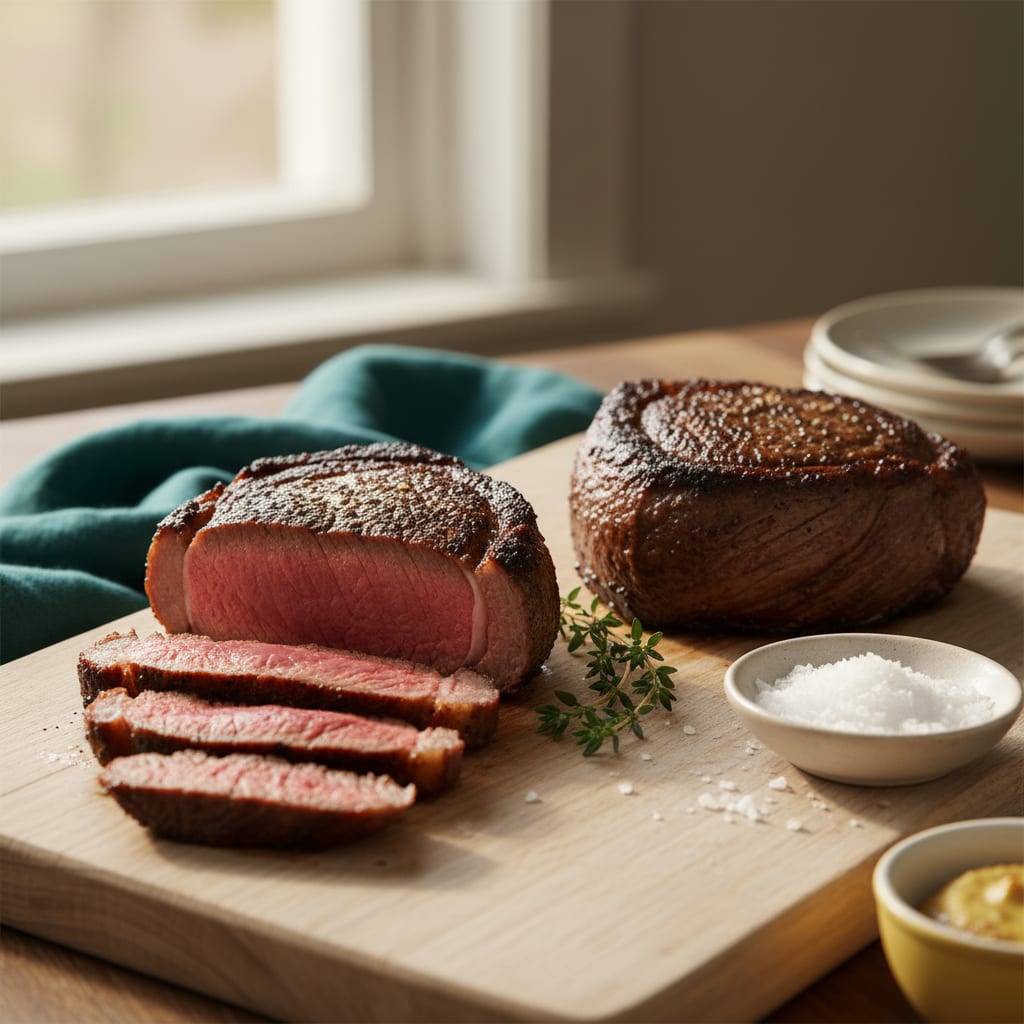
Buy 6 to 8 oz of boneless steak per adult, or 12 to 16 oz if the steak is bone-in. Steak is the one meat people buy as objects rather than weight — two ribeyes, four fillets — so the useful question is not pounds per person but which size of steak to put in the basket, and the bone is what moves the answer by half a pound.
Worth naming the gap up front, because it confuses people at the counter: North Dakota State University Extension puts a typical serving of beef at 3 ounces, “about the size of a deck of cards”. Almost nobody serves a 3 oz steak. That figure is a nutrition portion; the numbers below are what actually goes on a plate.
The chart
| Cut | Buy per adult | Notes |
|---|---|---|
| Sirloin, flank, skirt, flat iron | 6 oz | Sliced across the grain and shared out |
| Strip, ribeye, boneless | 8 oz | The standard single-steak size |
| Filet mignon | 6–8 oz | Small in area, dense on the plate |
| Bone-in ribeye | 14–16 oz | Roughly a quarter of it is bone |
| T-bone or porterhouse | 16–20 oz | Two muscles plus a substantial bone |
| Tomahawk | 30–40 oz | Feeds two, sometimes three |
| Whole roast, boneless | 1/2–3/4 lb | See the roast section below |
Six ounces is right when there is a starchy side doing real work — potatoes, rice, bread. Eight is right when the steak is the event. These agree with the steak line in our meat quantities per person chart, which this page expands.
The bone is the whole difference
A bone-in ribeye and a boneless ribeye are the same eating experience at very different weights, because bone is dense and you cannot eat it. That is why the chart jumps from 8 oz to 14 or 16 for what is nominally the same steak.
South Dakota State University Extension’s holiday meat guidance makes the same point for the biggest version of the cut. For prime rib, one rib per two people if it is bone-in, or 1/2 to 3/4 lb per person if boneless. A rib of beef weighs far more than the two boneless portions it yields, and the ratio holds all the way down the scale to a single steak.
Two practical consequences:
- Bone-in is not automatically worse value. It is usually cheaper per pound, and the meat next to the bone is the best on the steak. You just have to buy by the right number.
- A T-bone is two steaks. Strip on one side, a small piece of tenderloin on the other, bone through the middle. A 20 oz T-bone genuinely feeds one large appetite or two moderate ones, which is why it is the most misjudged steak on any counter.
Buy fewer, bigger steaks
The best-kept secret of cooking steak for a table is that four 8 oz steaks are harder to get right than two 16 oz steaks sliced and shared.
A thicker steak has a wider window between “raw in the middle” and “grey all the way through,” so it is far more forgiving. It also rests better, loses proportionally less to the pan, and fits a household skillet without crowding — and crowding is what turns searing into steaming.
So for six people, we would rather buy three large sirloins, cook them to one temperature, rest them, slice them across the grain and put the slices on a board than try to time six separate steaks and six separate doneness requests. It also solves the problem of the one person who wants theirs more done: the end slices from a rested steak are always further along than the middle.
The three adjustments that actually move the number
SDSU frames buying meat around who, what and when, which is the right framework for steak too:
- Who is eating. Teenagers and big eaters clear a 10 oz steak; most adults are comfortable at 8; children under about ten eat a third to a half of an adult portion, and are usually happier with slices off someone else’s steak than with a small steak of their own.
- What else is on the table. A steak with potatoes, a salad and bread is a 6 oz steak. A steak with a green salad and nothing else is a 10 oz steak. This single factor moves the requirement further than any other.
- When it is served. A late dinner with an hour of standing around beforehand needs less steak and more of everything else. Front-load a big table with something substantial — the make-ahead items in our tailgate food that travels round-up do this job well — and the meat goes further.
Rest time and carryover, which change how much meat reaches the plate
Steak keeps cooking after it leaves the heat. SDSU’s guidance on a large roast is that the meat continues cooking for 10 to 20 minutes after it comes off, so a medium-rare result means pulling it at 130 to 135°F, medium at 140 to 145°F, and resting for 10 to 15 minutes before cutting.
Individual steaks carry over less than a roast but still enough to matter — usually a few degrees over a five-minute rest. Cutting into a steak immediately loses juice onto the board, and that lost juice is real weight off the serving.
For safe-cooking reference points, University of Illinois Extension’s meat guidance gives whole beef cuts such as steaks and roasts at 145°F for medium rare, 160°F for medium and 170°F for well done.
None of those numbers are usable without a thermometer, and steak is the cut where guessing is most expensive. A cheap instant-read like the ThermoPro TP19H pays for itself the first time it saves a ribeye.
If you are buying a whole roast instead
When a table gets past about eight people, individual steaks stop making sense and a roast starts to. The arithmetic changes with it: NDSU’s shopping rule of thumb is about 1 pound of boneless roast for four servings, and SDSU’s 1/2 to 3/4 lb per person for boneless prime rib is the same figure with holiday appetites allowed for.
NDSU also flags the cuts worth knowing at this end of the counter — flat iron, petite tender and ranch cut, all from the chuck and shoulder, all lean and all “reasonably priced, compared with traditional cuts, such as T-bones, tenderloins and rib-eye steaks.” A flat iron sliced across the grain feeds a table for a fraction of what the same weight of ribeye costs.
For the slow-cooked end of the beef counter, the yield arithmetic is completely different and lives in our brisket per person post — a brisket loses about half its weight, where a steak loses a fraction of that.
FAQ
How many ounces of steak per person?
Six to eight ounces of boneless steak for most adults, 10 to 12 for big eaters, and 14 to 16 if the steak is bone-in.
How much steak do I need for 10 people?
About 5 lb of boneless steak, which is four or five large steaks to be sliced and shared rather than ten small ones. Bone-in, budget 9 to 10 lb.
Is a 16 oz steak too much for one person?
For most people, yes, if it is boneless. A 16 oz bone-in steak is a different matter — a quarter of that weight is bone, which puts it in normal single-serving territory.
How much steak per person for a buffet?
Cook large steaks, slice them, and count on 5 to 6 oz per adult of sliced meat plus about 15% for self-service. Sliced steak goes further than whole steaks because nobody has to commit to a whole one.
How much steak for a child?
Two to three ounces, and usually best given as slices off an adult steak rather than as a portion of its own — it stays hotter, and it avoids a small steak overcooking while the big ones finish.
✳ More From the Kitchen
Lunchbox & Kids
Freezer & Meal Prep
Lunchbox & Kids