There is no good evidence that tart cherry juice helps children sleep. Tart cherries do contain some melatonin, and a handful of small studies found modest sleep benefits, but every one of them was in adults, most of them older adults with insomnia. No study has tested it in children. And the American Academy of Pediatrics is clear that children should not be given fruit juice at bedtime at all, and no juice before age 1. If you like the idea, serve cherries as part of dinner or an earlier snack, and put your effort into the routine, which is what actually moves a child’s bedtime.
Where the “natural melatonin” idea comes from
Melatonin is the hormone the brain releases in the evening as the light fades. Tart cherries, especially the Montmorency variety, contain a small amount of it, which is the whole basis for the claim. Cleveland Clinic’s dietitian Q&A on cherries and sleep adds tryptophan and magnesium to the list, and notes that Montmorency cherries have more than six times the melatonin of Balaton tart cherries.
“Contains melatonin” is not the same as “works like a melatonin supplement,” though. The question is whether drinking the juice changes anyone’s sleep, and that is where the evidence gets thin.
What the studies actually tested
There are two studies people usually mean. Both are worth reading for who was in them.
- Older adults with insomnia. A 2010 pilot study in the Journal of Medicinal Food (full text on PMC) gave 15 older adults with chronic insomnia a tart cherry juice blend or a placebo drink for two weeks each. Compared with placebo, the juice reduced minutes awake after falling asleep, but “no such improvements were observed for sleep latency, total sleep time, or sleep efficiency.” The authors called the effects “modest” and “considerably less than those for evidence-based treatments of insomnia.” The juice maker funded the study “in its entirety.”
- Healthy adult volunteers. A 2012 study in the European Journal of Nutrition (PMID 22038497) gave 20 healthy adults a tart cherry concentrate or a placebo for 7 days. Melatonin in their urine went up, and so did time in bed and total sleep time.
That’s the evidence base: a few dozen adults, a week or two each. Cleveland Clinic’s summary is fair: “these studies were very small,” and “more research is needed to know exactly how — and how well — tart cherry juice works for sleep.”
None of this was done in children. Poison Control’s article on tart cherry juice says it directly: “there is no evidence that tart cherry juice is effective in treating sleep regression in children,” and “there is no medical evidence supporting the use of tart cherry juice as a treatment for sleep disturbances in children.”
We are deliberately not printing a dose. The adult studies used different products and amounts, there is no tested amount for children, and a “kid dose” made up from adult research is exactly the kind of number that spreads online and shouldn’t.
The bigger problem: juice at bedtime
Even if the melatonin did something, a cup of juice is a poor bedtime drink for a child. The AAP’s position on fruit juice on HealthyChildren says:
- Fruit juice should not be given to infants under 12 months. It “offers no nutritional benefit” at that age and “can increase risk of tooth decay.”
- For children 1 to 6, limit juice to “no more than 4 to 6 ounces (120 to 180 ml) each day,” and favor whole fruit.
- “Children should not be given fruit juice at bedtime.”
Poison Control adds that the sugars in the juice “may contribute to dental problems and gastrointestinal symptoms” in toddlers, and that the AAP and the American Academy of Pediatric Dentistry recommend against juice in bottles for toddlers. A bottle of juice at lights-out, sipped after teeth are brushed, is the pattern dentists worry about most.
There’s a tummy angle too. The Sleep Foundation’s tart cherry juice page notes that stone fruits contain sorbitol, a natural sugar that “can cause stomach problems and diarrhea” in people who don’t tolerate it. That’s not what you want at 2 a.m.
Is tart cherry juice safe for kids at all?
As a drink with a meal, in the AAP’s juice limits, for a child over 1, it’s simply juice. It’s very sour, so many brands are sweetened or blended with apple juice; read the label for added sugar, and dilute it with water if you serve it. Check with your pediatrician before using it regularly if your child takes any medicine. Cleveland Clinic suggests avoiding it in people who take blood thinners or medicines that interact with melatonin.
What we’d skip: tart cherry extracts, capsules and concentrates “for sleep.” Those are supplements, not food, and that’s a conversation for the pediatrician, not the grocery aisle.
If you want cherries in the evening
Whole fruit is the better choice anyway: more fiber, less sugar per serving, and no drink to sip in bed.
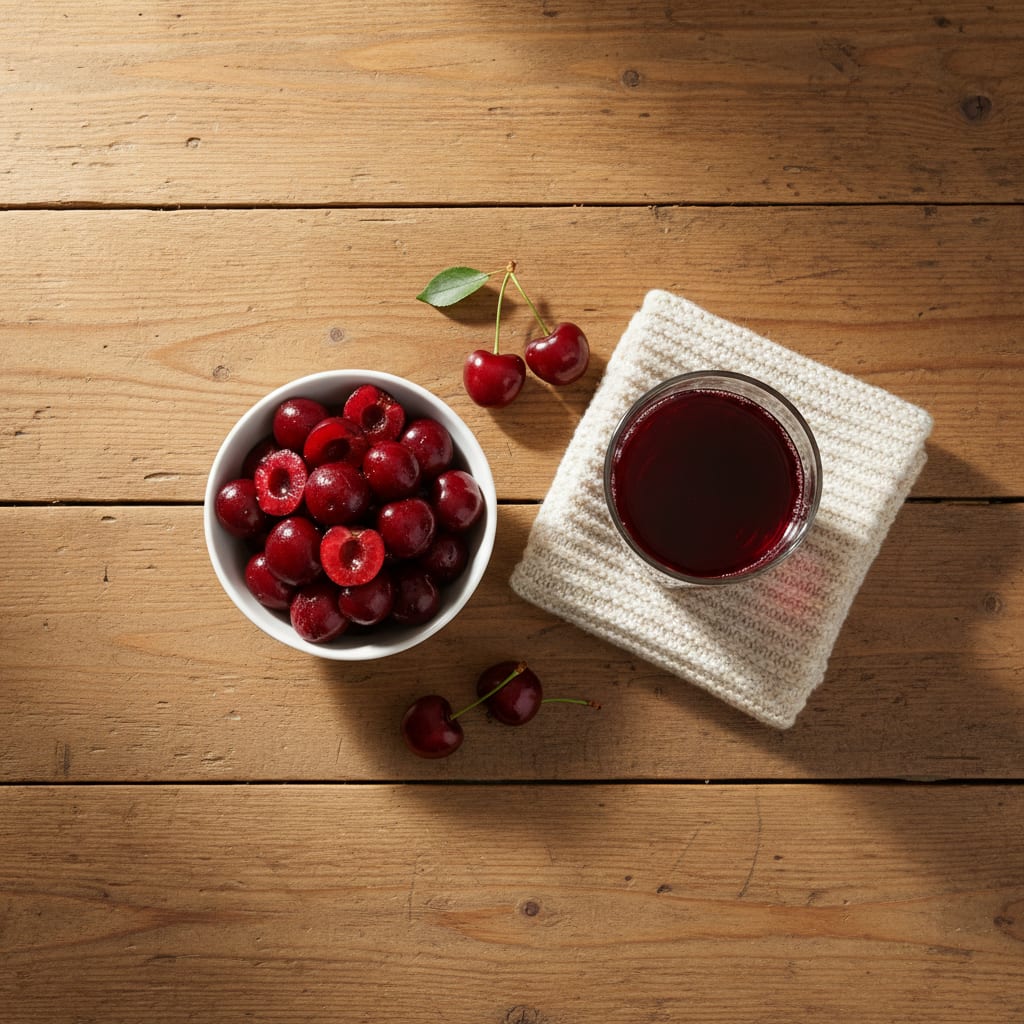
- Pit and cut them. HealthyChildren’s choking prevention page asks for round, firm foods like grapes to be “completely chopped into tiny pieces” for young children. Treat cherries the same way. A cherry pitter makes a bowl quick work, and it’s a job older kids enjoy.
- Serve them at dinner or an early snack, not in bed. Frozen pitted cherries, thawed, work out of season.
- Pair them with something filling. Our list of bedtime snacks for toddlers has easy pairings and explains when a snack helps at all.
What actually helps a child fall asleep
Most of the bedtime “sleep foods” have the same story. Turkey’s tryptophan doesn’t knock kids out (our piece on whether turkey makes kids sleepy covers why), and chamomile’s sleep evidence is just as thin, though weak chamomile tea at least has no sugar in it. What all of them can offer is a cue: dinner’s over, the lights are lower, it’s time to slow down.
The things that work are less exciting: a consistent bedtime, a short predictable routine, dim lights in the last hour, and screens off. A child’s own melatonin rises when the room gets dark, which is free and doesn’t come in a bottle. If you’re wondering about melatonin itself, Betteroo’s pediatrician-reviewed guide for parents considering it for a toddler says it is “not recommended as a first step,” and that routine changes fix most toddler sleep problems better than any supplement.
 Looking for a bedtime fix in the fridge?
Betteroo builds an age-matched sleep schedule around your child's day, so bedtime works without a special drink.
Take the sleep quiz →
When to talk to the doctor
If you’re looking at sleep remedies because your child struggles to fall asleep or stay asleep most nights, that’s worth raising with your pediatrician. Snoring, gasping, long night wakings or a child who is exhausted in the day all deserve a proper look, not a juice.
FAQ
Does tart cherry juice help kids sleep?
There’s no evidence it does. The small studies that found modest benefits were all in adults, and Poison Control notes there is no medical evidence supporting it for children’s sleep problems.
Can toddlers drink tart cherry juice?
Children over 1 can have it as ordinary juice with a meal, within the AAP’s limit of 4 to 6 ounces of juice a day for ages 1 to 6. The AAP says children should not be given juice at bedtime, and no juice under 12 months.
How much tart cherry juice should a child have for sleep?
There is no tested amount for children, so we don’t give one. If you’re considering it for sleep, talk to your pediatrician first.
Is tart cherry juice natural melatonin?
Tart cherries contain a small amount of melatonin, and one study in healthy adults found higher melatonin levels after a week of concentrate. That’s not the same as a melatonin supplement, and it hasn’t been studied in children.
Are whole cherries better than juice for kids?
Yes. Whole fruit has more fiber and is what the AAP favors over juice. Pit cherries and cut them into small pieces for young children to reduce the choking risk.