How Long to Boil Lobster (By Weight, Tails Included)
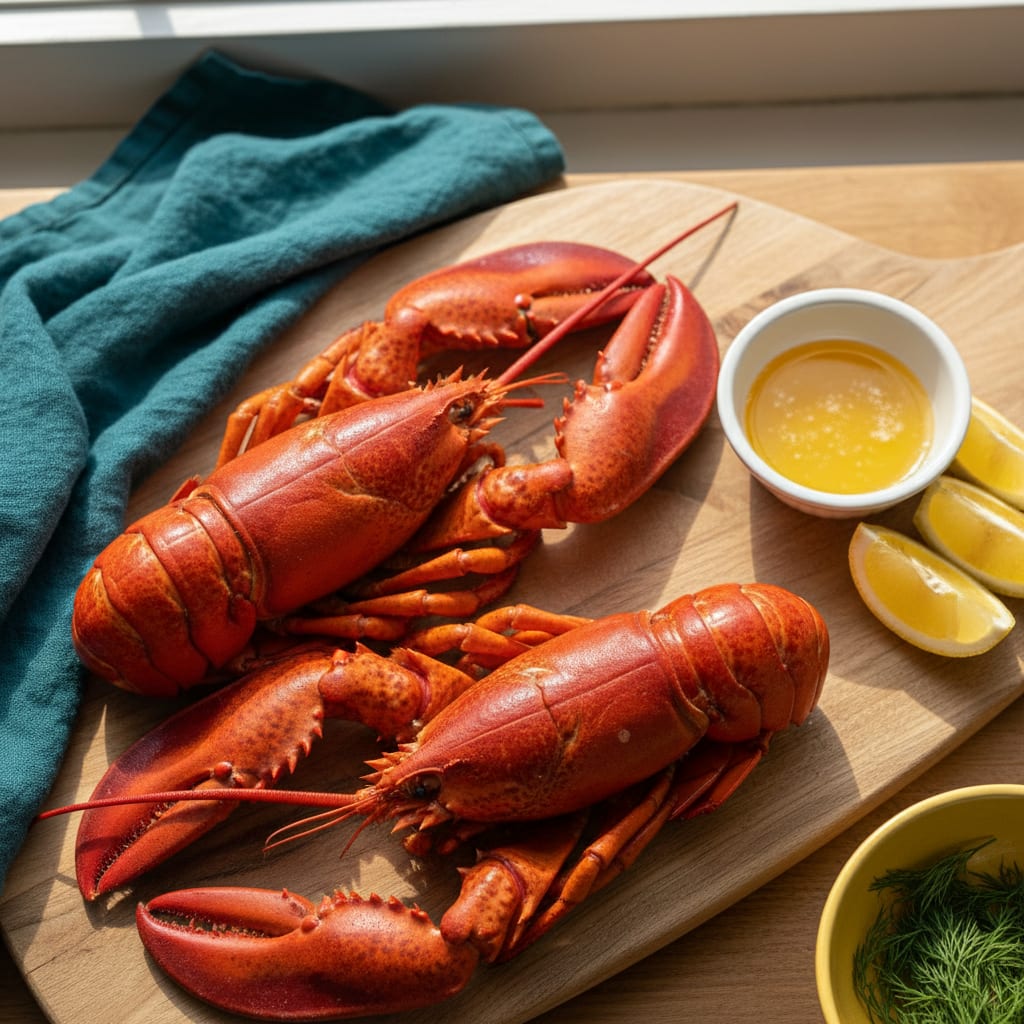
Boil a 1-pound lobster for about 8 minutes, a 1.25-pound for 9 to 10, a 1.5-pound for 11 to 12 and a 2-pound for around 15, timing from when the water returns to a rolling boil. Lobster tails are much faster: 4 to 5 minutes for a 4-ounce tail and 5 to 6 for a 6-ounce one. Time each lobster by its own weight, never by the combined weight of the pot — four 1.5-pounders are four twelve-minute lobsters, not one forty-eight-minute one.
That last point is where most first-time lobster dinners go wrong, and it is worth saying before anything else: the pot does not cook the pile, it cooks each animal, and the thickest part of the biggest one is the only thing the clock is about.
Times by weight
| What you are cooking | Time from the return to a boil |
|---|---|
| 1 lb whole lobster | 8 minutes |
| 1.25 lb whole lobster | 9–10 minutes |
| 1.5 lb whole lobster | 11–12 minutes |
| 1.75 lb whole lobster | 12–13 minutes |
| 2 lb whole lobster | 14–15 minutes |
| 2.5 lb whole lobster | 18–20 minutes |
| 3 lb whole lobster | 22–25 minutes |
| 4 oz lobster tail | 4–5 minutes |
| 6 oz lobster tail | 5–6 minutes |
| 8 oz lobster tail | 6–8 minutes |
| 10–12 oz lobster tail | 8–10 minutes |
These are our kitchen times, and we publish them as ours because no extension service or sea grant programme we could load publishes a minutes-per-pound table. What the public sources give is the finish test rather than the clock, which is genuinely the more useful half — see the next section.
Two adjustments worth knowing. A soft-shell lobster — a “shedder”, common in late summer, with a shell you can dent with a thumbnail — carries less meat and more water for its weight and wants a minute or two less than the table says. And a lobster going straight into a recipe to be reheated later, in a roll or a chowder, should come out a minute early.
The doneness test that actually works
Colour is the first cue and Illinois Extension names it directly in its meat-safety guidance: “Lobster should turn bright red.” Maine Sea Grant’s seafood guide says the same and adds the second half — steam or boil “until the shell turns bright red and the meat is opaque and firm.”
Both halves matter, because the shell goes red well before the meat is done. The reliable version is a two-step check:
- Look at the shell. Uniformly bright red-orange with no mottled brown or greenish patches left.
- Crack the joint where the body meets the tail. The meat there should be opaque white rather than translucent and grey. If it is still glassy, put it back for two more minutes.
Illinois Extension puts fish generally at 145°F at the thickest point, and that is the number to use if you are working with a thermometer; push the probe into the underside of the tail where it meets the body, not into the claw. A whole lobster carries enough mass to keep climbing after it leaves the water, so pull it at the lower end and let it rest five minutes — the shell finishes the job and the meat reabsorbs the moisture it has pushed out.
The pot, the water and the salt
A crowded pot is the second-biggest cause of unevenly cooked lobster, because the water takes so long to recover its boil that the animals at the bottom cook while the ones on top steam.
- Give each lobster room. A large stockpot handles two 1.5-pounders comfortably; three is a squeeze. Cook in batches rather than stacking.
- Salt it well. Lobster is a saltwater animal and tastes flat from plain water. We use about a quarter cup of coarse salt per gallon.
- Bring it to a full rolling boil first, add the lobsters one at a time head first, cover, and start the timer when the boil returns.
- Stir or turn them halfway so the ones at the bottom are not doing all the work.
Steaming is the gentler alternative and takes roughly the same time plus a minute or two. An inch or two of salted water under a rack, lid on, gives you slightly firmer meat and a less waterlogged body cavity — the same trade we described in our how long to boil crab legs guide, where submerging the shell washes flavour out through the joints.
Buying lobster and holding it until dinner
Maine Sea Grant is specific about the day between the shop and the pot, and it is not what most people do. Live lobsters “should be cooked as soon as possible after purchase, but can be stored in the refrigerator for 24–36 hours”, kept upright with the tails tucked under, in a bowl or container lined with seaweed, a damp towel or newspaper soaked in cold salted water.
The two things not to do are the two things people reach for: do not store a live lobster in fresh water, and do not bury it in ice — Sea Grant warns both can kill it. A lobster that died in your fridge is not a lobster to cook.
One more note from the same source, worth passing on because it rarely appears on a recipe page. The State of Maine advises against eating the tomalley, the soft green substance in the body cavity that functions as the liver and pancreas, because it can accumulate contaminants. Serve the tail, the claws and the knuckles, and leave the tomalley in the shell.
Frozen raw tails are a completely legitimate shortcut and lose very little — thaw them overnight in the fridge on a rimmed plate, or seal them in a bag in cold water until pliable, then boil to the table above. What you should not do is boil from frozen and guess, which is how tails end up rubbery at the tip and raw in the middle.
Serving it, and how much to buy
A 1.25-pound lobster is one adult portion when there is a starter and sides, and it yields far less meat than its weight suggests — most of what you are buying is shell. For a lobster-roll night we plan roughly two 1.25-pounders for three rolls.
Lobster cools faster than almost anything else you will put on a table, so serve it the moment it is cracked. On a buffet it needs the covered-dish treatment in our keeping food warm for a party guide rather than an open platter, and it holds far better as picked meat in warm butter than as whole bodies.
Cooked meat keeps a few days in the fridge and freezes acceptably, though the texture softens — the same short-shelf-life rule we apply to shrimp in our how long to boil shrimp guide.
FAQ
How long do you boil a 1.5 lb lobster?
Eleven to twelve minutes, timed from when the water returns to a rolling boil after the lobster goes in, then a five-minute rest before cracking.
How long do you boil lobster tails?
Four to five minutes for a 4-ounce tail, 5 to 6 for a 6-ounce one, and 8 to 10 for a 10 to 12-ounce tail. The meat should be opaque all the way through and the shell bright red.
How do you tell when lobster is done?
The shell turns uniformly bright red and the meat is opaque and firm rather than translucent. If you are using a thermometer, Illinois Extension puts fish at 145°F at the thickest point.
Do you time lobster by total weight or individual weight?
Individual weight, always. Four 1.5-pound lobsters each need 11 to 12 minutes, not forty-eight — though a crowded pot takes longer to come back to the boil, which is why cooking in batches is more accurate.
Can you keep a live lobster overnight?
Yes, for 24 to 36 hours in the refrigerator, kept upright with the tail tucked under and covered with a damp towel or seaweed. Never in fresh water and never packed in ice.
Is it better to boil or steam lobster?
Steaming gives slightly firmer meat and a less watery body cavity; boiling is faster to set up and easier to time. Both work, and steaming takes about a minute or two longer than the table above.
✳ More From the Kitchen
Lunchbox & Kids
Lunchbox & Kids