Bedtime Snacks for Toddlers: Do They Help, and What to Give
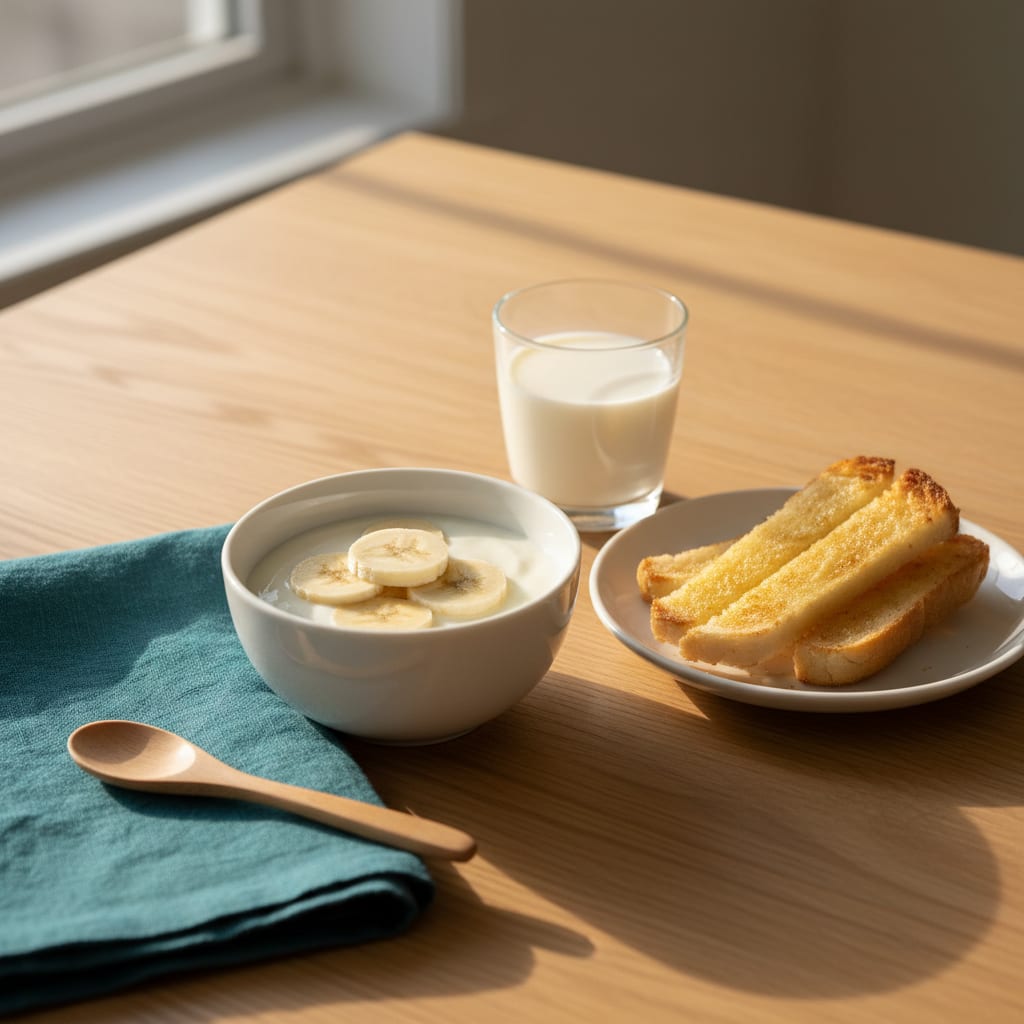
A bedtime snack helps a toddler sleep only when hunger was going to wake them — after an early dinner, a refused dinner or an unusually busy day. It is not a sleep aid, and no food will make a wide-awake child drowsy. When you do offer one, keep it small and plain (a dairy or protein food plus a fruit or grain), serve it at the table at the start of the routine, and brush teeth after it. If your toddler ate a good dinner an hour ago, they probably don’t need one at all.
Does a bedtime snack actually help a toddler sleep?
It helps in one specific way: it removes hunger as a reason to wake up. That is worth something, because toddlers have small stomachs. The American Academy of Pediatrics’ guide to building balanced toddler snacks puts it plainly — children this age use a lot of energy but “may not be able to eat enough at mealtime” to last between meals. The same page notes that many toddlers need an afternoon snack and some need a morning one. It does not describe a bedtime snack as a standard part of the day, — it’s a tool for particular nights, not a fixture.
What it doesn’t do is sedate. We would not count on warm milk, a banana or anything else to switch a child off. If bedtime is a fight every night, the answer is usually in the schedule — nap length, bedtime creeping, a child going down under- or over-tired — rather than on the plate.
The nights a snack earns its place
- Dinner was early. Dinner at 5:00 and bed at 7:30 is a two-and-a-half-hour gap for a stomach that doesn’t hold much.
- Dinner was refused. Toddler appetite swings wildly from day to day. HealthyChildren’s feeding guide for one-year-olds describes toddlers eating everything at breakfast and almost nothing for the rest of the day, which is normal — but it means some nights the tank really is low.
- The day was unusually physical. A park afternoon, a party, a long walk.
- You’re changing something at night. If you’re dropping a night feed, the calories need somewhere to go; our post on night weaning a toddler who still wants milk at 2am covers how dinner and the evening snack carry that load.
The nights it doesn’t
- They ate a solid dinner within the last hour or so.
- “Snack” has become the first of several requests that push lights-out later.
When to give it
Put the snack at a fixed point, early in the routine: after the bath or pyjamas, before teeth, at the table. Three reasons.
First, teeth. The NHS advice on looking after children’s teeth is to brush “last thing at night before bed”, with fluoride toothpaste. A snack after brushing undoes that, so after teeth it’s water only.
Second, safety. HealthyChildren’s choking prevention guidance says children should sit down to eat and should never “run, walk, play or lie down with food in their mouths”. A snack in bed or on the move is exactly that, and a sleepy child chews less carefully.
Third, habit: a snack fixed to one step stays a step, while one that can be requested at any point becomes a lever.
If your toddler still has milk at bedtime, the same rule applies to the cup. Betteroo’s sample feeding day for a one-year-old places bedtime milk in a cup at the start of the routine, followed by teeth, and not in bed — which is the same shape as a snack and can simply be the snack on lighter nights.
What to give: a simple formula
HealthyChildren suggests building a toddler snack from a protein food (dairy counts), a fruit or vegetable, and a grain or starchy vegetable — and adds that not every snack needs to be a mini-meal. At bedtime we lean on the first and last of those: something with protein or fat in it so it lasts, and something starchy so it feels like enough. Keep the portion small. HealthyChildren’s own example of a starting toddler serving is three quartered strawberries and an eighth of a quesadilla; let them ask for more.
| Snack | How to serve it for under-4s |
|---|---|
| Plain yogurt with soft fruit | Fruit diced small; banana sliced lengthwise, then across |
| Oatmeal made with milk | Stir in a thin swirl of peanut butter, never a spoonful |
| Toast with a thin spread of nut or seed butter | Spread thinly and cut into fingers |
| Cottage cheese with canned peaches | Rinse the peaches, cut into small pieces |
| Cheese on toast | Grated cheese melted on, rather than cubes |
| A cup of milk and half a banana | Banana cut lengthwise first |
| Scrambled egg on half an English muffin | Soft curds, muffin torn small |
| Low-sugar cereal soaked in milk | Let it soften for a minute |
| Hummus with soft pita | Pita torn into strips |
| Half a small quesadilla | Cheese plus smashed beans, cut into thin wedges |
| Mashed avocado on toast | Spread, not sliced |
| Leftover pasta from dinner | Short shapes, a spoonful of sauce |
The last one is our most-used. A toddler who wouldn’t eat dinner at 5:30 will often eat three bites of the same dinner at 7:00, cold, at the table, without an audience. Keeping it the same food also teaches something useful: refusing dinner doesn’t unlock a better option.
What to skip at bedtime
Sugary things. HealthyChildren’s toddler snack guidance says toddlers don’t need added sugar or salt and advises avoiding both until age 2. Cookies and pastries are fine sometimes — just not as the nightly bedtime ritual, and not right before the brush.
Salty crackers and chips. Same guidance. A salty snack late in the evening is also a good way to generate a “thirsty” wake-up; our post on the toddler who wakes every night asking for water walks through that pattern.
Juice. The same page suggests serving snacks with water or milk, and delaying juice until age 2 to protect teeth.
The usual choking hazards, and a sleepy child makes them worse. HealthyChildren advises keeping high-risk foods from children until age 4 or older, and lists hot dogs, whole grapes, nuts and seeds, popcorn, raw carrot sticks, raw apple chunks, marshmallows, hard or sticky candy, chunks of meat or cheese, and thick chunks of nut butter among the foods to avoid or modify. Round foods like grapes can be served if cut small, and it suggests pieces no larger than half an inch. At bedtime we just pick from the soft end of the list.
A big portion. A snack that turns into a second dinner pushes bedtime later and makes the tired-but-wired stretch longer, which costs more sleep than any hunger it prevented.
When the snack has become a stall
You’ll know: it arrives after the story, it’s oddly specific, and water and one more hug follow it. The fix is the same one that works for every bedtime request: offer the snack once, at its fixed step, and after that the kitchen is closed. Say it kindly and say it the same way every night.
If late dinners are why the evening keeps collapsing, our short bedtime routine for late nights shows what to cut when the clock is against you and where the snack sits in a six-minute version.
FAQ
Is it OK for a toddler to eat right before bed?
Yes, if it’s small, eaten sitting at the table, and followed by teeth. Not in bed, and nothing but water after brushing.
What is the best bedtime snack for a toddler?
Something small and plain that pairs a dairy or protein food with a grain or soft fruit — yogurt with fruit, oatmeal made with milk, toast with a thin spread of nut butter, or a spoonful of leftover dinner.
Does warm milk help a toddler sleep?
Don’t count on it as a sleep aid. A cup of milk at the start of the routine can take the edge off hunger, which may help a child who was going to wake hungry, but it won’t make a wide-awake child sleepy.
Should a toddler have a snack if they refused dinner?
Yes, a small one — ideally some of the same dinner. It keeps hunger from waking them without turning refusal into a route to a better menu.
✳ More From the Kitchen
Lunchbox & Kids
Feeding a Crowd
Kitchen How-Tos