Substitute for Evaporated Milk: 6 Swaps With Ratios
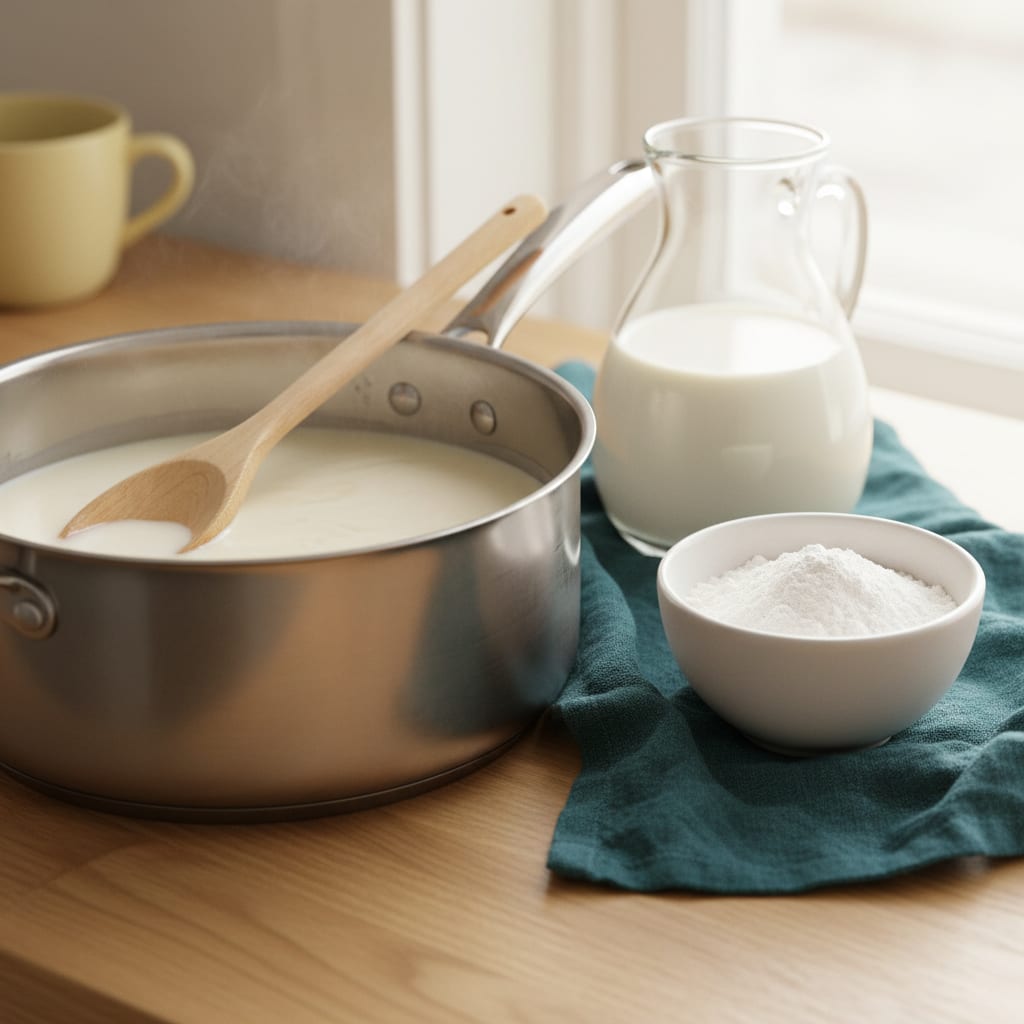
The best substitute for evaporated milk is whole milk simmered down to half its volume: 2 cups of milk gently reduced to 1 cup replaces 1 cup of evaporated milk, so a 12-ounce can (1 1/2 cups) takes 3 cups of milk. If you have no time to simmer, North Dakota State University Extension’s substitution chart replaces a 12-ounce can with 1 cup of nonfat dry milk whisked into 1 3/4 cups of warm water. Half-and-half also works one-for-one in most cooked dishes. Do not reach for sweetened condensed milk. It is a different ingredient, and it will make a savory dish sweet.
The ratios below come from the federal definition of evaporated milk and from published university extension charts. Where a swap is our own kitchen judgment rather than a chart figure, the copy says so.
What evaporated milk actually is
The FDA’s standard of identity, 21 CFR 131.130, defines evaporated milk as “the liquid food obtained by partial removal of water only from milk”, with at least 6.5% milkfat and at least 23% total milk solids by weight. Ordinary milk, under 21 CFR 131.110, needs at least 3.25% milkfat and 8.25% other milk solids, about 11.5% in total.
Put those side by side and evaporated milk is roughly milk at twice the strength, with nothing added but vitamins. That is the whole logic of the best substitute: take water out of milk until it is about twice as concentrated. It is also why the can is not sweet. The sweetness people expect belongs to sweetened condensed milk.
Quick chart: evaporated milk substitutes
| Swap | To replace 1 cup evaporated milk | To replace one 12-oz can | Best for |
|---|---|---|---|
| Whole milk, simmered down | 2 cups milk reduced to 1 cup | 3 cups reduced to 1 1/2 cups | Pies, custards, sauces |
| Nonfat dry milk + water | 2/3 cup powder + 1 cup and 2 1/2 tbsp warm water (NDSU’s can ratio, scaled) | 1 cup powder + 1 3/4 cups warm water (NDSU) | Baking, soups, casseroles |
| Half-and-half | 1 cup | 1 1/2 cups | Mac and cheese, soups, coffee |
| Whole milk, straight | Only where the recipe thins the evaporated milk with equal water | See below | Recipes that dilute the can |
| Unsweetened soy or oat milk, simmered | 2 cups reduced to 1 cup | 3 cups reduced to 1 1/2 cups | Dairy-free cooking |
| Canned coconut milk | 1 cup | 1 1/2 cups | Curries, soups, dairy-free desserts |
The six swaps
1. Simmered whole milk: the closest match
Pour twice the amount of whole milk you need into a wide, heavy saucepan and keep it at a bare simmer, stirring often and scraping the bottom, until it has reduced by half. Pour it into a measuring jug to check rather than guessing by eye. A wide pan reduces faster than a deep one. On low heat it is a slow job, often half an hour or more, so start it before anything else. Skim off any skin, and let it cool before it goes into a pie filling or custard.
Because it is the same milk with water removed, this is the swap that behaves most like the can. It tastes fresher and a little less cooked than canned evaporated milk, which the federal standard requires to be heat-processed to keep it from spoiling.
2. Nonfat dry milk and warm water: the pantry swap
NDSU Extension’s Ingredient Substitutions chart (FN198, reviewed January 2023) gives this for one can of evaporated milk, about 12 ounces: whip until smooth 1 cup nonfat dry milk and 1 3/4 cups warm water, and keep it refrigerated. A canister of Carnation instant nonfat dry milk keeps in the cupboard for exactly this kind of night.
Nonfat powder makes a leaner result than whole evaporated milk, so it suits baking, soups and casseroles better than a rich custard.
3. Half-and-half: the no-prep swap
Both University of Illinois Extension’s recipe substitutions page and the NDSU chart list undiluted evaporated milk as a one-for-one replacement for half-and-half. They give it in that direction, but it tells you the two do the same job in cooking. Using half-and-half in place of evaporated milk, cup for cup, is our own call, and it is the easiest swap on this list. It is a touch richer and less caramel-tasting, which most people never notice in a sauce.
4. Plain whole milk, in recipes that dilute the can
Some recipes call for evaporated milk and then tell you to add an equal amount of water. NDSU and New Mexico State University’s In a Pinch substitution guide both equate 1/2 cup evaporated milk plus 1/2 cup water with 1 cup of whole milk. So if the recipe dilutes the can 1:1, skip both and use the same total amount of whole milk. It does not work where the evaporated milk goes in straight. Plain milk there is too thin.
5. Simmered soy or oat milk, for dairy-free cooking
The simmering method also works with unsweetened soy or oat milk: reduce it by half. This is our suggestion rather than an extension figure, and results vary by brand. Oat milk can thicken as it heats, so watch it more closely and stir more often. Always use unsweetened. Vanilla or “original” cartons are often sweetened.
6. Canned coconut milk
Full-fat coconut milk from a can is already thick and rich, and it goes in cup for cup in curries, soups and dairy-free desserts. The coconut flavor comes through, so use it only where coconut belongs. It is the wrong choice for mac and cheese.
What not to use
- Sweetened condensed milk. The NDSU chart’s homemade version of it is evaporated milk heated with sugar and butter, which tells you the difference: condensed milk is evaporated milk plus a lot of sugar. It will make a savory dish sweet and an already sweetened pie far too sweet.
- Skim milk simmered down. It reduces fine, but it has almost no fat, so the result is thin and flat next to the can.
- Cream straight from the carton in a recipe that relies on evaporated milk’s body. Heavy cream is much fattier than evaporated milk and can turn a pie filling or sauce greasy. Half-and-half is the better dairy swap.
Common recipes and the swap to use
Pumpkin pie. Simmered whole milk is the closest, with half-and-half a close second. Both are our picks for a custard that has to set, because they carry the most fat and body.
Mac and cheese. Half-and-half, cup for cup. If you are out of milk instead, our mac and cheese swaps go the other way and use the can. And if you do have a can, our evaporated milk mac and cheese is the stovetop recipe built around it.
Soups and chowders. Dry milk and water, or half-and-half.
If you cook from the can often, it is worth keeping a couple of cans of Carnation evaporated milk in the cupboard so you need this page less.
FAQ
Can I use regular milk instead of evaporated milk?
Only in two ways: simmer it down to half its volume first, or use it in recipes that mix the evaporated milk with an equal amount of water. Straight from the carton, regular milk is about half as concentrated and makes a thinner result.
How do you make evaporated milk from regular milk?
Gently simmer whole milk, stirring often, until it has reduced to half its starting volume. Two cups of milk makes about 1 cup of evaporated milk. Cool it before using.
Is evaporated milk the same as condensed milk?
No. Evaporated milk is milk with water removed and nothing sweet added. Sweetened condensed milk is concentrated milk with a lot of sugar, and the two are not interchangeable.
Can I use half-and-half instead of evaporated milk?
Yes, cup for cup in most cooked dishes. Extension charts list evaporated milk as a one-for-one stand-in for half-and-half, so the two behave alike in cooking.
What is a dairy-free substitute for evaporated milk?
Unsweetened soy or oat milk simmered down by half, or full-fat canned coconut milk where the flavor suits the dish.
✳ More From the Kitchen

Lunchbox & Kids


Lunchbox & Kids