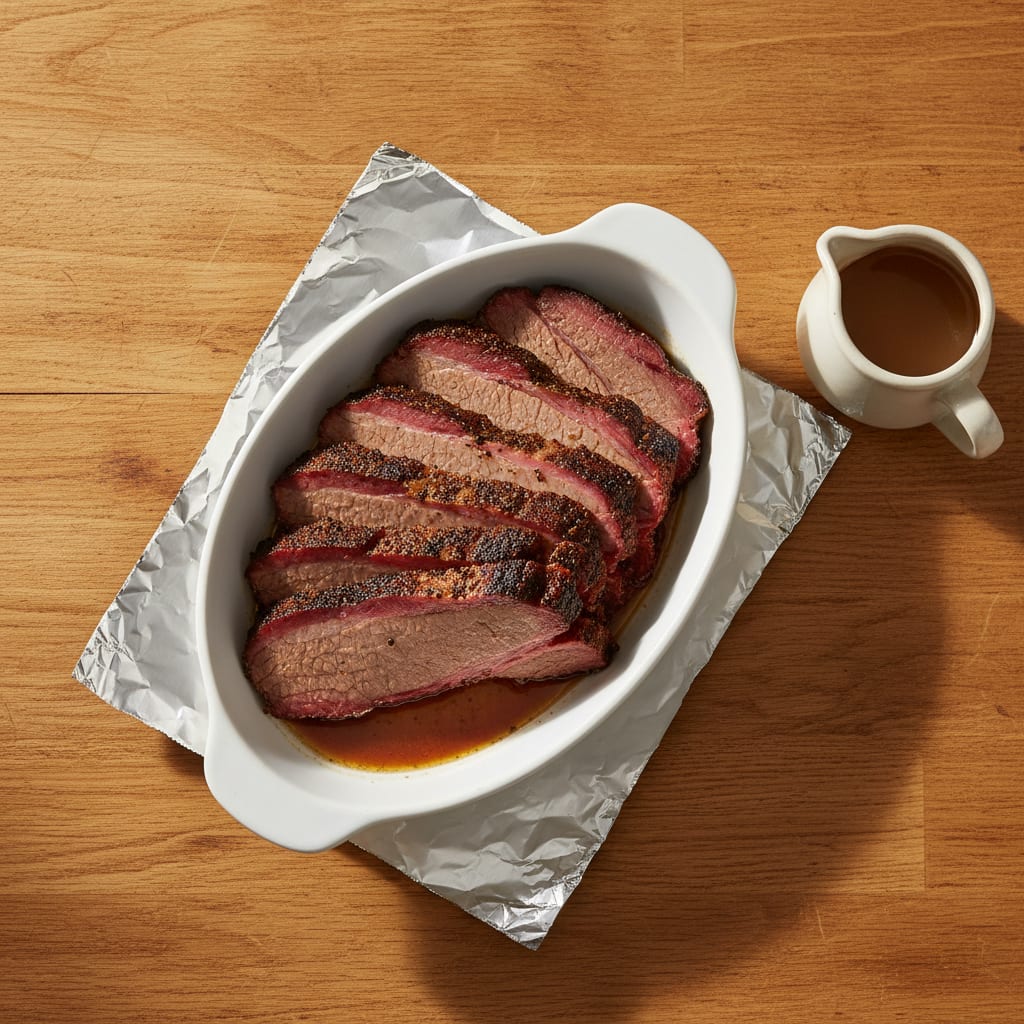
To reheat brisket so it stays juicy, wrap it tightly in two layers of foil with a few spoonfuls of its own juices or beef broth, and warm it in a low oven, around 250°F, until the thickest part reads 165°F. A whole chunk takes about an hour; slices take far less. Keep it in one piece if you can and slice it after reheating. Brisket dries out for two reasons: heat that is too high, and cut surfaces exposed to the air. A low oven, a tight wrap and some liquid fix both.
Why reheated brisket goes dry
Brisket is a tough cut made tender by hours of slow cooking, and most of what makes it good is moisture and rendered fat. Reheat it fast and hot and that moisture leaves first. Smoked BBQ Source’s reheating guide puts the microwave problem plainly: it works “by turning the water molecules into steam”, leaving “dry, rubbery and downright horrible meat.”
Slicing makes it worse, because every slice is two more cut faces. The same guide says that “reheating the brisket whole, and then slicing it when it’s time to serve helps keep the brisket from drying out.” If you are packing up leftovers after a barbecue, keep the biggest piece whole, and save any juices from the pan in a separate container.
The target: 165°F
The food-safety number for reheated leftovers is 165°F. University of Illinois Extension’s leftovers page says to “reheat to a minimum of 165 F, the safe temperature needed to kill harmful bacteria that may be present.” Smoked BBQ Source uses the same number and adds the most useful line in its guide: “check the temperature and not the clock.”
Brisket is well past 165°F when it is first cooked, so reaching it again does no harm, unlike a pink prime rib. Use an instant-read thermometer in the thickest part rather than guessing by the clock.
Method 1: Low oven (the best way)
This is the method both brisket guides we read recommend first.
- Let the fridge chill come off a little. Bearded Butchers’ reheating guide suggests half an hour on the counter, “but not so long that it will fall into the danger zone.” Thirty minutes, no more.
- Heat the oven. Smoked BBQ Source uses 225 to 250°F; Bearded Butchers uses 325°F. We go with 250°F: slower, but more forgiving.
- Add liquid. A few spoonfuls of saved juices, beef broth or a little melted butter over the meat. Bearded Butchers also lists a barbecue sauce mixture.
- Wrap tightly, twice. Two layers of foil, crimped at the edges, with the liquid inside. Heavy-duty foil like Reynolds Wrap Heavy Duty holds a seal without tearing on a bark edge. Set the parcel in a baking dish in case it leaks.
- Heat to 165°F. Smoked BBQ Source gives 20 minutes to an hour “depending on the size of the brisket”; Bearded Butchers says “about an hour for large pieces.” Start checking the thickest part at 30 minutes.
- Rest, then slice across the grain. Open the foil away from your face, let the steam go, and slice.
Method 2: Slices in a covered dish
Already sliced? Lay the slices overlapping in a baking dish, spoon broth or juices over them, cover tightly with foil and heat until hot through. Bearded Butchers heats slices at 375°F for only 15 to 20 minutes “to avoid drying out.” Overlapping slices protect each other; a single layer spread out dries faster.
Method 3: Sous vide (for planned leftovers)
If you own an immersion circulator, this is the gentlest method. Both guides set the water bath to 165°F. Bearded Butchers estimates “about one hour per inch of thickness”; Smoked BBQ Source leaves the vacuum-sealed brisket in the bath until the meat reaches the water’s temperature. It is slow, but it is almost impossible to dry the meat out, and brisket that was vacuum-sealed and frozen can go straight in.
What about the microwave?
Both guides advise against it. If you must, Bearded Butchers says thin-sliced brisket can go in “in 10-second bursts.” We would add a spoonful of broth and a loose cover, and keep it to one plate of slices for a quick lunch.
Reheating frozen brisket
Thaw it in the fridge first. Smoked BBQ Source calls the fridge “the easiest way to thaw your meat without losing too much moisture,” and says to make sure brisket has “defrosted properly” before you reheat it. Allow a day for a large piece. The exception is a vacuum-sealed pack going into a sous vide bath.
Leftover brisket keeps 3 to 4 days in the fridge, by Illinois Extension’s leftovers page. For a crowd next time, our chart for how much brisket per person has the shrink figures that decide how much ends up as leftovers.
Serving reheated brisket to a crowd
Reheat it all, then keep it covered and hot until serving. Our post on keeping food warm for a party covers the other household methods. Reheat only what you will serve: NC State’s Safe Plates program, in its leftovers advice, says to “only reheat leftovers once.”
Pulled pork from the same cook reheats in much the same way. Our guide to reheating pulled pork has the details.
FAQ
What temperature should I reheat brisket at?
A low oven, 225 to 250°F, with the brisket wrapped tightly in foil with some liquid. Some guides use 325°F, which is faster but less forgiving. Heat it until the inside reads 165°F.
How long does it take to reheat brisket in the oven?
About an hour for a large piece, and 20 to 30 minutes for a smaller chunk or slices. Check the temperature rather than the clock: 165°F in the thickest part.
Should I slice brisket before or after reheating?
After, if you can. A whole piece keeps its moisture; slices dry out faster. If it is already sliced, overlap the slices in a covered dish with broth.
How do you reheat brisket without drying it out?
Low heat, liquid and a tight seal: a few spoonfuls of juices or broth, two layers of foil and a 250°F oven. Avoid the microwave for anything thicker than a thin slice.
Can you reheat brisket twice?
It’s not recommended. NC State’s Safe Plates program says to reheat leftovers only once. Reheat the portion you will eat and keep the rest cold.