Growth Spurt Feeding: When the Schedule Stops Working
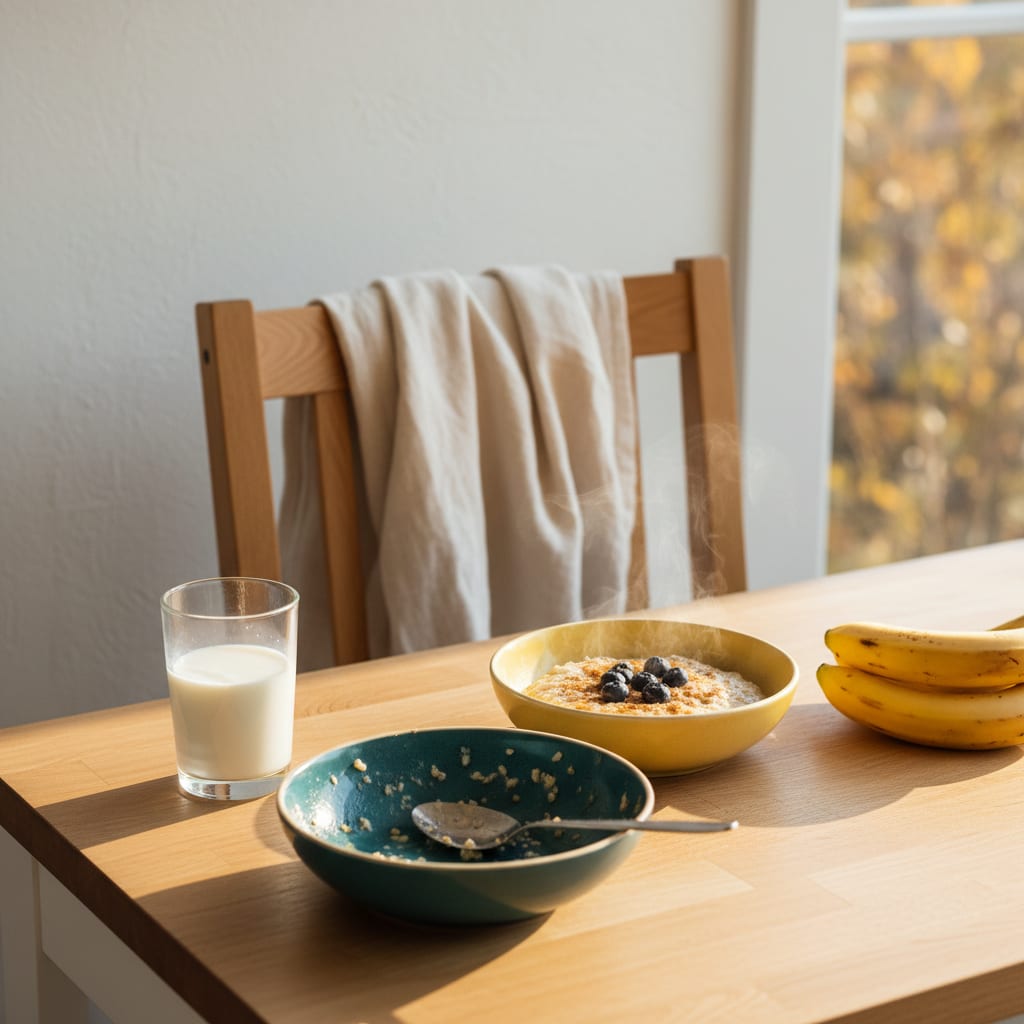
When a growth spurt hits, don’t rebuild the schedule — add volume to the one you have. The times stay put. The amounts go up, an extra eating slot appears in the afternoon, and for a few days your child is hungry in a way that feels like something has gone wrong. Nothing has. A baby who was feeding every three hours starts asking every ninety minutes; a five-year-old eats a second dinner at 7 p.m. and is starving again at breakfast. The fix isn’t a new routine, it’s food that’s already cooked and reachable at the moments the old routine leaves empty.
The mistake almost everyone makes — us included, three times over — is treating the spurt as evidence the schedule was wrong. It wasn’t. It’s about to be right again in a week.
What a spurt actually does to the day’s eating
The pattern is different by age, but the shape is identical: a short window of relentless appetite, then a return to something like normal.
Babies. Feeds bunch together, often heavily in the late afternoon and evening. A baby who had settled into a predictable gap suddenly wants the breast or bottle again forty minutes after the last one, and the night that had stretched out picks up an extra waking. The American Academy of Pediatrics’ guidance on how often babies eat is that babies should be fed when they seem hungry rather than on a fixed clock, which is exactly what a spurt week is asking of you. Betteroo’s guide to what a growth spurt looks like in practice lays out the ages these tend to cluster around, which is mostly useful for reassurance that it’s short.
Toddlers and preschoolers. Appetite tracks growth rate, which is why the AAP tells parents not to be surprised when a two-year-old eats less than expected — fewer calories are needed while growth is slow. Run that in reverse and you have the spurt week: the child who has picked at dinner for a month clears the plate and asks for more, twice.
School-age kids. The tell is timing, not volume. They come home from school genuinely ravenous rather than performatively hungry, eat a proper meal at 4 p.m., and still want dinner.
Why the schedule shouldn’t move
It’s tempting to push dinner later because everyone ate at four, or to drop a meal because nobody’s hungry the next morning. Both make the following week harder.
Meal times are the load-bearing part of family eating. They’re what makes a child arrive at the table hungry, what stops the day dissolving into constant grazing, and what everything else — bath, bedtime, homework — is pegged to. A spurt lasts days. A collapsed dinner time takes weeks to rebuild.
So: same times, bigger plates, and one extra sanctioned eating moment. That’s the entire adjustment.
The shelf that makes a spurt week survivable
The reason growth spurts feel like a crisis is that the extra hunger always arrives when you have no capacity to cook. Solve it with what’s in the fridge before it happens, not with a new dinner plan.
Keep these standing, and top them up on whatever day you shop:
| Ready food | Why it works in a spurt |
|---|---|
| Hard-boiled eggs, already peeled | Protein with zero assembly, eaten cold |
| A tub of cooked rice | Reheats in ninety seconds, bulks out anything |
| Shredded cooked chicken | Turns any leftover into a real second helping |
| Cheese, cut into cubes | The fastest calorie-dense thing in the house |
| Full-fat yogurt in a big tub | Cheaper than pots, portioned to appetite |
| Bananas and apples in a bowl at kid height | Self-serve means they stop asking you |
| Bread and butter | Underrated, always eaten, never refused |
| Two or three frozen dinner portions | The night you have nothing left |
That’s a fridge you can feed a bottomless child from without cooking twice. The self-serve principle behind it is the same one in our after-school snack system — a spurt week is that system running at double volume.
If the hungry one is a baby and you’re the one who hasn’t eaten, the honest version of that week is in cooking dinner with a baby, which is written for exactly the evening where feeding happens continuously from four o’clock onward.
Where the extra eating slot goes
The extra eating moment almost always lands mid-to-late afternoon. Give it a name and a place rather than letting it become grazing.
Make it a real small meal at the table: half a sandwich, a bowl of yogurt with fruit, eggs on toast, leftovers reheated. Ten minutes, sitting down, then finished. What breaks dinner isn’t a substantial 4 p.m. snack — it’s an open bag of crackers that runs from four until six.
If your child then eats less at dinner, that’s fine. Over a week the total evens out. Serve dinner anyway, at the usual time, and don’t comment on how much goes.
Nights get worse before they get better
Extra feeding and broken sleep tend to arrive together, which is why a spurt often gets diagnosed as sleep regression. They’re not the same thing and they call for different responses — one is answered with food, the other with the routine. Betteroo has a useful side-by-side on telling the two apart, and the short version is duration: hunger-driven disruption clears in days, and a regression doesn’t.
Practically, for the food side of it: front-load the day. A bigger breakfast and a real afternoon meal do more for a hungry night than anything you can add at bedtime, and a large late dinner tends to make bedtime worse rather than better.

Cook once for the week ahead
A spurt is a good argument for having a freezer that isn’t empty. Not elaborate meals — volume. A doubled batch of chili, a tray of meatballs, a bag of cooked rice, portioned into single servings, means the second dinner at 7 p.m. costs you three minutes rather than a decision.
If you’re heading into this with a new baby, stocking the freezer beforehand is the highest-value hour you’ll spend — freezer meals to stock before baby arrives is the list we hand to friends. And if the hungry one is a toddler with a short list of accepted foods, toddler lunch ideas is where to raid for volume without introducing a fight.
FAQ
How long does a growth spurt last?
Typically a few days to about a week. The appetite change is the most obvious part and it fades first. If heavy, unrelenting hunger runs for several weeks with no let-up, that’s worth mentioning to your pediatrician rather than managing with more snacks.
Should I feed my baby more often during a growth spurt?
Yes — feed on hunger cues rather than watching the clock. The AAP’s guidance is to feed babies whenever they seem hungry, and a spurt week is exactly when a fixed interval stops matching what the baby needs. The longer gaps usually return on their own within days.
Why is my toddler suddenly eating so much?
Most often a growth spurt, and it’s usually the mirror image of the low-appetite stretch that came before it. Toddler appetite follows growth rate, so it swings. Keep offering meals at the normal times and let the amounts do the moving.
Should I change dinner time if my child is hungry at 4pm?
No. Add a real snack-meal at four and keep dinner where it is. Moving dinner later solves one hungry afternoon and creates a bedtime problem that outlasts the spurt by weeks.
What should I keep in the fridge for a growth spurt?
Cold protein and easy carbohydrate: boiled eggs, cheese, yogurt, cooked rice, shredded chicken, bread, and fruit within reach. The goal is food that requires no cooking, so an extra helping is a thirty-second job rather than another meal to plan.
Do growth spurts affect sleep as well as eating?
Often, yes — extra night waking and short naps commonly show up in the same week. The distinguishing feature is how long it runs. A hungry week settles quickly once the feeding catches up; a pattern that persists for several weeks is usually something else.
✳ More From the Kitchen
Lunchbox & Kids
Freezer & Meal Prep
Feeding a Crowd