How Much Pasta Per Person? Portions for Any Group
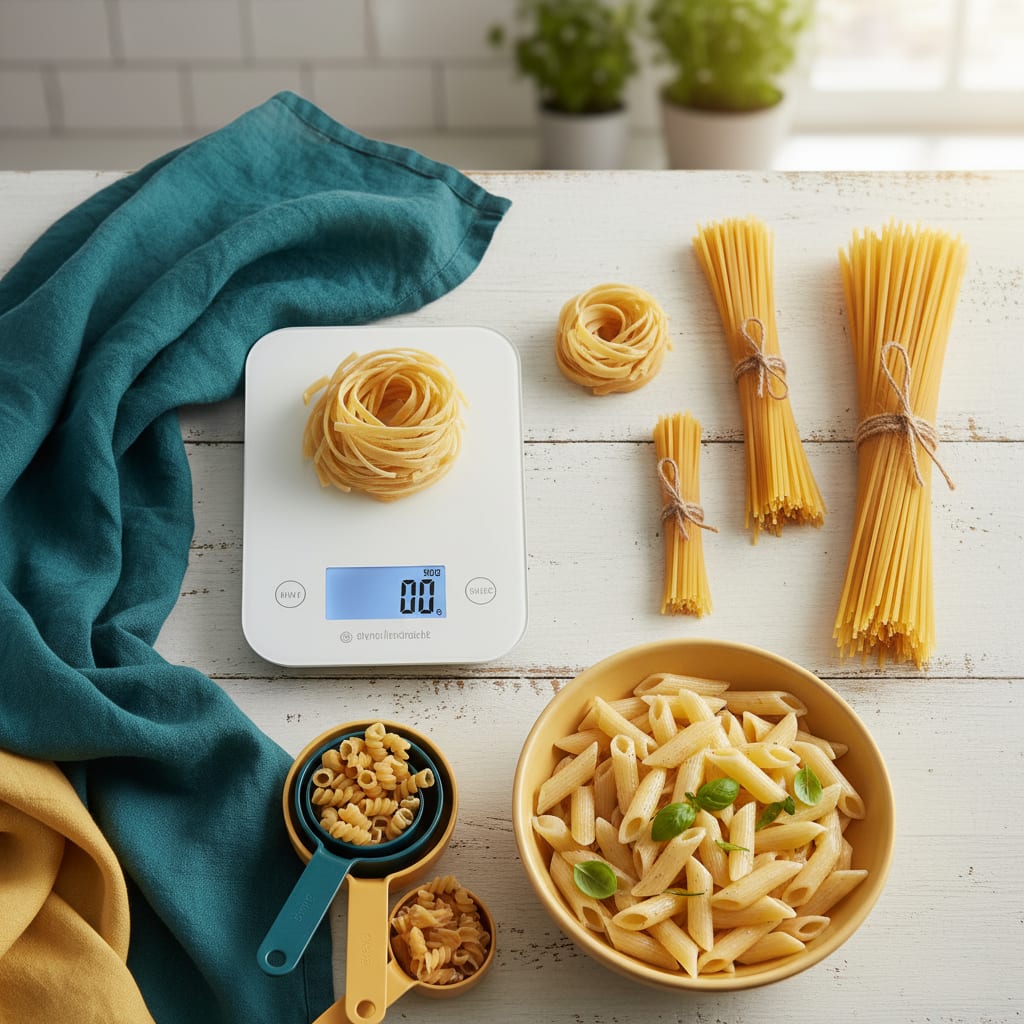
Short answer: plan 2 oz (about 57 g) of dry pasta per person as a side or starter, and 3–4 oz (85–113 g) per adult when pasta is the main event. Spaghetti is no different: weigh it the same way. Dry pasta roughly doubles in weight once cooked, so 2 oz dry becomes about 1 heaping cup of cooked short pasta. For a family of four eating pasta for dinner, that’s most of a 1 lb box; for 20 people, plan on about 5 lbs dry. Below is the full math — dry vs cooked, long vs short shapes, and a scaling table from date night to a party of 50.
We cook pasta at our house at least twice a week, and we’ve fed it to groups from 4 picky kids to 40 hungry teenagers — so these numbers come from actual pots, not just the side of the box.
Dry vs cooked: the conversion that trips everyone up
Recipes and boxes measure dry; hungry people eat cooked. Dry pasta roughly doubles in weight in the pot (a little more for small shapes that trap water), which is why a “sensible” 2 oz serving looks small in your hand and fine on the plate.
| Dry pasta | Grams (dry) | Cooked yield (roughly) | Good for |
|---|---|---|---|
| 2 oz | 57 g | about 1 heaping cup | Side dish, soup add-in, small kid plate |
| 3 oz | 85 g | about 1.5 cups | Light main, big-kid plate |
| 4 oz | 113 g | about 2 cups | Hearty main for an adult |
| 8 oz (half box) | 227 g | about 4 cups | Main for 2 adults or 3 kids |
| 16 oz (full box) | 454 g | about 8 cups | Main for 4 adults, side for 8 |
Two notes on that table. First, sauce changes everything: a rich, meaty, or creamy sauce stretches pasta further than a light olive-oil toss, so lean toward 3 oz per adult with a heavy sauce and 4 oz with a light one. Second, count kids under 10 as roughly half an adult portion and teenagers as a full adult — or more, if your house is anything like ours.
The scaling table: 2 to 50 people
This is the chart we check before every family dinner and every potluck. The “main course” column assumes pasta plus one side (salad or garlic bread); if pasta is truly the only food, round up by about 25%.
| People | As a side (2 oz each) | As a main (4 oz per adult) | Boxes to buy (1 lb) |
|---|---|---|---|
| 2 | 4 oz (115 g) | 8 oz (225 g) | 1 |
| 4 | 8 oz (225 g) | 1 lb (450 g) | 1 |
| 6 | 12 oz (340 g) | 1.5 lbs (680 g) | 2 |
| 8 | 1 lb (450 g) | 2 lbs (900 g) | 2 |
| 10 | 1.25 lbs (570 g) | 2.5 lbs (1.1 kg) | 3 |
| 12 | 1.5 lbs (680 g) | 3 lbs (1.4 kg) | 3 |
| 16 | 2 lbs (900 g) | 4 lbs (1.8 kg) | 4 |
| 20 | 2.5 lbs (1.1 kg) | 5 lbs (2.3 kg) | 5 |
| 30 | 3.75 lbs (1.7 kg) | 7.5 lbs (3.4 kg) | 8 |
| 40 | 5 lbs (2.3 kg) | 10 lbs (4.5 kg) | 10 |
| 50 | 6.25 lbs (2.8 kg) | 12.5 lbs (5.7 kg) | 13 |
Buying whole boxes builds in a small buffer, which is exactly what you want — running out of pasta at a party is a disaster, while an extra half-box of leftovers is tomorrow’s lunch. Past 12 people, cook in two pots (or in batches) so the water stays at a real boil; a crowded pot makes gummy pasta. At 30 to 50 people you are cooking 7.5 to 12.5 lbs of dry pasta for a main, which is a batch job however many pots you own: cook it in rounds of a couple of pounds, drain, toss each round with a little oil or sauce, and hold it warm while the next one cooks. For timing once it is in the water, our how long to boil pasta chart has minutes by shape.
Long vs short shapes: how to measure without a scale
A kitchen scale is the honest answer, but here’s how we eyeball it:
- Long shapes (spaghetti, linguine, fettuccine): a 2 oz bundle of dry spaghetti is about the diameter of a US quarter. Make a ring with your thumb and index finger a little smaller than a soda-bottle cap — that’s one serving. Four servings together is roughly the diameter of a tennis ball.
- Short shapes (penne, rotini, shells, macaroni): 2 oz dry is roughly 1/2 to 2/3 cup, depending on how the shape packs. Short shapes also drink up slightly more water, so they come out a touch heavier cooked.
- Egg noodles: lighter for their volume — 2 oz dry is closer to a full cup. Measure these by weight if you can.
- Fresh pasta: it’s already hydrated, so plan about 4 oz fresh per side portion and 5–6 oz as a main, and expect much less swelling in the pot.
Leftovers math (and why we over-cook on purpose)
Cooked pasta keeps 3–5 days in the fridge, so we deliberately cook a half-box extra whenever the pot’s already boiling. One pound of dry pasta yields roughly 8 cups cooked — dinner for four tonight plus two lunches. Toss the extra with a little olive oil before it goes in the container so it doesn’t fuse into a brick, and revive it in a skillet with a splash of water or straight into a lemon butter pasta situation the next night. Plain leftover noodles are also the fastest kid dinner we know — see our butter noodles formula.
If you’re scaling up for a party rather than a weeknight, pasta is one of the cheapest ways to feed a lot of people — it anchors several of the menus in our easy meals for a group guide, with the same per-person math baked into the shopping lists.
FAQ
How much pasta is one serving?
The standard serving on the box is 2 oz (57 g) dry, which cooks up to about a heaping cup. That’s realistic as a side dish. When pasta is the main course, most adults eat 3–4 oz dry, so a 1 lb box feeds about four adults for dinner.
How much pasta do I need for 10 adults?
For a pasta main, plan about 2.5 lbs dry (10 servings at 4 oz each) — call it three 1 lb boxes for a buffer. As a side dish, 1.25 lbs is plenty. Add 25% if there’s no bread or salad alongside.
Does dry pasta double when cooked?
Roughly, yes. Most dried pasta about doubles in weight after boiling, and small shapes can gain slightly more. In volume terms, 2 oz of dry short pasta becomes about 1 heaping cup cooked, and a 1 lb box yields roughly 8 cups.
How many servings are in a pound of spaghetti?
Eight servings at the 2 oz box serving, which is a side-dish portion. As a main course at 3–4 oz per adult, a 1 lb box of spaghetti feeds four to five adults. For 10 adults, buy three boxes; for 20, five.
How do I measure spaghetti without a scale?
A 2 oz single serving of dry spaghetti is a bundle about the diameter of a US quarter. Two servings is about the size of a golf-ball cross-section, and four servings together is roughly a tennis ball. For short shapes, use 1/2 to 2/3 cup dry per serving.
✳ More From the Kitchen
Lunchbox & Kids
Freezer & Meal Prep
Freezer & Meal Prep