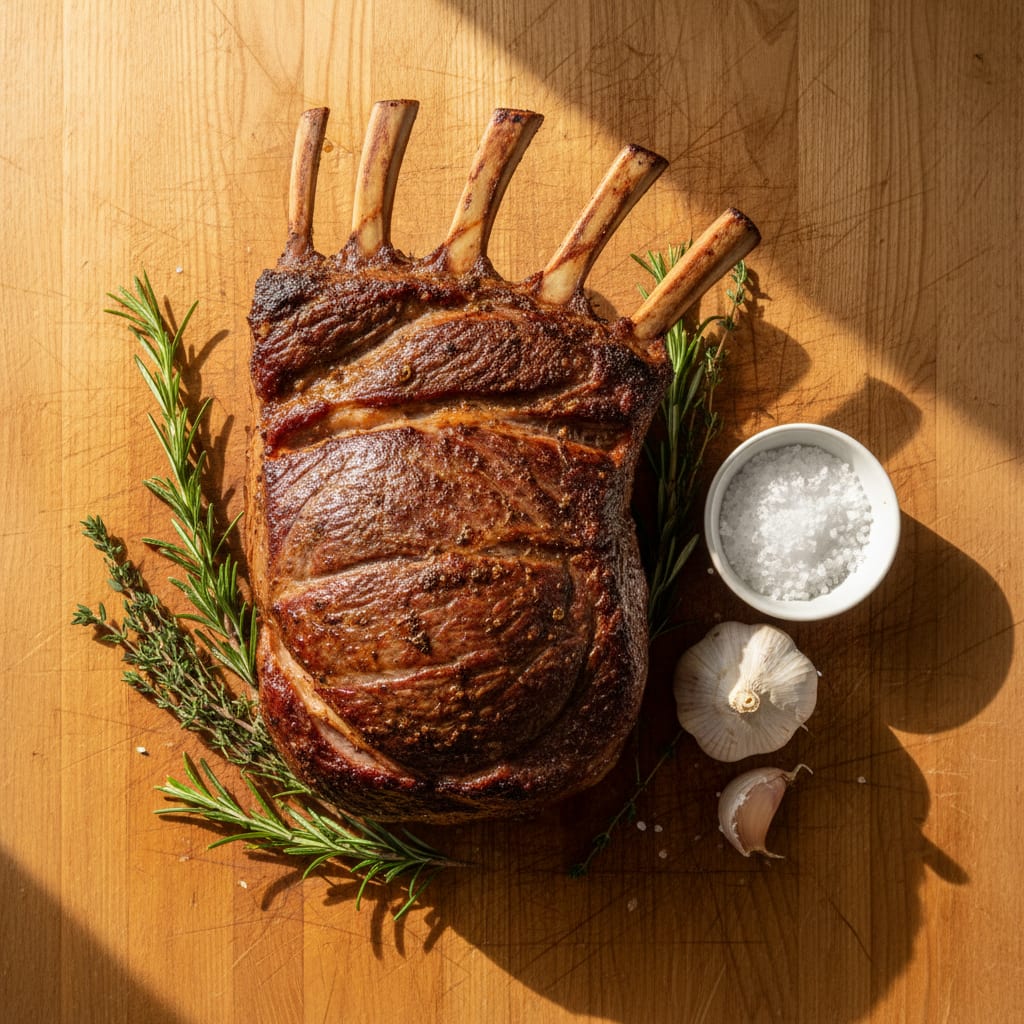
Buy one rib for every two people if the prime rib is bone-in, or 1/2 to 3/4 pound per person if it is boneless. That is South Dakota State University Extension’s holiday guidance for prime rib, and it is the rule we use too. So a bone-in roast with four ribs feeds eight, and a boneless roast for eight weighs 4 to 6 pounds. Go to the top of the boneless range when the roast is the whole point of the meal, and to the bottom when the table is full of sides.
Prime rib is the most expensive thing most families buy all year, so it is worth getting the number right before you order. Most butchers take Christmas roast orders weeks ahead, and they will ask you how many ribs you want.
The chart, by headcount
The rib counts come straight from SDSU’s one-rib-per-two-people rule, and the boneless pounds are its 1/2 to 3/4 lb per person multiplied out. The approximate bone-in weights are our arithmetic from one seller’s published averages (see below), so treat them as a guide to what the butcher will quote you, not a target.
| Guests (adults) | Bone-in ribs | Approx. bone-in weight | Boneless roast |
|---|---|---|---|
| 4 | 2 ribs | about 4 to 5 lb | 2 to 3 lb |
| 6 | 3 ribs | about 7 lb | 3 to 4 1/2 lb |
| 8 | 4 ribs | about 9 lb | 4 to 6 lb |
| 10 | 5 ribs | about 11 lb | 5 to 7 1/2 lb |
| 12 | 6 ribs | about 13 to 14 lb | 6 to 9 lb |
| 14 | 7 ribs | about 15 to 16 lb | 7 to 10 1/2 lb |
| 16 | 8 ribs (two roasts) | about 18 lb | 8 to 12 lb |
| 20 | 10 ribs (two roasts) | about 22 lb | 10 to 15 lb |
Where the weights come from: Snake River Farms, a beef seller, lists the average weights of its bone-in rib roasts as “3 bone - 7 lbs. 4 bone - 9 lbs.”, and says weights can vary by about three-quarters of a pound either way. That works out to a little over 2 pounds per rib, which is how we filled in the other rows. Your butcher’s roast will not match to the ounce.
Past seven ribs, plan on two roasts. A whole beef rib section is seven ribs long, and two smaller roasts also fit a home oven better and cook more evenly than one very long one.
Why bone-in needs so much more weight
A rib of beef carries a lot of bone, and you pay for it by the pound. One rib is a big piece of meat on the bone, but it plates as two generous slices, which is why the rule is “per two people” and not “per person”.
The bone is not wasted, though. It shields the meat beside it while the roast cooks, and it is usually cheaper per pound than the boneless cut. If you like the look of a standing roast on the table, bone-in is worth it. If you want easy, even slices and less to carve around, boneless is simpler.
What the oven takes away
Raw weight is not plate weight, and prime rib loses more than a cooked ham does. SDSU says the reverse when it explains why you buy less ham: ham “has already been cooked, and it won’t lose as much weight when you’re reheating it.” A raw roast loses fat and juice as it cooks.
Snake River Farms puts numbers on that for its own roasts: “Boneless roasts will shrink about 20% and bone-in roasts lose about 30% of the final weight (because of the extra weight of the rib bones).” The same page suggests “eight ounces of cooked prime rib roast per person” as a good serving. That is why the per-person rule starts at half a pound of raw boneless meat and runs up to three-quarters: the extra covers the shrink and the bigger appetites.
Cooking it past medium costs you more. SDSU notes the meat “will continue to cook for 10 to 20 minutes” after it leaves the oven, so pull it at 130 to 135°F for medium rare or 140 to 145°F for medium, then rest it 10 to 15 minutes before carving. A good instant-read thermometer such as the TempPro TP19H makes that easy, and a roasting pan with a rack, like the Cuisinart Chef’s Classic 16-inch, keeps the bottom of a boneless roast out of the drippings.
Adjusting the number for your table
SDSU tells hosts to ask “who, what and when” before buying any holiday roast. Here is how we would use that with prime rib.
- Who is eating. Teenagers and big eaters push you to 3/4 lb boneless. Our own planning rule for children under about ten is to count two children as one adult. Small children usually want a few thin slices, not a slab.
- What else is on the table. With potatoes, Yorkshire puddings or rolls, two vegetables and a salad, the low end of the range is plenty. If the roast is close to the only thing on the plate, use the high end.
- When you eat. A long afternoon of appetizers before a late dinner means people eat less roast. A dinner at the usual time with nothing before it means they eat more.
- Whether you want leftovers. Prime rib sandwiches on the 26th are half the reason some families buy it. If that is you, add one rib or about a pound and a half of boneless to the chart figure.
If prime rib is too much for your budget
For a smaller table, steaks cut from the same rib can do the job. Our guide to how much steak per person covers bone-in and boneless ribeye by the steak. For a leaner and pricier roast, see how much beef tenderloin per person, and for mixing two meats on one holiday table, the meat quantities per person chart has a line for each cut.
And if you did buy a rib too many, our guide to reheating prime rib keeps the leftovers tender.
FAQ
How much prime rib do I need for 8 adults?
Four ribs bone-in, which is roughly a 9 pound roast, or 4 to 6 pounds of boneless prime rib.
How much prime rib do I need for 10 people?
Five ribs bone-in, about 11 pounds, or 5 to 7 1/2 pounds boneless. Add a rib if you want leftovers.
Is one rib per person too much?
Yes, for most tables. SDSU’s rule is one rib per two people, and a rib-per-person roast would leave you with about twice what your guests can eat.
How much prime rib per person for kids?
We count two children under about ten as one adult, so about 1/4 to 3/8 pound of boneless roast each, served in thin slices.
Should I buy bone-in or boneless prime rib?
Bone-in looks more impressive and is often cheaper per pound, but you need more weight. Boneless is easier to carve evenly. Both taste the same when they are cooked to the same temperature.