Can You Freeze Avocados? Only Puréed, Not Whole
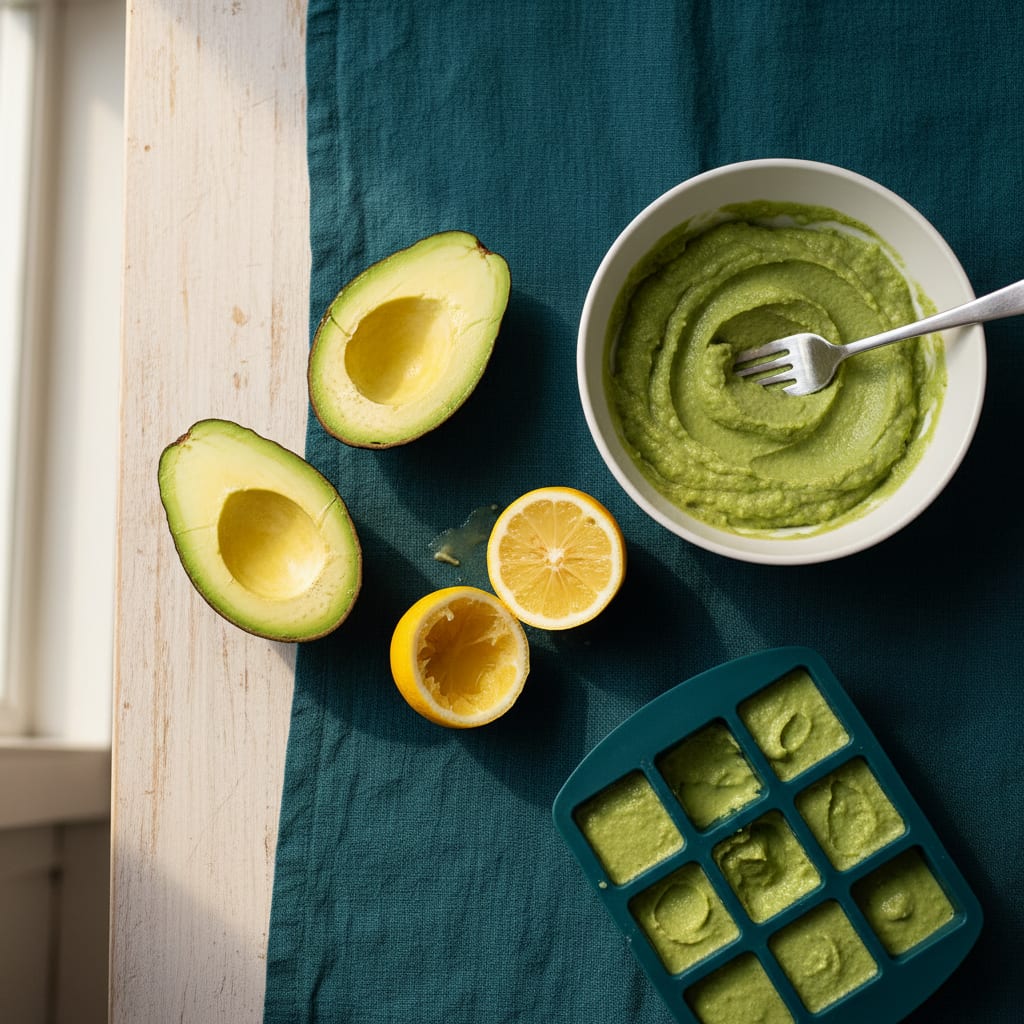
Yes, but only as a purée. The National Center for Home Food Preservation is unusually blunt about this one: avocados “should not be frozen whole or sliced, as they do not freeze satisfactorily in these forms.” What does work is mashing them first — “avocados are best frozen as purée” — with a little acid stirred in to hold the color, packed into a container with headspace, sealed and frozen.
So the two-for-$3 bag that ripened all at once is salvageable. It just isn’t going to come back as guacamole chunks or slices for a salad.
Why a whole avocado falls apart
An avocado is mostly water suspended in soft, fat-rich flesh with very little structure holding it together. Freeze it and the water inside each cell expands into ice crystals that puncture the cell walls. In a firm vegetable like a carrot you notice this as a loss of snap. In an avocado, which has almost no snap to begin with, the same damage reads as total collapse — you thaw it and get grey, watery slush that separates in the container.
Mashing first is a way of getting ahead of that. You do the structural damage yourself, on purpose, while the flesh is still green and fresh, so that the freezer has nothing left to ruin. The purée goes in smooth and comes out smooth.
The purée method, step by step
- Pick the right fruit. NCHFP says to “select avocados that yield to gentle pressure with rinds free from dark blemishes.” Rock-hard avocados won’t develop flavor in the freezer, and ones already going brown inside will only get worse.
- Peel, halve and pit them. Scoop the flesh into a bowl.
- Mash to the texture you want. A fork gives you a rustic mash; a food processor gives you a smooth purée that portions more evenly.
- Stir in acid immediately. NCHFP’s ratio is “1/4 teaspoon (750 mg) ascorbic acid to each quart of purée,” or “1 tablespoon lemon juice for each 2 avocados.” Do this before the mash sits, not after.
- Pack, leaving headspace. Purée expands. A half inch in a rigid container, or a flattened freezer bag with the air pressed out.
- Label and freeze flat. Flat bags stack, and they thaw in a fraction of the time a block does.
Ascorbic acid or lemon juice — they are not equal
Both work by shutting down the enzyme that turns cut avocado brown, and both are worth doing. But they aren’t interchangeable in strength. Penn State Extension’s freezing-fruit guidance puts it plainly: “sometimes lemon juice or other citrus fruit solutions are used to control browning, but they are not as effective as treatment with ascorbic acid.”
In practice: lemon juice is what’s in your fridge, so lemon juice is what most of us use, and it’s fine for a purée you’ll eat within a couple of months. If you’re freezing a big batch to last, ascorbic acid powder — sold as fruit-preserving powder, or crushed vitamin C tablets — holds the color noticeably better. Either way, expect the purée to darken slightly at the surface where it touches air. That’s cosmetic, and pressing plastic wrap flat onto the surface before you seal the lid mostly prevents it.
Sweetened, unsweetened, and why NCHFP bothers to say
The instructions specify “unsweetened for salads and sandwiches, sweetened for other uses.” That reads oddly to anyone who only ever eats avocado on toast, but sweetened avocado purée is standard in a lot of the world — smoothies, batidos, ice cream, milkshakes. Sugar also acts as a mild preservative in frozen fruit, which is why Penn State notes that unsweetened packs deteriorate faster than sugared ones.
For family cooking, unsweetened is almost always what you want. Just know that it’s the version with the shorter runway.
Portion it for the thing you actually make
The single biggest determinant of whether frozen avocado gets used is the size you froze it in. A quart of purée is a project. A tablespoon is a sandwich.
- Ice cube trays — roughly two tablespoons per cube, which is exactly what Souper Cubes 2-tablespoon trays hold. Pop them out, bag them, and take one for toast or a bowl.
- Half-cup flat bags — a batch of guacamole for two adults, or the avocado for a dinner’s worth of tacos.
- Cubes for smoothies — one or two frozen avocado cubes give a smoothie the thick, milkshake texture that banana usually does, with no sweetness. They drop straight into a freezer smoothie pack with the fruit and greens.
- Baby-size cubes — for anyone spoon-feeding, an ice cube of plain avocado purée thawed in the fridge is a meal’s worth.
Freeze it in the shape the dinner needs. You can always thaw two cubes; you cannot un-freeze a quart.
How long it keeps
Frozen at 0°F or below, avocado purée is safe indefinitely — that’s the standing rule from FoodSafety.gov, which states that “frozen foods stored continuously at 0°F (-18°C) or below can be kept indefinitely.” Quality is the real clock. Penn State’s window for frozen fruit generally is to “use frozen fruits within 8 to 12 months for best quality,” and unsweetened avocado sits at the short end of that. Realistically, treat three to six months as the point where the flavor is still genuinely good, and use it sooner if you can.
Thaw it in the fridge overnight, or set the bag in a bowl of cool water for twenty minutes. Never on the counter all day. Stir well when it thaws — some separation is normal — and taste before you commit it to a bowl of guacamole for guests. Our freezer storage chart covers the same math for cooked dishes.
What it is good for, honestly
Good: guacamole, smoothies, avocado crema for tacos, sandwich and toast spread, baby purée, salad dressing, chocolate avocado pudding.
Not good: anything sliced. Sushi, avocado toast where the slices are the point, a fanned garnish, a Cobb salad. There is no method that returns a frozen avocado to slice-able. If that’s what you need it for, buy it the day you need it and store the rest of the batch in the fridge to slow ripening instead. The freezer basics rule applies here as much as anywhere: freeze the form you’ll use, not the form you bought.
FAQ
Can you freeze a whole avocado in its skin?
You can put one in the freezer, but NCHFP specifically advises against freezing avocados whole or sliced because they don’t freeze satisfactorily that way. The flesh thaws watery and grey, and the skin makes it harder to salvage. Mash it first.
Does frozen avocado turn brown?
Slightly, at the surface where air reaches it. Stirring in lemon juice or ascorbic acid before freezing is what keeps the color, and pressing wrap directly onto the surface before sealing does the rest. Mild darkening is a quality issue, not a safety one.
Can you make guacamole from frozen avocado?
Yes, and it’s the best use for it. Thaw the purée in the fridge, drain any water that separated, then stir in your onion, cilantro, lime and salt fresh. Don’t freeze a finished guacamole with the aromatics already in — the onion goes harsh and the tomato goes to mush.
Can you freeze avocado for baby food?
Yes. Plain mashed avocado with no additions freezes well in an ice cube tray, and one cube thawed in the fridge is about a serving. Label the date and use within a couple of months for the best flavor.
Is frozen avocado still healthy?
Freezing doesn’t remove the fat or the fibre, which is most of why avocado is worth eating. Some vitamin loss happens slowly over months in any frozen food, which is another argument for using it inside a few months rather than a year.
✳ More From the Kitchen
Lunchbox & Kids
Freezer & Meal Prep
Lunchbox & Kids