Can You Freeze Milk? Yes — Here's What Changes
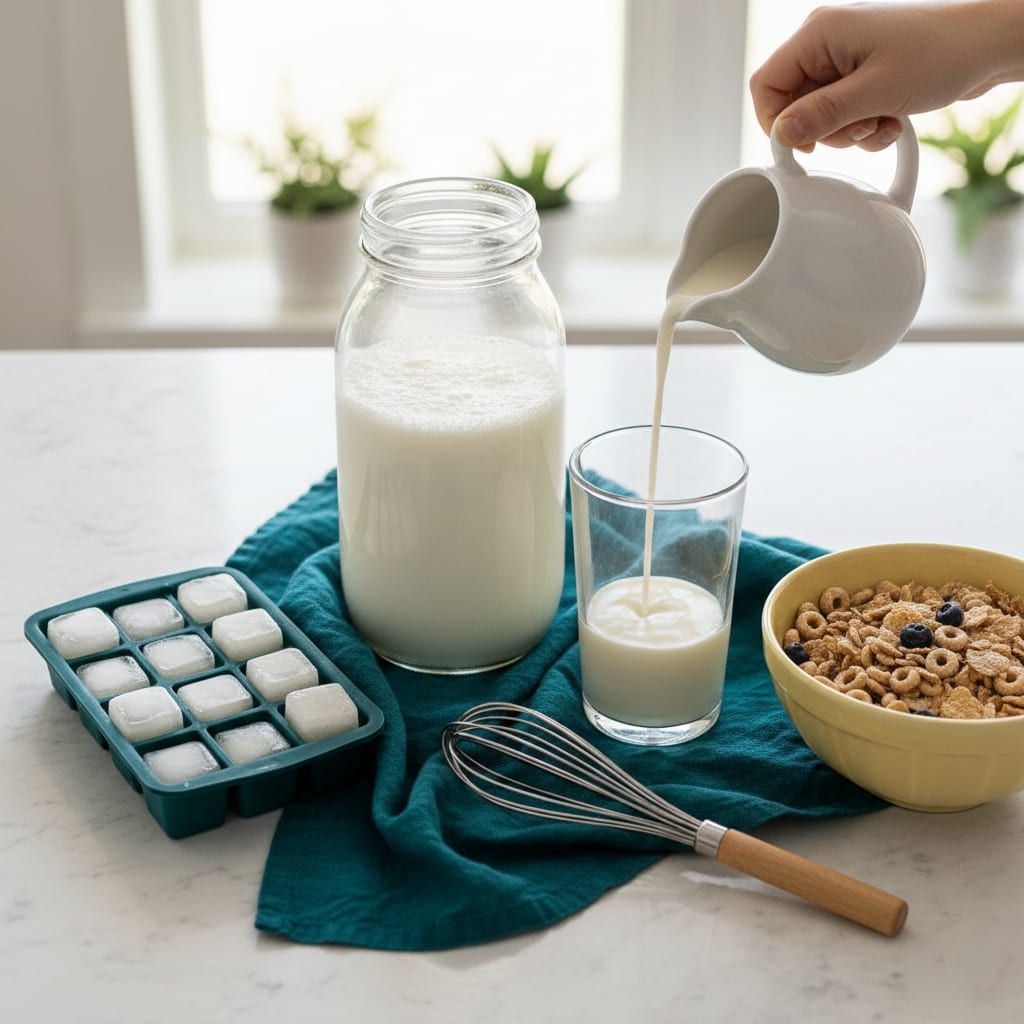
Yes, you can freeze milk — it stays perfectly safe, but it comes back slightly separated and sometimes a little yellow. U.S. Dairy puts the window at up to six months in the freezer, with the best quality inside the first month. The two rules that decide whether it’s worth doing: leave room in the container for the milk to expand, and thaw it in the refrigerator, never on the counter. Shake it hard once it’s liquid again and most of what changed goes away.
So the honest answer isn’t a flat yes. It’s yes, and you’ll want it for cooking and cereal more than for a cold glass. That’s still a very good deal on a gallon that was about to turn.
What actually happens inside the jug
Milk is mostly water with fat, protein and sugars suspended in it. Freeze it and the water crystallizes first, crowding everything else into pockets. Thaw it and the fat doesn’t slide neatly back into suspension on its own — you get a grainy, slightly gritty look and sometimes visible flecks along the side of the jug.
Nothing has spoiled. MU Extension also notes that frozen milk can take on a yellow tinge because riboflavin behaves differently in the cold, and that safety and nutrition are unaffected — it just looks odd. Thirty seconds of shaking, or five seconds in a blender, and it looks like milk again.
The practical rule to carry: the lower the fat, the better it freezes. Skim comes back nearly unchanged. Whole milk separates most. Cream separates hardest of all.
Which dairy liquids freeze, and which don’t
| Liquid | Freezes? | What to expect |
|---|---|---|
| Skim and 1% milk | Very good | Barely changes; shake and pour |
| 2% milk | Good | Mild separation, gone after shaking |
| Whole milk | Fair | Noticeable graininess; best in cooking |
| Buttermilk | Good | Separates a lot, but bakes identically |
| Half-and-half | Fair | Splits; fine in soups, poor in coffee |
| Heavy cream | Poor for pouring | Won’t whip well after; use in sauces |
| Evaporated milk | Don’t | Separates badly; refrigerate instead |
| Sweetened condensed | Don’t | Sugar keeps it from freezing solid |
| Oat, soy and almond milks | Fair | Split hard; shake or blend, cook with it |
| Lactose-free milk | Good | Behaves like the milk it was made from |
Breast milk is a different category with its own storage guidance from your pediatrician or health department — don’t apply the numbers on this page to it.
How to freeze it so it’s worth thawing
- Leave headspace. Milk expands as it freezes and a full container will bulge or split. MU Extension’s numbers are worth copying exactly: at least half an inch in wide-mouth pint jars, an inch for wide-mouth quarts, and an inch and a half in regular-mouth pint and quart jars. If you’re freezing in the original plastic jug, pour off about a cup first.
- Never freeze milk in glass that’s filled to the shoulder. Straight-sided, wide-mouth jars only, and only with real headspace.
- Freeze in the size you’ll use. A whole gallon takes two days to thaw and then you’re committed to using a gallon. Quart containers, or a two-cup portion for a baking week, are far more useful.
- Freeze a tray of milk cubes from the last inch. They go straight into smoothies, and they chill a hot cocoa without watering it down.
- Get it in early. Freeze milk while it’s still clearly fresh. The freezer pauses quality, it doesn’t restore it — milk that already smells off will thaw smelling off.
Quality windows are about flavor, not danger. FoodSafety.gov is clear that food kept continuously at 0°F stays safe indefinitely.
Thawing without ruining it
Move it to the refrigerator and leave it. A quart takes overnight; a gallon can take two full days. Milk is perishable the moment it’s liquid again, so a jug thawing on the counter has an outer layer sitting in the danger zone while the middle is still ice.
When it’s thawed, shake it hard for a good thirty seconds — really hard, the way you’d shake a salad dressing. If it still looks grainy, ten seconds in a blender fixes it completely. Then treat it exactly like fresh opened milk and use it within a few days.
If you’re in a hurry, a sealed container under cold running water works. Don’t microwave a jug of milk to thaw it; you’ll scald the edges and cook a skin onto the surface.
Where frozen-and-thawed milk is genuinely great
This is the list that makes the whole exercise worth it, because in all of these nobody can tell:
- Pancakes, waffles and muffins — batter hides separation completely.
- Mac and cheese and cream sauces — the milk is being heated and emulsified anyway. If you’re out entirely, our mac and cheese milk substitutes covers what else works.
- Soups, chowders and mashed potatoes — whisked into something hot, it disappears.
- Smoothies — frozen milk cubes are an upgrade, not a compromise.
- Oatmeal, cereal and hot chocolate — fine after a shake.
- Bread and dinner rolls — buttermilk especially bakes exactly as it did fresh.
Where it disappoints: a cold glass with dinner, milk in coffee or tea where the split shows, and anything where the milk is the whole point.
Building it into the freezer rotation
Milk is a component, not a meal — same shelf logic as frozen rice or a bag of grated cheese. Buying the second gallon when it’s on offer only pays off if you actually find it later, which is why we rotate the freezer front-to-back the way our freezer meal storage chart lays out. Milk goes at the front, because its useful window is shorter than a lasagna’s.
If you’re already freezing dairy, freezing cheese is the companion move: block cheese comes back crumbly and melts perfectly, which covers most of the same weeknight dinners this milk will end up in.
FAQ
How long can you freeze milk?
Up to about six months, with best quality in the first month, per U.S. Dairy. It stays safe far longer than that at a steady 0°F — the time limit is about flavor and texture, not safety.
Why did my frozen milk turn yellow?
Riboflavin freezes differently than the rest of the milk, which can leave a yellow tinge. MU Extension notes this doesn’t affect safety or nutrition. Shaking usually evens the color out; if the flavor is off, cook with it instead.
Can you freeze milk in the plastic jug it came in?
Yes, as long as you pour off about a cup first so it has room to expand. A full jug will bulge, and a bulged jug sometimes splits at the seam and leaks as it thaws.
How do you fix separated milk after thawing?
Shake it hard for thirty seconds, or blend it for five. If it’s still grainy after that, it’s still safe — put it into pancakes, a cream soup or mashed potatoes where the texture doesn’t show.
Can you refreeze milk that’s been thawed?
You can, but each cycle costs texture and thawed milk is already on a short clock. It’s better to freeze in portions you’ll finish in one go — a quart, or a two-cup baking portion.
Does whole milk freeze worse than skim?
Yes. Fat is the part that separates, so whole milk shows the most graininess and skim the least. Whole milk is still perfectly usable — just plan on it going into cooking rather than into a glass.
✳ More From the Kitchen
Lunchbox & Kids

Easy Dinners
Kitchen How-Tos