Can You Freeze Cheese? What Survives the Thaw
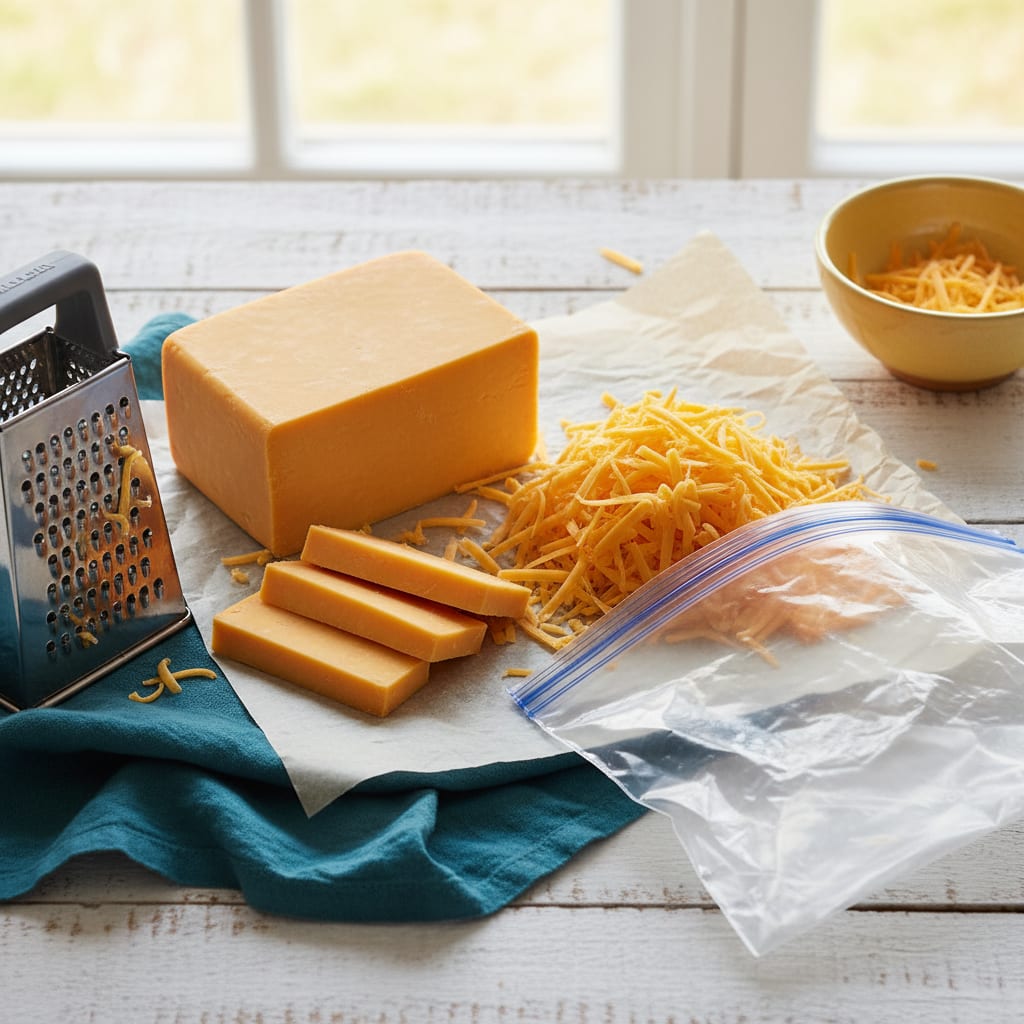
Yes, you can freeze cheese — hard and semi-hard blocks freeze safely and keep their flavor, but they come out crumbly. The National Center for Home Food Preservation is blunt about it: hard or semi-hard cheese can be frozen in pieces of 1½ pounds or less, wrapped in moisture-vapor-resistant packaging, and it “may become crumbly and mealy when frozen, but will retain its flavor.” So the honest answer isn’t yes or no. It’s yes, for cooking. Frozen-then-thawed cheddar is excellent in a quesadilla, a casserole or a sauce, and disappointing on a cheese board.
That distinction is the whole post. Freeze cheese on purpose, for the jobs it will still be good at, and you’ll never throw out a half block again.
What the freezer actually does to a block of cheddar
Cheese is a protein-and-fat structure holding a surprising amount of water. Freeze it and that water forms ice crystals that push the curd apart from the inside. Thaw it and the structure doesn’t fully knit back together — so instead of slicing cleanly, the block fractures. Bite into it cold and it feels slightly dry and grainy.
Nothing unsafe has happened. Flavor is essentially untouched, which is why the cheese is still perfectly good the moment it melts. Melting redistributes the fat and the crumbliness stops existing. That’s the practical rule to carry: if the cheese will end up melted, freeze it freely. If it will be eaten cold and sliced, don’t.
Which cheeses hold up
| Cheese | Freezes? | What to expect |
|---|---|---|
| Cheddar, Colby, Monterey Jack | Good | Crumbly when cold, perfect melted |
| Mozzarella (low-moisture block) | Very good | The best performer; barely changes |
| Swiss, Gouda, Havarti | Good | Crumbles more than cheddar; grate it |
| Parmesan, Pecorino (hard, aged) | Excellent | Low moisture means almost no damage |
| Fresh mozzarella in brine | Poor | Weeps badly; the ball collapses |
| Blue cheese | Fair | Freezes safely but crumbles further |
| Brie and other bloomy rinds | Fair | Texture flattens; use in baked dishes |
| Cottage cheese, ricotta | Don’t | NCHFP lists these as not freezing well; they separate |
| Cream cheese | Special case | Splits on thaw — see below |
Cream cheese is enough of a separate problem that we gave it its own walkthrough: can you freeze cream cheese covers why it splits and the cooked dishes where it still works perfectly.
How to wrap it so it’s worth thawing
- Cut it down first. Half-pound pieces or smaller freeze fast and thaw evenly. A two-pound brick freezes slowly at the center, and slow freezing means bigger ice crystals and more damage.
- Wrap it twice. Plastic wrap pressed against every surface — air is what dries the edges — then a freezer bag or foil over the top. Cheese also picks up freezer smells with enthusiasm.
- Or grate it before it goes in. This is the single best move for anyone who mostly cooks with cheese. Grated cheese freezes loose in a bag, scoops out by the handful, and goes straight into a hot pan frozen. There’s no thaw step to be disappointed by.
- Label with the date. Quality holds for around six months in a freezer at 0°F. FoodSafety.gov is clear that food kept continuously at 0°F stays safe indefinitely — storage times are about quality, not danger.
A note on pre-shredded bagged cheese from the store: it freezes fine, and the anti-caking starch on it actually helps the shreds stay separate.
Thaw it slowly, or not at all
Thaw cheese in the refrigerator, overnight, still wrapped. The slower it goes, the less moisture it loses, and moisture loss is exactly what produces the dry crumble. Never thaw a block on the counter or in the microwave — you’ll get a sweating, oily exterior and a frozen middle.
Better still, skip thawing. Frozen grated cheese goes directly onto a pizza, into a sauce, or over a casserole. Frozen block cheese grates beautifully straight from the freezer, better than soft cheese does at room temperature.
Where crumbly cheese is genuinely great
This is the list to keep on the fridge, because thawed cheese isn’t a compromise in any of these:
- Quesadillas and grilled cheese — melting resets the texture entirely. Our sheet pan quesadillas feed six and were built on freezer cheese.
- Mac and cheese and cheese sauces — the cheese is being melted into liquid anyway.
- Casseroles, baked pasta, enchiladas — topping cheese browns identically.
- Soups and chili toppings — a handful of frozen shreds over a hot bowl melts in seconds.
- Scrambled eggs, omelets and breakfast burritos — small amounts, all melted.
- Scones, biscuits and savory muffins — crumbly is the point.
Where it fails: cheese boards, a slice on a cold sandwich, cubes for a lunchbox, caprese salad. If that’s what a block is destined for, keep it in the fridge and eat it.
Fitting cheese into the freezer rotation
Cheese isn’t a meal, it’s a component — the same category as frozen rice or shredded chicken. Buying the big block on offer and freezing two-thirds of it grated is one of the cheapest upgrades to a freezer shelf, because it turns a dozen half-finished dinners into complete ones. If you’re building the shelf out properly, our how long do freezer meals last chart sets the rotation order so nothing gets buried and forgotten.
FAQ
How long can you freeze cheese?
Around six months at 0°F for good quality, and it stays safe beyond that — FoodSafety.gov notes that food held continuously at 0°F is safe indefinitely, so the dates are a quality guide. Hard aged cheeses like Parmesan hold up longest; softer, wetter cheeses degrade fastest.
Does freezing cheese ruin it?
It changes the texture, not the flavor. Expect a crumbly, slightly mealy block that no longer slices cleanly. Since melting hides that completely, frozen cheese is a genuine downgrade only for cold eating — sandwiches, cheese boards, snack cubes.
Can you freeze cheese in the original packaging?
Only if it’s unopened vacuum-sealed plastic, which is already moisture-vapor resistant. Opened cheese in loose deli paper or a partly torn wrapper will dry out and pick up freezer odors within weeks. Rewrap it tightly first.
Can you refreeze cheese that’s been thawed?
You can, but each cycle costs texture, and thawed cheese has already lost moisture. Better to freeze in portions you’ll use in one go — half-pound blocks or bags of grated cheese sized for a single dinner.
Does shredded cheese freeze better than a block?
For everyday cooking, yes. Shreds freeze quickly, stay loose enough to scoop, and never need thawing, so the crumbly-block problem never arises. Blocks are worth freezing when you want the option to grate fresh later.
✳ More From the Kitchen
Lunchbox & Kids
Easy Dinners
Easy Dinners