How Long Do Freezer Meals Last? A Storage Chart
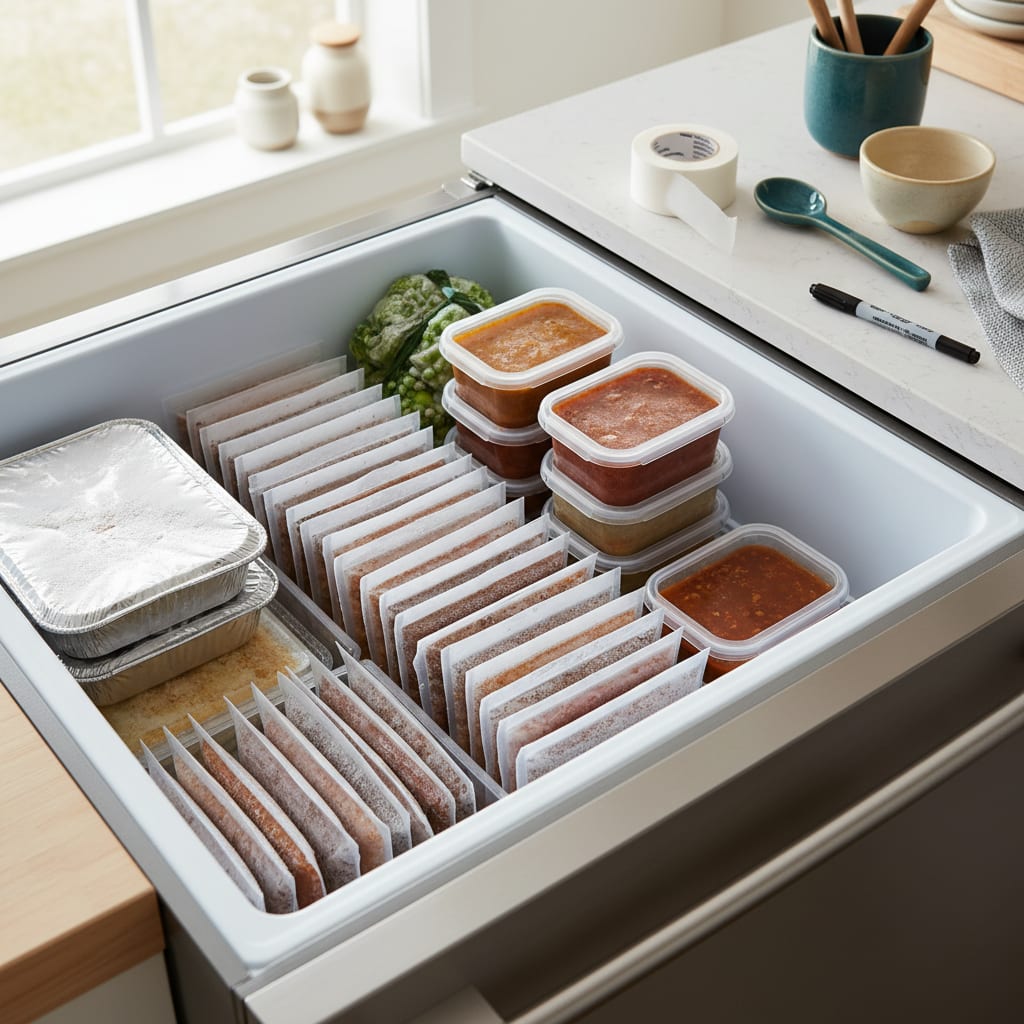
Most homemade freezer meals are at their best for roughly 2–4 months, and stay perfectly safe far beyond that as long as the freezer holds 0°F (-18°C). That’s the part people get wrong in both directions: food frozen solid at 0°F doesn’t spoil, so nothing in your freezer is dangerous at four months — but quality absolutely declines, and a casserole at eight months tastes like the inside of a freezer. So the number that matters isn’t a safety deadline. It’s a “eat this while it’s still good” window, and it varies a lot by dish. Here’s the chart.
The storage chart
Best-quality windows for home-frozen food, based on the ranges published by USDA food-safety guidance:
| What you froze | Best quality within | Notes |
|---|---|---|
| Soups, stews, chili | 2–3 months | Freeze without cream or pasta; add those at reheat |
| Cooked casseroles (lasagna, baked ziti, enchiladas) | 2–3 months | Double-wrap; the top layer dries first |
| Cooked meat and poultry dishes | 2–3 months | Sauce protects them; naked shredded chicken dries faster |
| Uncooked ground beef, pork, lamb | 3–4 months | Flat-frozen in bags, not the store tray |
| Uncooked chicken pieces | Up to 9 months | Marinated and flat-frozen is our default |
| Uncooked whole chicken | Up to 12 months | Needs a full day-plus to thaw in the fridge |
| Uncooked steaks and roasts | 4–12 months | The longest-keeping thing in most freezers |
| Bacon and sausage | 1–2 months | Cured, salty, fatty — the fastest to go stale-tasting |
| Cooked rice and grains | About 1 month | See can you freeze cooked rice for the method |
| Mashed potatoes | About 2 months | Fat content decides everything — details in can you freeze mashed potatoes |
| Breakfast burritos and hand pies | About 3 months | Foil-wrapped inside a bag |
| Muffins, quick breads, pancakes, waffles | About 3 months | Flat-freeze, then bag |
| Cookie dough (portioned) | About 3 months | Bake from frozen, add a minute or two |
| Home-frozen fruit and vegetables | 8–12 months | Blanch vegetables first or they go limp |
| Broth and stock | 4–6 months | Ice-cube-tray portions for pan sauces |
Notice the pattern: raw keeps longer than cooked, fatty keeps worse than lean, and sauce keeps better than bare. Fat is the thing that goes rancid in a freezer — slowly, but it’s why bacon and sausage top out at a month or two while a raw roast is fine for the better part of a year.
Why “safe forever” and “still good” aren’t the same
At 0°F, bacteria don’t grow. Full stop. That’s why the USDA says frozen food stays safe indefinitely. What keeps happening at 0°F is physics and chemistry: water molecules migrate out of the food and refreeze as surface ice (that’s freezer burn), fats slowly oxidize, and volatile flavor compounds escape. None of it will make anyone sick. All of it makes dinner disappointing.
The killer is temperature swings, not time. A chest freezer that sits undisturbed at a steady 0°F preserves food dramatically better than a fridge-top freezer compartment that gets opened eleven times a day and cycles through a defrost mode. If your freezer meals go bad faster than the chart says, that’s usually why — and it’s the reason the door shelf is the worst place for anything you care about.
The three things that actually protect quality
- Get the air out. Air is what causes freezer burn. Press bags flat and squeeze them empty, or wrap in plastic then foil. If you batch-cook seriously, a countertop vacuum sealer like the FoodSaver space-saving sealer roughly doubles the useful life of everything it touches — it’s the one piece of gear that changes the chart.
- Freeze fast and flat. A thin, flat package freezes through in an hour or two; a deep block of chili takes most of a day, forming big ice crystals the entire time. Big crystals are what turn a stew mealy.
- Cool completely first. Warm food in a sealed bag makes condensation, condensation makes ice, and ice makes texture problems. Cool on a sheet pan, not in a deep pot.
A rotation system that takes five minutes
Charts only work if you know what’s in there. Ours is deliberately low-effort:
- Label everything with the date it went in, not the date it “expires.” Masking tape and a marker on the counter, permanently.
- One bin per category. Breakfast, dinner mains, components (rice, mash, shredded chicken), bread. Reaching into a bin beats excavating a shelf.
- Newest to the back. Ten seconds of discipline at load time saves the archaeology later.
- Eat-first shelf. Anything past its window on the chart goes to a single front basket, and that basket is what dinner comes from this week.
If you’re starting the whole habit from zero, our freezer meal prep for beginners walkthrough sets up the first batch, and freezer breakfast burritos are the single best test case — quick, forgiving, and gone within the window whether you plan it or not.
One place the chart is worth taking seriously: the freezer stash people build before a baby arrives. Those meals often get frozen in a burst two months early and then forgotten for weeks, which is exactly when the 2–3 month window on casseroles matters. Freeze the sturdiest things (soups, burritos, marinated raw chicken), label them clearly, and if the newborn weeks are already loud, Betteroo’s free sleep assessment is a better use of ten minutes than reorganizing a shelf.
How to tell when something has gone past it
- Ice crystals inside the bag or a thick frost layer on the food: freezer burn. Safe to eat; cut off the affected part or use it in something highly seasoned like chili.
- Grey-brown dry patches on meat: same story — quality only.
- A stale, “freezer” smell on opening: the fat has oxidized. Chicken and fish show this first.
- A bag that’s collapsed and re-inflated, or food frozen into one solid puddle at the bottom: it thawed and refroze at some point. If you know it stayed cold, it’s fine to cook; if you don’t, throw it out.
FAQ
Do freezer meals go bad?
Not in the food-safety sense, as long as the freezer stays at 0°F — frozen food is safe indefinitely. They go bad in the eating sense: freezer burn, dried-out edges and flat flavor. Most homemade meals are noticeably worse after 3–4 months, which is why the chart above is written as a quality window rather than an expiry date.
How long do freezer meals last in a deep freezer versus a fridge freezer?
A chest or deep freezer holds a much steadier temperature and doesn’t run a defrost cycle, so food routinely keeps 1.5–2 times as long at good quality. A fridge-top freezer, opened constantly and cycling through defrosts, is where you’ll see the short end of every range on the chart.
Can you refreeze a freezer meal you thawed?
If it thawed in the refrigerator and is still cold, yes — refreeze it within a day or two, accepting some texture loss. If it thawed on the counter or has been above refrigerator temperature for more than about two hours, don’t. Cook it fully and eat it, or discard it.
Should freezer meals be frozen raw or cooked?
Raw generally keeps longer (see the chart) and reheats better because it only gets cooked once. Marinated raw chicken, uncooked meatballs and assembled-but-unbaked casseroles are the best value. Freeze cooked when you’re specifically buying back weeknight time — soups, chili and shredded meat are worth it.
What’s the best container for freezer meals?
Flat zip-top freezer bags for anything pourable, foil pans for casseroles you’ll bake in, and rigid containers only for things that would be crushed. Whatever you use, the goal is the same: minimal air, thin profile, tight seal, dated label.
✳ More From the Kitchen
Lunchbox & Kids
Freezer & Meal Prep
Feeding a Crowd