Can You Freeze Cream Cheese? Yes, With One Catch
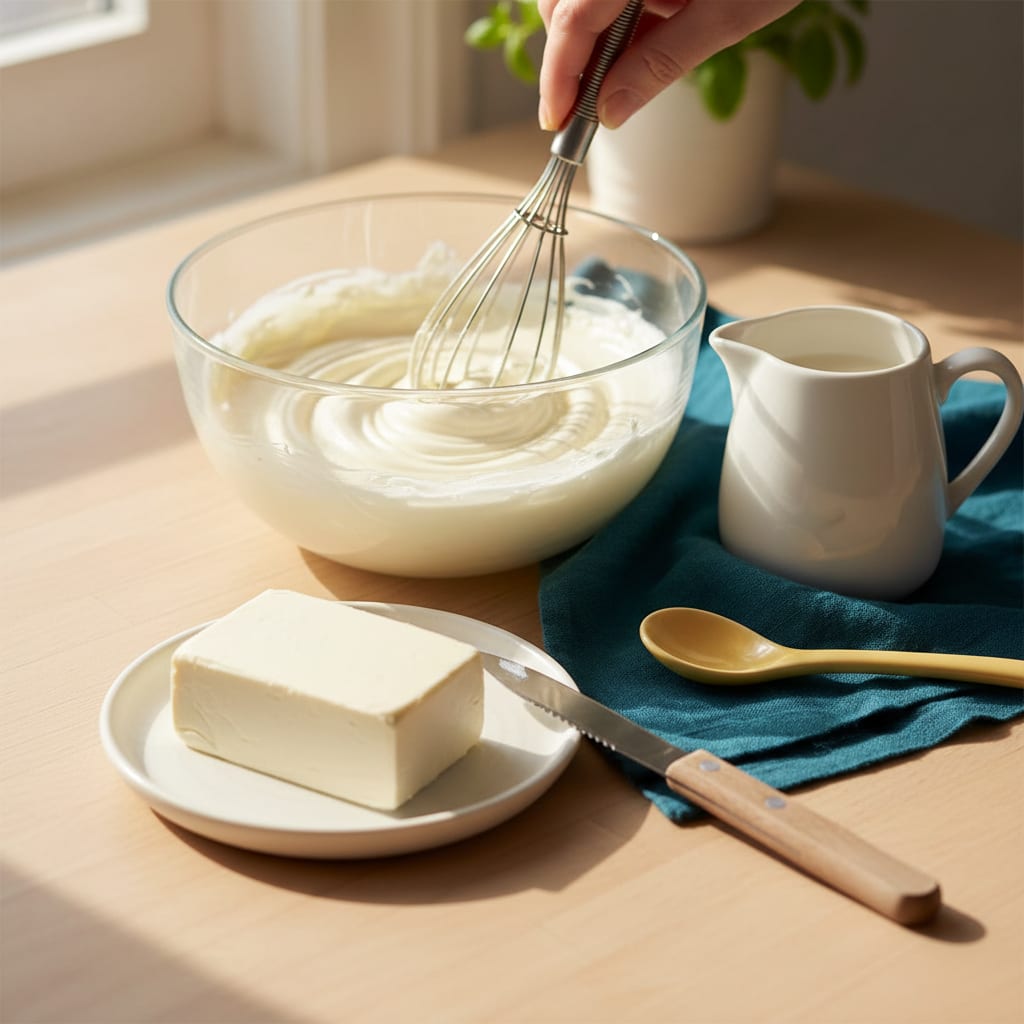
Yes, cream cheese freezes safely — but it splits. Thaw a frozen block and you get something grainy and slightly watery that will never spread on a bagel again. The National Center for Home Food Preservation lists cream cheese among the cheeses that “do not freeze well,” with one exception: combined with heavy cream, it freezes for later use in dips and frostings. So freeze it for cooked and blended jobs — pasta sauces, dips, cheesecake batter, frosting, soups — and it’s a genuinely useful thing to have in the freezer. Freeze it for toast and you’ve wasted a block.
We freeze it on purpose now, because cream cheese is always on offer in three-packs and always about to expire in ones.
Why it splits when other cheese doesn’t
Cream cheese is an emulsion — fat suspended in water, held together in a smooth soft gel. Hard cheddar has a firm protein structure that survives freezing in a crumbly-but-intact way. Cream cheese has no such scaffolding. When the water in it freezes, the crystals break the emulsion apart, and on thawing the fat and water are simply no longer combined. What you’re looking at in the tub isn’t spoilage. It’s a broken sauce.
That framing is useful, because broken sauces have a standard fix: heat and agitation. Which is exactly why cooked applications work and cold ones don’t.
How to freeze it properly
- Freeze it unopened in its foil wrapper, then slip the whole block into a freezer bag. The foil is already a good moisture barrier; the bag stops freezer smells.
- Opened blocks get double-wrapped — plastic pressed to the cut face, then foil or a bag.
- Portion a tub before freezing. Whipped and spreadable tubs suffer the most, so if you’re freezing one, spoon it into small containers or a silicone tray so you thaw only what a recipe needs.
- Label it, and plan to use it within about two months for best results. Like all frozen food, it stays safe far longer at 0°F — FoodSafety.gov notes that food held continuously at 0°F is safe indefinitely, and storage times are quality guidance.
- Thaw in the refrigerator overnight. Never on the counter, and never in the microwave, which cooks the edges and worsens the split.
Bringing it back together
Thawed cream cheese looks alarming and is mostly rescuable. Take the block out of the fridge, let it come to room temperature, and then:
- Beat it. A hand mixer on low, or two minutes of hard work with a fork or small whisk. Room-temperature beating re-emulsifies most blocks.
- Add a spoonful of liquid fat. A tablespoon of heavy cream or sour cream per block gives the emulsion something to rebuild around. This is the same logic NCHFP flags when it says cream cheese frozen with heavy cream works for dips and frostings.
- Warm it gently, don’t melt it. Ten seconds in the microwave at half power, then beat. Melting fully makes it soupy.
- Drain the free water first if there’s a visible pool, otherwise you’re beating extra liquid into a sauce that needed to be thick.
Perfect smoothness is not the goal. Restaurant-smooth is only needed for a bagel, and a bagel is the one job you’ve already given up on.
Where thawed cream cheese is genuinely fine
| Use | Works? | Notes |
|---|---|---|
| Cream cheese pasta sauce | Excellent | It melts into the sauce; nobody could tell |
| Baked dips (spinach-artichoke, buffalo chicken) | Excellent | Heat and stirring do the fixing for you |
| Cheesecake and baked bars | Very good | Beat it smooth first, strain if stubborn |
| Frosting | Good | Best if frozen with cream added, per NCHFP |
| Soups and chowders, stirred in | Very good | Adds body; texture is irrelevant once dissolved |
| Stuffed chicken, jalapeño poppers, filled pastries | Very good | Filling is baked |
| Scrambled eggs | Good | Small chunks melt in |
| Spread on a bagel or toast | No | Grainy and weepy; this is the deal-breaker |
| Cold no-bake cheesecake or icebox pie | No | Nothing heats, so nothing re-emulsifies |
| Piped decorative frosting | No | Won’t hold a sharp edge reliably |
Our cream cheese pasta — five ingredients, twenty minutes — is the single most useful destination for a thawed block, because the whole recipe is built on melting the cream cheese into pasta water anyway.
The freezer-shelf case for keeping some
Cream cheese is a fat, and fat is what protects other things in the freezer. A spoonful stirred into mashed potatoes before they’re frozen is the most reliable insurance against a grainy thaw, which is the whole argument in can you freeze mashed potatoes. It thickens a soup that came out thin. It turns frozen shredded chicken into a filling.
And if you’re freezing a block of cheddar in the same session, the rules are completely different — hard cheese comes back crumbly but usable cold, while cream cheese does not. We split them into two guides for exactly that reason; can you freeze cheese covers the block-and-shred side.
FAQ
How long does cream cheese last in the freezer?
Around two months for reasonable quality. It stays safe far longer at 0°F, but the split gets progressively harder to beat back together the longer it sits, and it picks up freezer odors through thin wrapping.
Can you freeze cream cheese frosting?
Yes, and it’s one of the better outcomes — frosting is already beaten full of fat and sugar, which stabilizes the emulsion. Thaw it in the fridge, then re-whip before using. Frosting already piped onto a cake freezes acceptably too; expect a slightly softer edge.
Why is my thawed cream cheese watery and lumpy?
The emulsion broke during freezing, which is normal rather than a sign it’s spoiled. Pour off the free liquid, bring it to room temperature, and beat it with a tablespoon of heavy cream. If it’s destined for a cooked dish, you can skip the rescue entirely.
Can you freeze a cheesecake?
Yes — baked cheesecake freezes very well, better than raw cream cheese does, because the eggs and sugar set the structure before it ever freezes. Chill it fully, wrap it twice, and thaw overnight in the fridge.
Can you freeze whipped or flavored cream cheese?
You can, but whipped tubs have air beaten into them and collapse on thawing, and flavored spreads with herbs, onion or smoked salmon separate further. If you must, freeze them in small portions and plan to cook with them rather than spread them.
✳ More From the Kitchen
Lunchbox & Kids
Lunchbox & Kids
Feeding a Crowd