Can You Freeze Mushrooms? Raw vs Cooked, Tested
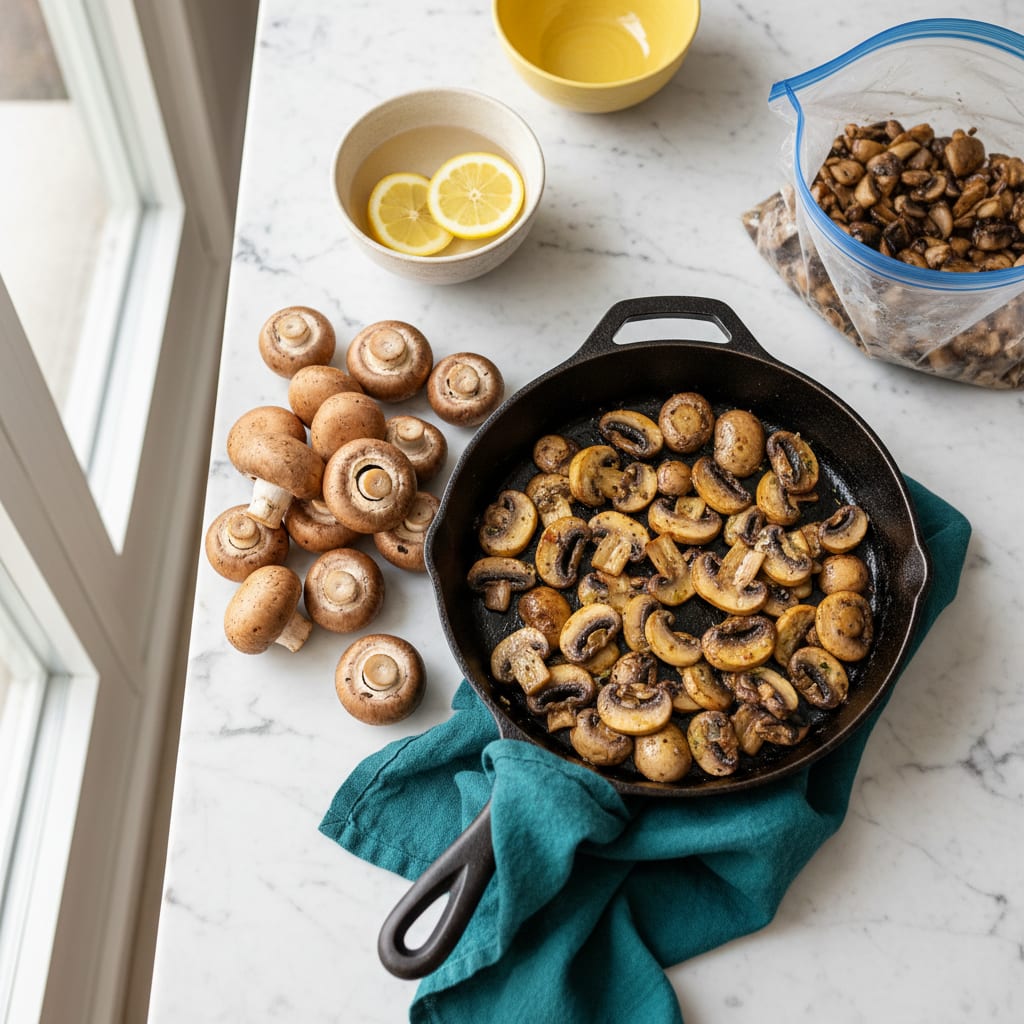
Yes, you can freeze mushrooms — but cook them first. Raw mushrooms are mostly water, and freezing them raw turns that water into ice crystals that wreck the structure; they thaw spongy, dark and weeping. Cook the water out first and the problem largely disappears. The two approved methods are sautéing them in butter or oil until almost done, or steam blanching, which the National Center for Home Food Preservation times at 5 minutes for whole mushrooms, 3½ minutes for buttons or quarters and 3 minutes for slices. Cool, pack, freeze. Then cook them from frozen forever after.
This is one of the best returns on ten minutes of work in the whole kitchen, because mushrooms go slimy in the fridge faster than almost anything else you buy.
Why raw ones disappoint
A mushroom’s texture comes from a delicate cell structure holding a great deal of water. Freeze that water and it expands into crystals that puncture the cell walls from the inside. Thaw it and the water runs straight out, taking the structure with it. What’s left is limp and grey.
You will find people who freeze raw sliced mushrooms and are perfectly happy. They’re usually throwing them straight into a soup or a slow cooker, where texture was never going to matter. That’s a legitimate shortcut — just make it a deliberate one. If the mushrooms are meant to be recognizable pieces in a stroganoff or on a pizza, cook them before they go in the freezer.
The sauté method (the weeknight default)
This is what we actually do, usually the evening a punnet is about to turn.
- Clean and trim. Wipe or rinse quickly in cold water, trim the stem ends, and slice or quarter anything larger than about an inch across.
- Cook them dry first. Hot pan, no fat, mushrooms in a single layer. They’ll release liquid and then reabsorb it. Wait for the pan to go dry again — that’s the water gone.
- Add the fat. Butter or oil, then cook until almost done. NCHFP’s version of this method says the same: heat small quantities in butter or margarine in an open pan until almost done. Leaving them slightly underdone means reheating won’t turn them to leather.
- Cool them fast. Spread on a plate or sheet pan, or set the pan in cold water. Don’t let hot mushrooms steam themselves in a closed container.
- Freeze flat in a bag, air squeezed out, or in portioned blocks. Freeze them loose on a tray first if you want to scoop out a handful at a time.
Season lightly or not at all. Salt draws out more water, and you’ll be seasoning the finished dish anyway.
The steam-blanch method (better for long storage)
NCHFP notes that steamed mushrooms hold their quality longer than those heated in fat, which makes this the method for a big haul you want to keep for months.
- Optional anti-darkening dip: 5 minutes in a solution of 1 teaspoon lemon juice (or 1½ teaspoons citric acid) per pint of water. This is what keeps them pale rather than grey-brown.
- Steam: whole mushrooms 5 minutes, buttons or quarters 3½ minutes, slices 3 minutes.
- Cool immediately in cold water, then drain thoroughly.
- Pack into containers leaving ½ inch of headspace, seal and freeze.
Full instructions and the reasoning behind the timings are on the NCHFP freezing mushrooms page, which is the source we use for every blanching time on this site.
Which mushrooms freeze best
| Mushroom | Freezes? | Notes |
|---|---|---|
| Button and cremini | Very good | The workhorses; sauté or steam, both fine |
| Portobello (sliced or diced) | Very good | Cook first; whole caps go floppy |
| Shiitake | Excellent | Sturdy and low-moisture; among the best |
| Oyster | Good | Sauté only; too delicate to blanch well |
| Enoki and other very fine varieties | Fair | Use them in broth after; they lose all bite |
| Wild mushrooms (chanterelle, morel) | Good | Always cook first — never freeze wild raw |
| Whole raw mushrooms in a bag | Poor | Spongy and dark on thaw; soup-only |
| Cooked mushroom sauce or duxelles | Excellent | Freezes beautifully; freeze in ice cube portions |
Quality holds for months, and safety isn’t the limiting factor: FoodSafety.gov is explicit that food stored continuously at 0°F stays safe indefinitely, so storage times are quality guidance. We aim to use ours within about six months, mostly because the freezer needs the space.
Cooking with them afterwards
Never thaw frozen mushrooms. Thawing gives them time to weep, which is the one thing you spent ten minutes preventing. Instead:
- Straight into a hot pan with butter, for the last few minutes of a skillet dinner.
- Straight into the pot for soups, chili, curries, stroganoff, ragù and anything braised.
- Straight into a rice pot. A handful of frozen sautéed mushrooms stirred into one-pot chicken and rice during the last five minutes is the easiest upgrade that dinner has.
- Onto a pizza frozen, spread thin so they don’t wet the base.
Mushrooms are a component, not a meal — the same shelf logic as frozen rice, stock and shredded chicken. Our freezer meal prep for beginners walkthrough sets up that whole rotation, and can you freeze cooked chicken covers the protein half of the same dinner.
FAQ
Can you freeze mushrooms without cooking them?
You can, and it’s safe, but the texture pays for it — raw frozen mushrooms thaw soft, dark and watery. Reserve that shortcut for mushrooms headed into soups, stews or slow-cooker dishes where they’ll break down anyway.
How long do frozen mushrooms last?
Best quality for roughly six months to a year depending on the variety and how well they’re wrapped, and they remain safe indefinitely at 0°F. Steam-blanched mushrooms hold quality longer than sautéed ones, which is the reason to blanch a big batch.
Do you need to wash mushrooms before freezing?
Yes, wash them in cold water and trim the stem ends — NCHFP’s instructions call for exactly that. The old warning about mushrooms absorbing water applies to soaking them for a long time, not a quick rinse before they’re cooked.
Why did my frozen mushrooms turn black?
Enzymatic browning, which happens when they’re frozen raw or blanched without an acid dip. The lemon-juice or citric-acid soak before steaming is what prevents it. Dark mushrooms are still safe to eat and disappear into a dark sauce.
Can you freeze mushroom soup or sauce?
Yes, and better than the mushrooms alone — cooked mushroom sauces and duxelles freeze very well. Cream-based mushroom soups can separate; freeze the base and stir the cream in when you reheat it.
✳ More From the Kitchen
Lunchbox & Kids
Kitchen How-Tos
Lunchbox & Kids