Baby-Led Weaning Dinner Running Late? A Bedtime Plan
When a baby-led weaning dinner runs long and pushes bedtime late, don’t speed the baby up. Move the meal instead. Start the baby’s part of dinner earlier, end it when they show you they’re full rather than when the grown-ups finish, and keep bedtime where it is by trimming the routine, not the meal. Self-feeding is slow by design, and the NHS advice for a new eater is to “allow plenty of time and let your baby go at their own pace”. So the time has to come from somewhere other than the high chair.
That is easier said than done when family dinner lands at six and your baby is asleep by seven. Here is how we would set the evening up so the slow meal and the early bedtime stop fighting each other.
Why baby-led weaning dinners take so long
Baby-led weaning means the baby feeds themselves from the start: soft finger foods on the tray, picked up, squashed, examined, dropped and occasionally eaten. A spoon-fed dinner is over when the bowl is empty. A self-fed one is over when the baby decides it is, and in the early weeks very little of it is about eating. The NHS says it outright: “how much your baby eats is less important than getting them used to the idea of eating.”
Two rules mean you can’t hurry it, and shouldn’t try:
- Go at the baby’s pace. The NHS tells parents to “go at your baby’s pace and let them show you when they’re hungry or full,” and never to force food. Popping pieces into a self-feeder’s mouth to move things along takes away the control that makes the method work.
- Someone stays at the table the whole time. “Always stay with your baby when they’re eating in case they start to choke.” No starting the bath with them still in the high chair, and no half-watching from the sink.
There is also a timing problem built into the evening. The NHS suggests picking a time for solids “when you do not feel rushed and your baby is not too tired”. For a lot of babies, six o’clock is neither.
Three ways to set up the evening
There’s no single right schedule. These are the three shapes that work in practice, and the times are only examples for a baby who goes down around 7.
| Setup | How it runs | Best when |
|---|---|---|
| Early family dinner | Everyone sits down around 5:00 to 5:15; the baby eats alongside you | Someone is home early enough to cook |
| Baby eats first, then joins you | Baby’s finger-food dinner at about 5:00; at the family meal they sit in with a few pieces to handle | The grown-ups can’t eat before 6 |
| Main solids meal at lunch | The long, exploratory meal happens midday; dinner is a short, familiar plate | The first weeks of weaning, or a baby who is tired by late afternoon |
The third is the one most people miss. Betteroo’s guide to starting baby-led weaning suggests beginning with one solid meal a day and building to two and three over the following weeks, and the NHS notes that babies starting solids “do not need 3 meals a day”. Nothing says that one meal has to be dinner. Put the long, messy meal where the day has room for it, and add dinner once your baby is a quicker, more confident eater.
The family meal still matters. The American Academy of Pediatrics’ starting solids guidance says that “when you can, the whole family should eat together”. The second setup keeps that: the baby is at the table, seeing how everyone else eats, even on nights their real dinner happened an hour earlier.
Make the baby’s plate the fastest thing you serve
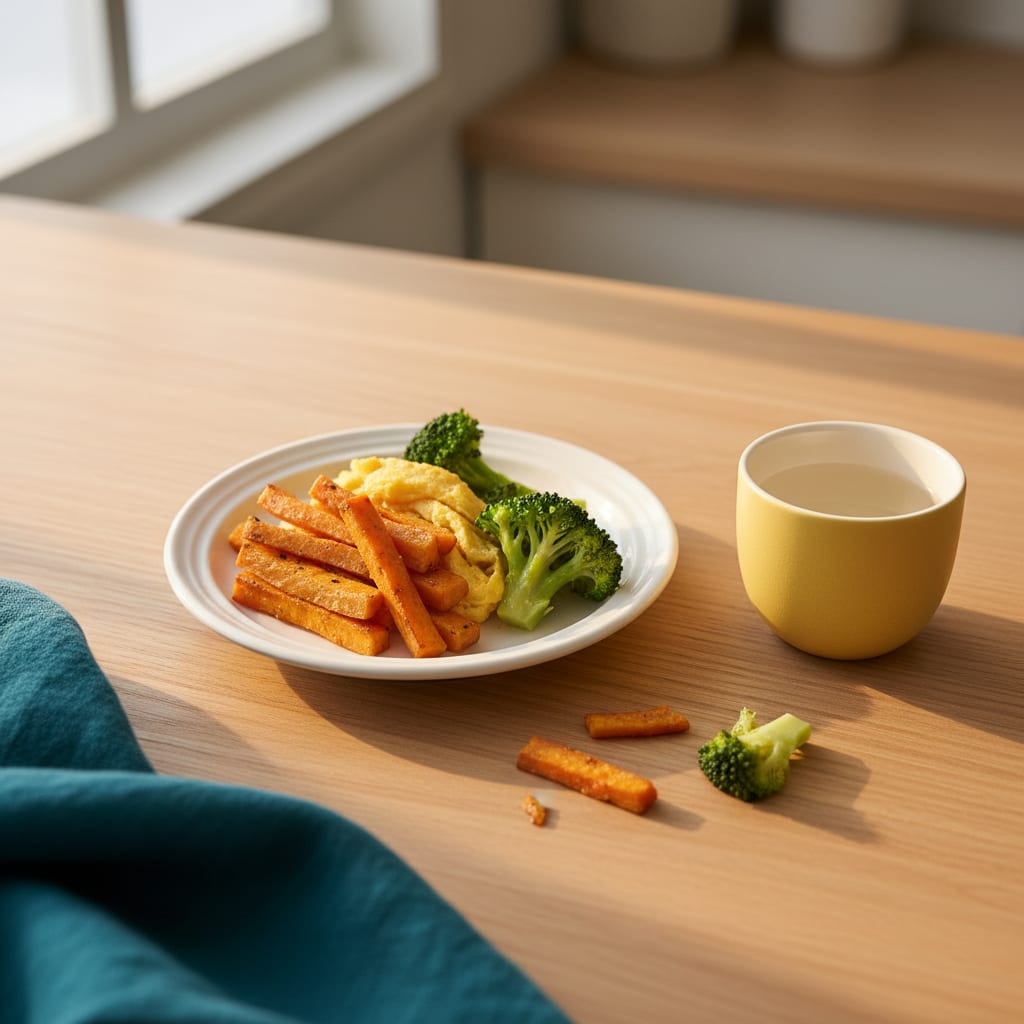
If the baby’s food is ready the moment they sit down, you skip the stretch of cutting and cooling that usually happens while they sit waiting in the high chair. Pull their portion from the family meal before any salt goes in. Our cooking dinner with a baby plan has the stove-side routine for that. Then cut it into the shape the NHS describes: pieces “about the size of your own finger”, long enough to stick out of a fist.
Dinners that give you finger food for free:
- Roast vegetable trays: sweet potato wedges, carrot sticks and broccoli florets with a stalk for a handle, roasted soft.
- Pasta nights: large pasta shapes, cooked soft, before the sauce goes on the grown-up pot.
- Chicken dinners: strips of soft, moist thigh meat, pulled before seasoning.
- Egg nights: a plain omelette cut into strips.
Do the cooling early too. The NHS says to “cool hot food and test it” before giving it to a baby, and a tray of food cools in minutes once it is spread out.
End the high chair when the baby is done
The grown-up meal and the baby’s meal don’t have to finish together. The NHS lists the signs that a baby has had enough, “firmly closing their mouth or turning their head away”, and says to stop when you see them. Pushing food aside and turning to look at everything else in the room usually mean the same thing.
That is the moment the baby’s dinner ends, even if yours has barely started. Wipe them down, lift them out, and let them sit on a lap or on a mat nearby while the table finishes. Keeping a full, tired baby in the high chair until the adults are done is how a short meal turns into a long one.
Cut the clean-up, not the routine
Baby-led weaning is messy, and the clean-up is the hidden cost on a late night. Three things shrink it:
- A long-sleeved bib such as the Bumkins Sleeved Bib, so pajama-ready arms stay clean.
- A suction plate, such as the ezpz Mini Mat, so less of dinner lands on the floor.
- A wipeable mat under the high chair, like the Bumkins Splat Mat, which turns floor-scraping into a shake over the bin.
Then decide whether tonight needs a bath at all. On a late night, a warm washcloth on face, hands and hair does the job. Our short bedtime routine covers what else you can drop when dinner runs over, and what you should never drop.
 Dinner keeps colliding with bedtime?
Betteroo builds an age-matched sleep schedule around your baby's naps and wake-up time, so you know when dinner has to land.
Take the sleep quiz →
Where the milk feed goes
Milk is still the main event at this age. The NHS says babies starting solids “will still be getting most of their energy and nutrients from breast milk or first infant formula,” so the bedtime feed stays, however dinner went.
A long dinner can quietly squeeze it, though. A baby who has grazed for a long time may take less milk, and a short feed before bed can mean an earlier waking. If you notice that pattern, leave a little more space between dinner and the bedtime feed. Our post on starting solids and baby sleep explains why a big late meal tends to make nights worse rather than better. The NHS is blunt on that point too: starting solid foods “will not make your baby any more likely to sleep through the night.”
FAQ
How long should a baby-led weaning meal take?
There is no set time. The NHS advice is to allow plenty of time and go at your baby’s pace, which makes self-fed meals slower than spoon-feeding. The useful limit is the baby’s own full signals: once they turn away or close their mouth, the meal is over.
Should I rush my baby’s dinner so they can get to bed on time?
No. Don’t feed a self-feeding baby faster or put food in their mouth to speed things up. Start the meal earlier instead, or move the longest meal of the day to lunchtime.
Can my baby eat dinner before the rest of the family?
Yes. Many families give the baby an early finger-food dinner and then sit them at the table with a few pieces during the family meal, so they still share it.
Should I give milk before or after baby-led weaning dinner?
At the start, the NHS suggests offering food before the usual milk feed, but not when your baby is very hungry. The AAP suggests a little milk first if hunger makes them frustrated. Either way, the bedtime milk feed still happens.
✳ More From the Kitchen
Kitchen How-Tos
Kitchen How-Tos
Freezer & Meal Prep