20-Minute Soups for Activity Nights That Protect Bedtime
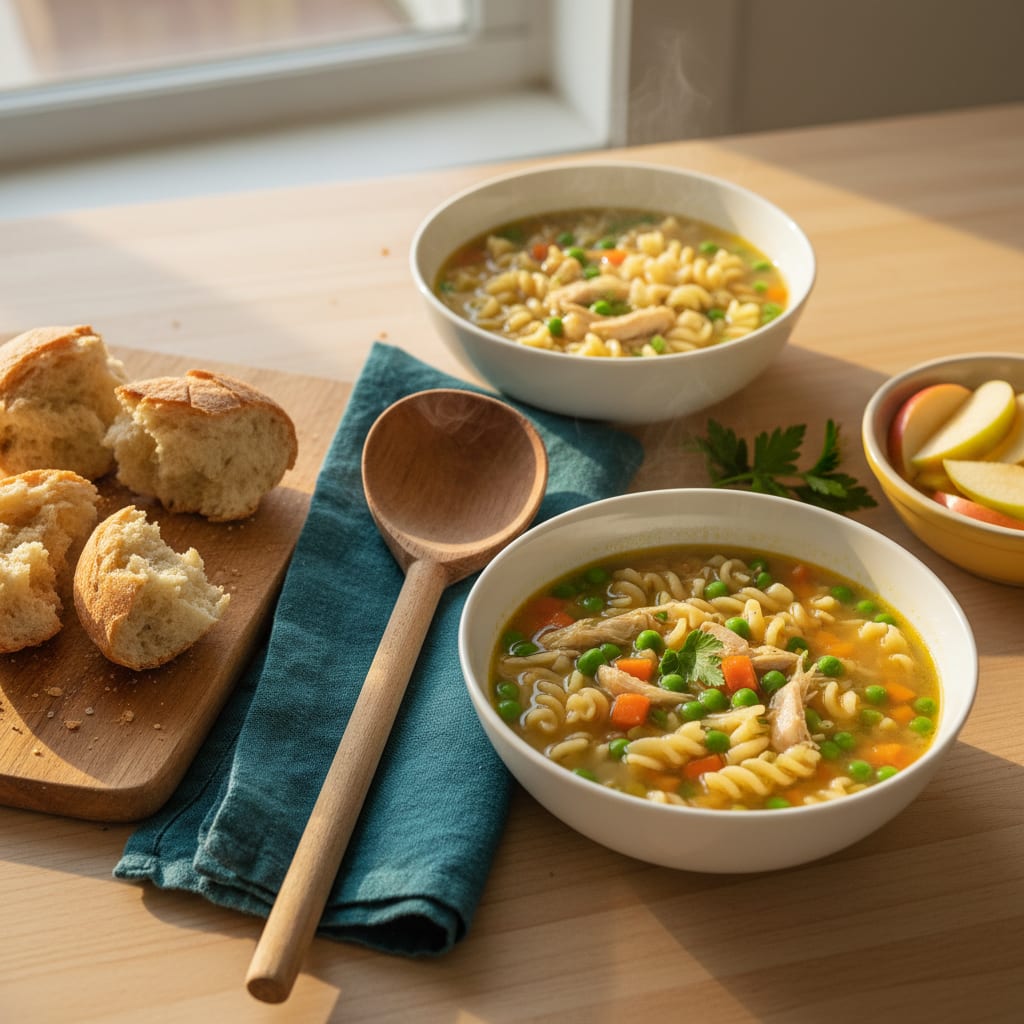
On an activity night, a 20-minute soup works because it is one pot, built from things that are already cooked, and it can be eaten early at the table or packed hot in a thermos for the car. Soften an onion for five minutes, add broth and a quick-cooking base, simmer ten minutes, stir in cooked protein and a handful of frozen vegetables, and serve. Then set the timing from bedtime, not from practice: eat before a late activity and keep the after-practice food to a light snack, so the evening ends at the usual lights-out time.
If tonight has already run late, our short bedtime routine is the rescue. This post is the dinner that stops you needing it every Tuesday and Thursday.
Why soup beats everything else on practice nights
Activity nights fail in two places: the 30 minutes before you leave, and the 30 minutes after you get home. Soup handles both.
- One pot, one spoon. Nothing to time against anything else, and only one pan to wash after bedtime.
- It holds. A pot of soup on low is still dinner 40 minutes later for whoever comes in last. A plated dinner is not.
- It travels. Soup is a food jar’s best case. Thermos lists soups, stews and chili first among the foods that hold heat well.
- It forgives timing. Two extra minutes on the stove never ruins it.
The 20-minute soup formula
Every soup below follows the same five steps. The times are our own weeknight numbers, not from any source, and where a step uses dried pasta or frozen tortellini, the package time wins over ours.
| Minutes | Step | What happens |
|---|---|---|
| 0 to 5 | Soften | A chopped onion (or a scoop of frozen diced onion) and a garlic clove in a little oil or butter |
| 5 to 8 | Boil | Add broth or stock and bring it to a boil with the lid on, which is faster |
| 8 to 18 | Simmer the base | Small pasta, tortellini, rice or canned beans, cooked to the package time |
| 18 to 20 | Finish | Stir in cooked protein and frozen vegetables, heat until steaming, taste for salt |
| 20 | Serve or pack | Ladle into bowls, or into a preheated food jar |
The trick is that nothing raw goes in at the end. The protein is already cooked (rotisserie chicken, precooked sausage, leftover meatballs, canned beans) and the vegetables are frozen, so the last two minutes are only about heating through.
Five activity-night soups
| Soup | Base | Protein, already cooked | Vegetables | Good for |
|---|---|---|---|---|
| Chicken noodle | Small pasta (stars, ditalini) | Pulled rotisserie chicken | Frozen peas and carrots | The child who eats only “plain” |
| Tomato tortellini | Frozen cheese tortellini in tomato broth | The cheese in the tortellini | A handful of baby spinach | Hungry swimmers |
| Black bean taco soup | Canned black beans and corn | Leftover taco meat or none | Canned diced tomatoes | Eating from a cup in the car |
| White bean and sausage | Canned white beans | Sliced precooked smoked sausage | Frozen green beans | A big appetite after soccer |
| Meatball and rice | Leftover rice, added at the end | Frozen cooked meatballs | Frozen mixed vegetables | Clearing out the fridge |
Two small things make these work on a weeknight. Cook the pasta in the soup itself rather than in a separate pot, and expect it to keep drinking broth as it sits, so add a splash of water when you reheat. If you’re feeding the whole team rather than your own family, our team snack guide covers the sideline side of things.
Eat before or after? Set it from bedtime
Start from the time your child needs to be asleep. Betteroo’s table of lights-out times by age and wake-up time puts a 6- to 8-year-old who wakes at 7:00 a.m. at lights out between 7:45 and 8:45 p.m. The same guide notes that ages 8 to 10 are when “activities, homework, and later bedtimes creep in”, and that many children quietly slip below 9 hours on school nights. Its kid-friendly version of the 10-3-2-1-0 rule asks for “a light snack rather than a big meal close to bed”.
So the meal goes wherever it leaves the most room before lights out. These are our own planning numbers for a child asleep by about 8:15:
| Activity runs | Soup | After the activity |
|---|---|---|
| 4:00 to 5:00 | At home, 5:30 | Straight into the routine at 7:30 |
| 5:00 to 6:00 | At home at 4:30, or from a thermos at 6:05 | A piece of fruit if they ask, then the routine |
| 6:00 to 7:00 | At home, 5:15, before you leave | Light snack only: toast, banana or yogurt |
| 6:30 to 7:30 | From a thermos at 5:45 in the car or the lobby | Light snack, teeth, a short routine |
For the late slots, the soup is the dinner and nothing heavy comes after it.
The thermos plan
A soup supper in the car works only if the soup is still hot when the lid comes off. Thermos’s own preheating guide gives the method:
- Heat the soup to above 165°F. It should be hotter than you would normally serve it.
- While it heats, fill the jar about three-quarters full with boiling water, cap it loosely and leave it for a full five minutes.
- Pour the water out and fill the jar with soup within 30 seconds, as close to the top as the portion allows, then seal it.
Done that way, Thermos rates its 10-ounce kids’ jar at up to 5 hours hot and its 24-ounce jar at up to 9 hours. That’s much longer than the 90 minutes between your stove and the pool. A 10-ounce Thermos Funtainer food jar is a child’s portion, and a 24-ounce Thermos Stainless King food jar holds enough for two children to share from cups. The same trick keeps a hot school lunch hot until noon.
One food-safety line matters here. NDSU Extension’s hot-and-cold guide sets the danger zone at 40 to 140°F and says food shouldn’t sit in it for more than two hours. If the soup comes out lukewarm rather than steaming, it has been cooling for a while, so don’t save the rest for later.
Leftovers for the next activity night
The pot you make on Tuesday can be Thursday’s dinner. Illinois Extension’s leftovers guidance says to refrigerate within two hours of serving, use leftovers within 3 to 4 days (or 3 to 4 months frozen), and reheat to at least 165°F. University of Minnesota Extension adds that hot food cools faster in shallow containers about 2 inches deep or less, so portion the soup out instead of putting the whole pot in the fridge. An instant-read thermometer settles the 165°F question in seconds.
 Busy week, same bedtime
Betteroo builds a sleep schedule around your child's age and real wake-up time, so you know when dinner has to be done on the nights you're out.
Take the sleep quiz →
FAQ
What is a quick dinner for sports practice nights?
A 20-minute soup made from cooked protein, a quick-cooking base and frozen vegetables. It’s one pot, it holds on low for whoever gets home last, and it packs hot in a preheated food jar if the family has to eat on the way.
Should kids eat before or after practice?
Set it from bedtime. If practice ends within about an hour of lights out, eat the soup before you leave and keep the after-practice food to a light snack. If it ends early, eat at home afterward as normal.
How do you keep soup hot in a thermos?
Heat the soup to above 165°F, preheat the jar with boiling water for five minutes, pour the water out and fill the jar with soup within 30 seconds, close to the top. A preheated jar stays hot for hours, much longer than a cold one.
Can I make the soup ahead for a second activity night?
Yes. Refrigerate it within two hours in shallow containers, eat it within 3 to 4 days, and reheat it to at least 165°F. Pasta soups thicken in the fridge, so add a splash of water or broth when you reheat.
✳ More From the Kitchen
Lunchbox & Kids
Lunchbox & Kids
Toddler Drinks Too Much Milk and Won't Eat Dinner? Start Here
Feeding a Crowd