Team Snack Ideas: Easy Snacks for 15+ Kids
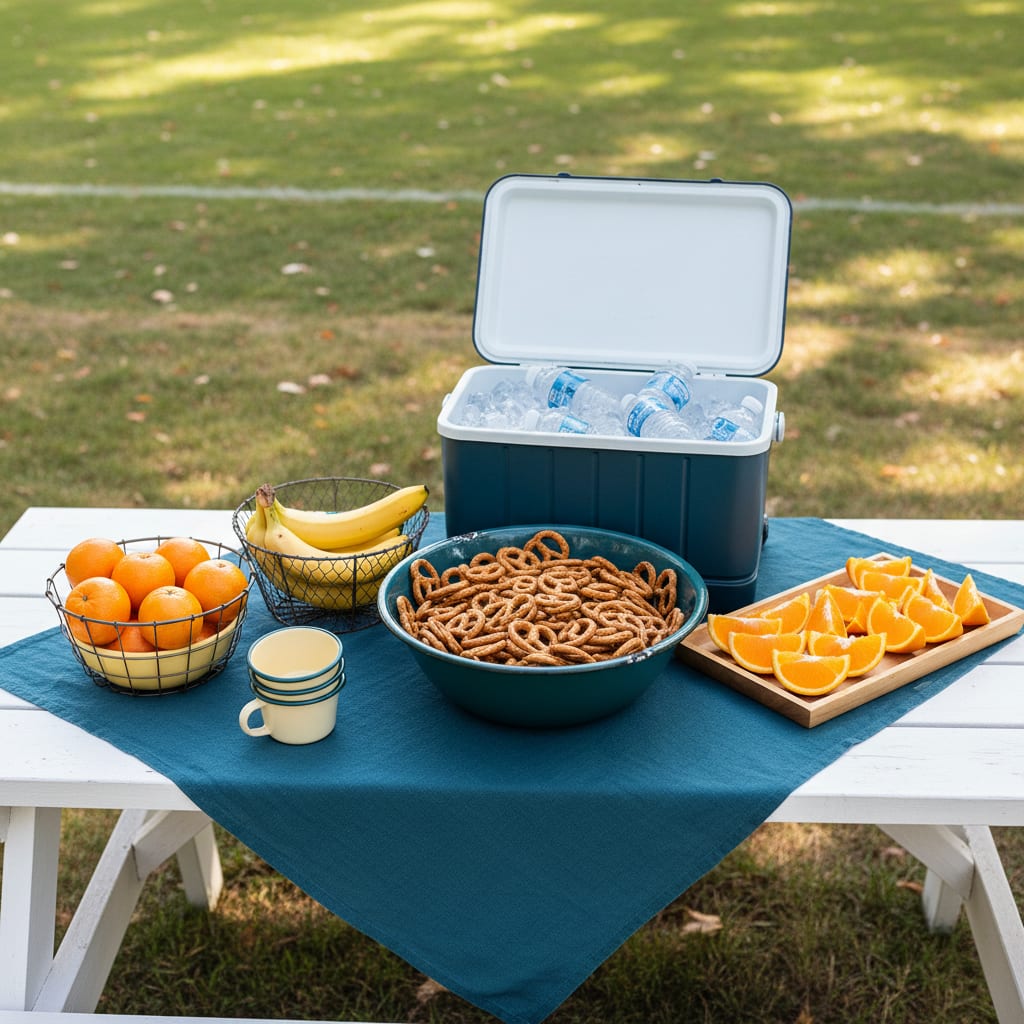
For a team of 15 to 25 kids, bring three things: something they can hold in one hand, one piece of whole fruit each, and more water than you think. Buy 1.5 servings per player, not one — siblings show up, and the kid who says no at half-time wants two after. Store-bought is completely fine and, for a group this size, usually safer than homemade. Nothing that needs a plate, a fork, or refrigeration past the drive home. That’s the whole job.
Snack duty gets treated like a test of parenting. It isn’t. It’s a logistics problem with a known answer.
How much to buy per player
Quantities are where snack duty actually goes wrong — either you bring one flat of clementines for 22 kids, or you bring enough for a wedding. Here’s what a group this size actually eats, assuming one snack moment (after the game, most commonly) plus stragglers.
| Item | 12 kids | 15 kids | 20 kids | 25 kids |
|---|---|---|---|---|
| Whole fruit (clementines, bananas) | 18 | 22 | 30 | 38 |
| Orange or watermelon wedges | 2 lbs | 2.5 lbs | 3.5 lbs | 4 lbs |
| Pretzels or crackers, in cups | 18 cups | 22 cups | 30 cups | 38 cups |
| Individual bars or bags | 18 | 22 | 30 | 38 |
| Water bottles | 20 | 24 | 32 | 40 |
| Small paper cups (if pouring) | 24 | 30 | 40 | 50 |
The 1.5× multiplier covers three predictable leaks: younger siblings on the sideline, kids who lose a snack in the grass, and coaches. If you’re the parent who hates leftovers, buy 1.25× on the fruit and 1.5× on the shelf-stable items — the crackers keep, the bananas don’t.
For the same math applied to a bigger, sit-down group, our feeding a group guide runs the per-person numbers on real meals rather than snacks.
Twelve snacks that survive a sideline
The test for a team snack is narrow: one hand, no utensils, no melting, no chilling, and no crumbs that end up inside a soccer bag. These clear it.
- Clementines — peel-and-go, no knife, no juice down a jersey.
- Bananas — the fastest calories on the list, though they bruise in a bag.
- Watermelon or orange wedges in a lidded tub, cut that morning.
- Pretzels portioned into cups — salt after a hot game is genuinely welcome.
- Goldfish-style crackers or plain saltines in small bags.
- Cereal bars or granola bars, one per kid, still wrapped.
- Rice crispy treats, homemade or bought, cut small.
- Popcorn, bagged in individual portions.
- Applesauce pouches — no spoon, no bowl, nothing to spill.
- Cheese sticks, if the drive is short and you have a cooler.
- Grapes, halved lengthwise for anyone under four on the sideline.
- Freeze pops for genuinely hot days — messy, and worth it anyway.
Notice how few of those require any cooking. That’s deliberate. Our after-school snack system works on the same principle at home: the snack that gets eaten is the one that needs zero assembly.
Allergy rules that actually keep everyone safe
You do not need to memorize every kid’s medical history. You need three habits.
Default to nut-free. Peanuts and tree nuts are the allergens most likely to be present and most likely to be severe, and a sideline is not a place anyone wants to test that. Skip trail mix, nut butter bars and anything “may contain.”
Read the actual package, every time. The FDA requires the nine major food allergens — milk, eggs, fish, crustacean shellfish, tree nuts, peanuts, wheat, soybeans and sesame — to be declared in plain language on labeled packaged food. That declaration is on the box in your hand, and formulations change between brands and even between flavors of the same brand.
Keep the packaging. Bring the box or bag to the field rather than decanting everything into unmarked containers. If a parent needs to check something, they can read it themselves in ten seconds, which is faster and more reliable than you remembering.
Homemade is where this gets hard: a tray of cookies has no ingredient list, so a parent managing a serious allergy has to decline it. For 15-plus kids, store-bought and sealed is the kinder choice, not the lazy one.
When to hand it out
Half-time and after the game are different jobs.
At half-time, kids mostly need fluid and something very light — orange wedges are the classic for a reason. A full snack at half-time sits heavily and comes back up on a sprint.
After the game is when the real snack lands, and it’s also when the group is at its largest and least organized. Set up on the tailgate or a folding table, put the trash bag out before you hand out a single thing, and let kids come to you rather than walking a tub down a line of twelve.
If you’re running a longer tournament day rather than a single game, the packing logic changes completely — that’s cooler territory, and our picnic food that survives the cooler covers what holds up over several hours in a hot car.
Packing the bag the night before
- One tub of cut fruit, one bag of shelf-stable snacks, one flat of water. Three items, three hands.
- Trash bag and wet wipes on top, where you’ll find them without unpacking.
- A small cooler only if you’re bringing cheese or anything with dairy; ice packs frozen solid the night before.
- Portion into cups or bags at home, not on the sideline. Twenty-two cups take four minutes at your counter and fifteen minutes in a wind.
FAQ
How much snack should I bring for a team of 20?
Plan on 30 servings — roughly 1.5 per player. That covers siblings, coaches and the kids who come back for a second. Buy shelf-stable items at the full 1.5×, and cut back slightly on fresh fruit if you’d rather not carry leftovers home.
Is store-bought okay for team snack?
Yes, and for a group of 15 or more it’s usually the better call. Sealed packaging carries an ingredient list, which is what a parent managing an allergy needs. Homemade treats are lovely for a party where families know each other; they are hard to serve safely to a whole roster.
What snack should I bring for half-time?
Something light and wet — orange or watermelon wedges, plus water. Save the bar or the crackers for after the final whistle. A heavy snack at half-time tends to come straight back up once the running starts again.
What’s the safest team snack for allergies?
Whole fruit. A clementine or a banana has no label to read and no cross-contamination risk. After that, plain pretzels or a simple cracker from a sealed box, with the packaging brought along so parents can check it themselves.
Do I need to bring drinks too?
Bring water, and bring more than the roster count. Most kids arrive with a bottle and roughly a third of them will have lost it, emptied it, or left it in another car by the end of the game.
✳ More From the Kitchen
Lunchbox & Kids
Freezer & Meal Prep
Kitchen How-Tos