How Long to Boil Cabbage: Wedges, Shreds and Frozen
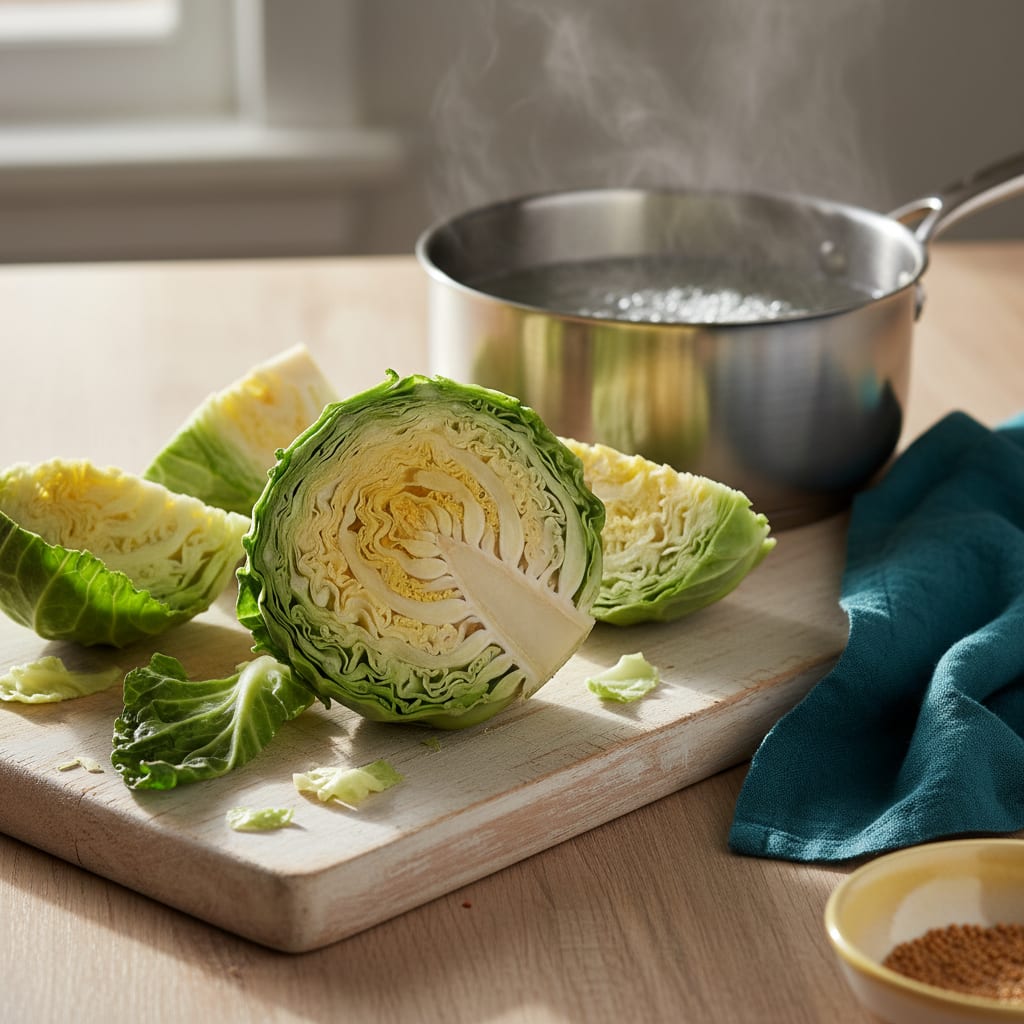
Boil cabbage wedges for 10 to 15 minutes and shredded cabbage for 3 to 8 minutes. Purdue Extension’s FoodLink gives 10 to 15 minutes for cut cabbage on the stove top, and University of Maine Extension Bulletin #4182 splits the same vegetable by cut: wedges “ten to 15 minutes,” shredded “three to eight minutes.” That is not two sources contradicting each other. It is one vegetable behaving like two different ones depending on how you cut it — and the piece that decides which is the core.
The chart
| Cut | Boiling time | Best for |
|---|---|---|
| Fine shreds | 3–5 min | Buttered cabbage, a stir-through, noodles |
| Coarse shreds | 5–8 min | A side dish with body |
| Thick slices, 1 inch | 8–10 min | Cabbage that still holds a shape on the plate |
| Wedges, core trimmed | 10–12 min | Corned beef, boiled dinners |
| Wedges, core left in | 13–15 min | The same, if you want the wedge to stay together |
| Whole leaves for rolls | 3–4 min | Softening leaves to roll and stuff |
| Frozen cabbage | 4–6 min from frozen | Cooked dishes only (see below) |
Start counting when the water returns to the boil.
The core is what sets the clock
Cut a cabbage in half and look at the cross-section. The leaves are thin — a couple of millimetres of wet, loose-packed tissue that cooks almost instantly. The core is a solid white cone, as dense as a raw turnip, and it runs a third of the way up the head.
That is the entire five-minute spread in the chart above. A wedge is mostly leaf with a wedge-shaped piece of core holding it together at the base, so the leaves are done at four minutes and the core is done at thirteen. Shreds contain almost no core, because Purdue’s own preparation note says to slice from the outside and “do not eat or slice into the core” — so shreds are done as soon as they go limp.
You get to choose which problem you have:
- Leave the core in and the wedge stays intact on the plate, which is what you want under corned beef or in a boiled dinner. Budget 13 to 15 minutes and accept that the outer leaves will be very soft.
- Trim the core down to a thin triangle — enough to hold the wedge together, not enough to need its own cooking time — and the whole wedge finishes at 10 to 12 with far better texture.
- Cut the core out entirely and slice the leaves, and you are in the 3-to-8-minute world.
Nothing else about boiling cabbage is difficult. This is the decision.
The smell is a timer, not a property
Maine’s bulletin is unusually blunt about why boiled cabbage has a reputation: “Brussels sprouts and cabbage contain the mineral sulfur. When these vegetables are cooked, the sulfur is released and an unpleasant odor is produced. The longer you cook these vegetables, the more sulfur is released. To reduce the smell, cook vegetables quickly.”
So the kitchen filling with that smell is not cabbage being cabbage. It is a clock running past where it should have stopped, and it is the single most reliable sign that the pan is two or three minutes overdue. It is the same relationship we describe with broccoli’s boiling times, and the fix is identical: less time, not more ventilation.
Two practical consequences. Boil cabbage in a wide pan with the lid off or ajar for shreds, so steam carries the sulphur compounds out rather than condensing back in. And never hold boiled cabbage warm for half an hour — cook it last, or cook it early and reheat it briefly.
Red cabbage needs acid
Red cabbage boiled in plain water turns a dispiriting blue-grey, because its pigment shifts colour with pH. Maine’s instruction for microwaved red cabbage is to “add two teaspoons of vinegar,” and the same trick works in a boiling pan: a splash of vinegar or lemon juice in the water holds the colour red.
Add it at the start, not the end. A tablespoon of cider vinegar per large pan is plenty, and it makes red cabbage taste more like itself.
Cabbage in a corned beef pot
The classic method — cabbage in with the meat for the last stretch — works, with one caveat that catches people out. The meat pot is already salty and already at a rolling boil, and a rolling boil shreds cabbage leaves apart.
Drop the heat to a bare simmer before the wedges go in, give them 12 to 15 minutes with the core left in so they hold together, and lift them out with a slotted spoon rather than pouring the pot through a colander. If you are timing a whole plate around this, our notes on keeping food warm for a party cover the holding problem; cabbage is the dish to cook last.
Frozen cabbage is for cooked dishes only
The National Center for Home Food Preservation is explicit in its freezing-cabbage instructions: frozen cabbage is “suitable for use only as a cooked vegetable,” and it goes into the freezer after a water blanch of just 1½ minutes.
Two things follow. Frozen cabbage will never be coleslaw — the cell walls are gone and it thaws limp. And because it arrives with 90 seconds of cooking already done, it needs only four to six minutes in boiling water from frozen. We go into the whole picture in can you freeze cabbage, including why the blanch is not optional.
How much to buy
A medium head of green cabbage runs around two to three pounds and serves six to eight as a boiled side, because cabbage collapses to roughly half its raw volume. A pound feeds two or three.
Buy heads that feel heavy for their size — Maine’s selection advice is “solid, fresh-looking heads that are heavy for their size” with smooth outer leaves — because a light head is a dry one, and dry cabbage boils to nothing.
FAQ
How long do you boil cabbage wedges?
Ten to 15 minutes, depending on how much core you left in. Trim the core to a thin triangle and 10 to 12 is enough; leave it whole and you need the full 15.
How do you know when boiled cabbage is done?
A knife tip should go through the thickest part of a wedge with only slight resistance, and shredded cabbage should be limp but not translucent. Translucent, grey-green and strong-smelling means you went past it.
Should you boil or steam cabbage?
Both work and the times are similar. Boiling is faster and better when the cabbage is joining a pot of something else; steaming holds the shape of wedges more reliably and keeps the colour brighter.
Can you boil cabbage ahead of time?
You can boil it, drain it and refrigerate it, then reheat briefly in butter — but do not hold it hot. Cabbage held warm keeps cooking and keeps releasing the sulphur smell.
Do you cut the core out before boiling?
For shreds, yes, always. For wedges it is a trade-off: the core is what stops the wedge falling apart, so trim it thin rather than removing it.
✳ More From the Kitchen
Lunchbox & Kids
Freezer & Meal Prep
Freezer & Meal Prep