Can You Freeze Yogurt? Yes — But Not Back Into Yogurt
Yes, you can freeze yogurt — it stays perfectly safe — but you will not get yogurt back. Thawed yogurt weeps a pool of thin whey and turns grainy underneath, and no amount of stirring makes it smooth enough to eat off a spoon again. So the useful question isn’t can you, it’s what are you freezing it for. Freeze it as smoothie cubes, as baking portions, as marinade portions, or as a frozen snack — decide before it goes in, and the texture problem stops being a problem.
That reframe is the whole post, and it’s what separates yogurt from most things in the freezer.
What actually happens to cultured dairy in the freezer
Yogurt is a protein gel holding water in place. Freeze it and that water crystallises, the crystals shove the protein network aside, and when it melts the network can’t take the water back. What you get is curd and whey in two layers.
There’s no way to talk around how the food-preservation people rate this. The National Center for Home Food Preservation doesn’t publish a yogurt page at all — the nearest thing it covers is sour cream, and its verdict there is flat: “Sour cream should not be frozen. Freezing causes the sour cream to separate, and it will not blend back together acceptably.” Yogurt is the same category of food and behaves the same way. We wrote up that verdict in full in our sour cream post.
Safety is a separate question and a much easier one. FoodSafety.gov is clear that “frozen foods stored continuously at 0°F (-18°C) or below can be kept indefinitely,” and its freezer timings are “for quality only.” Frozen yogurt is not going to hurt anyone. It’s just going to disappoint anyone expecting a smooth bowl.
One practical note before you start: don’t freeze it in the pot it came in. UGA’s Cooperative Extension is blunt about this — “many plastic containers foods are packaged in for purchase, like yogurt, dips and sour cream, do not provide characteristics for preserving quality in the freezer,” because they’re display packaging, not a moisture-vapour barrier. Move it.
Freeze it in the shape you’re going to use it
This is the part that turns a texture failure into a system. Pick the destination first.
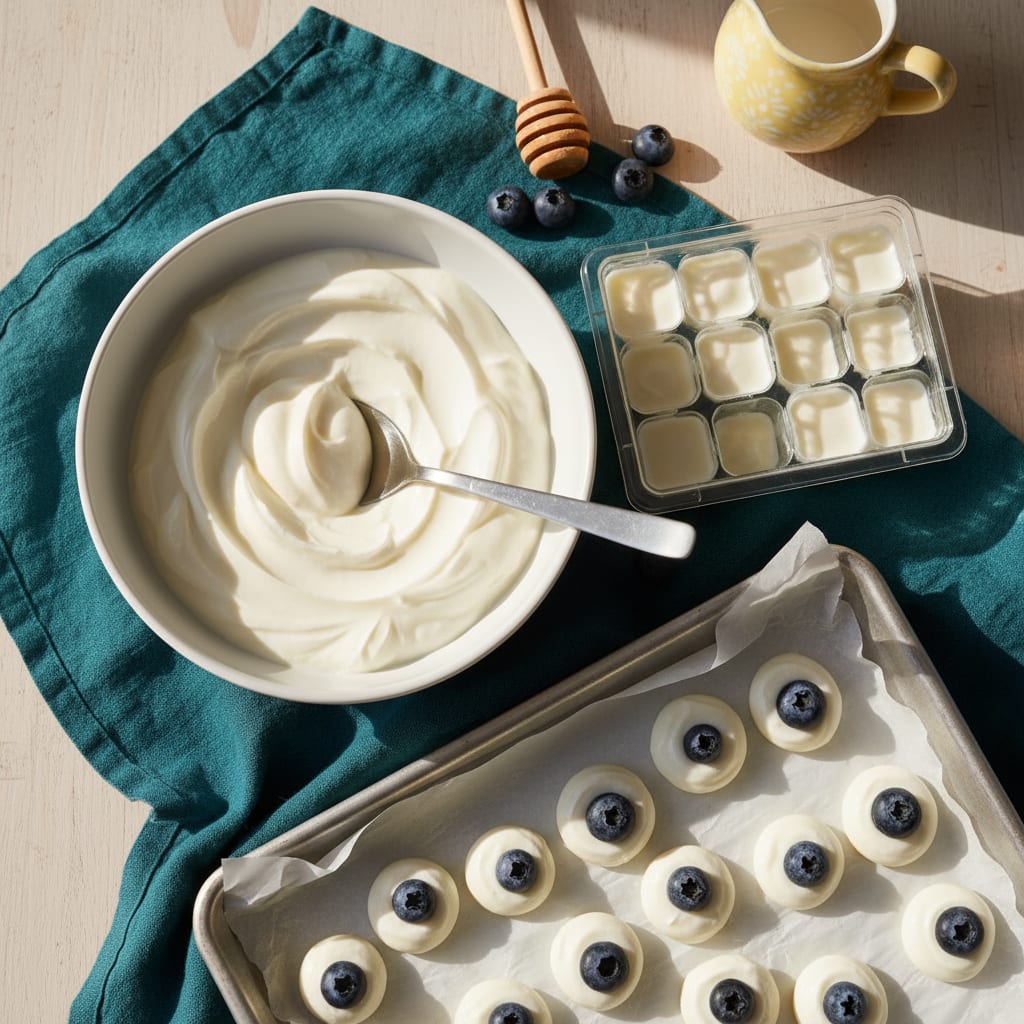
- Ice cube tray, for smoothies. Two tablespoons per well, frozen solid, then popped out into a bag. Each cube is roughly one smoothie’s worth of tang and thickness, and because it goes into a blender the graininess is irrelevant. This is far and away the highest-value version, and it slots straight into a freezer smoothie pack routine.
- Half-cup portions, for baking. Yogurt in pancakes, muffins, soda bread and marinades is being beaten into a batter or rubbed onto chicken, so separation doesn’t matter at all. Freeze it in the quantity your recipe asks for so you’re not chiselling.
- Flat in a bag, for cooking. Press a cup of yogurt flat in a freezer bag, squeeze the air out, and freeze it lying down. It thaws in twenty minutes and goes into curries, soups and dressings where it’s about to be stirred into something hot anyway.
Whichever you use, label the quantity — a frozen white puck tells you nothing about whether it’s a quarter cup or a cup.
The version kids will actually eat
Frozen yogurt drops are the one case where the texture change is a feature rather than a compromise, and they’re a genuinely good after-school food.
Pipe or spoon small blobs of thick yogurt onto a parchment-lined tray, add a berry or a smear of jam if you like, and freeze until firm. Lift them off, bag them, and keep them in the door of the freezer. They’re eaten straight from frozen, in a couple of bites, with no thawing step where the texture can go wrong.
The same idea spread thin across the tray gives you yogurt bark — a sheet about a quarter-inch thick, scattered with fruit, frozen solid and then snapped into shards. Both belong on the same shelf as the rest of our grab-it-yourself snack ideas, and both are considerably less sweet than anything from the freezer aisle.
Thawing it, and what it’s good for afterwards
Thaw in the fridge overnight, never on the counter and never in the microwave — warm yogurt splits harder and faster.
You’ll open the container to a layer of clear-ish liquid on top. Don’t pour it off; that’s whey and it carries most of the tang. Whisk it briskly back in, or give it a few seconds with a stick blender, and it’ll come back together enough to cook with. It will still be looser and slightly chalky compared to fresh.
Good uses for thawed yogurt: marinades, curry and dal finishes, salad dressings, pancake and muffin batters, soda bread, tzatziki-style dips where cucumber is adding water anyway. Bad uses: a bowl with granola, anything you’re serving cold and plain, and anything where it’s the star.
If you’re cooking with it in a hot pan, stir it in off the heat or at a bare simmer. Thawed yogurt curdles more readily than fresh, and boiling it will finish the job.
Which yogurts hold up best
Full-fat Greek yogurt is the clear winner, because most of the whey was already strained out before you bought it — there’s less water present to separate in the first place. Regular full-fat plain is next. Low-fat and non-fat separate the most, since water is a larger share of what’s in the pot.
Flavoured and fruit-on-the-bottom yogurts freeze into something distinctly icy, though for drops and bark that hardly matters. For anything you plan to thaw and cook with, buy plain and add flavour on the other end.
For where yogurt sits against everything else you’ve got frozen, our storage chart by dish type has the comparison.
FAQ
How long can you freeze yogurt?
Indefinitely as a safety matter, at a steady 0°F. For quality, treat a month or two as the sensible window — beyond that the ice crystals get coarser and the thawed texture gets worse, which is the thing that was already the weak point.
Does freezing yogurt kill the live cultures?
We couldn’t find an authoritative food-science source that puts a number on this, so we’re not going to invent one. What is well established is the texture outcome, and that’s the thing that decides how you should use it.
Can you freeze yogurt in the container it came in?
Better not to. UGA Extension notes that the plastic pots yogurt, dips and sour cream are sold in aren’t built to preserve quality in the freezer. Move it into a freezer bag, a rigid freezer container or an ice cube tray.
Why is my thawed yogurt watery?
Because ice crystals broke the protein gel that was holding the water, and the gel can’t reabsorb it. Whisk the liquid back in rather than draining it off, and use the result in cooking rather than eating it cold.
Can you refreeze yogurt after thawing it?
You can safely if it stayed cold, but there’s no reason to — the second thaw is noticeably worse than the first. Freeze it in the portion size you’ll use in one go instead.
✳ More From the Kitchen
Lunchbox & Kids
Lunchbox & Kids
Lunchbox & Kids