Can You Freeze Bacon? Yes — But Only for a Month
Yes, you can freeze bacon — but plan on weeks, not the six or nine months you’d give plain pork. The National Center for Home Food Preservation says the Food Marketing Institute “recommends that unopened bacon only be frozen up to one month,” and NCHFP’s own ceiling is “1 to 3 months for bacon and cured meats.” FoodSafety.gov’s cold-storage chart gives bacon one week in the fridge and one month in the freezer.
That’s a much shorter clock than most freezer advice, and it isn’t a safety limit. It’s a flavor one — and it’s worth understanding, because it changes how you buy bacon.
Why cured meat has a short freezer life
Most freezer windows are about ice damage and freezer burn. Bacon’s is about fat going off.
NCHFP puts the mechanism plainly: “cured meats have a short shelf life, even in the freezer, because of the high fat content and the development of rancid flavors,” and “the presence of the curing salts hastens its development.” Rancidity is oxidation of fat, and unlike bacterial spoilage it doesn’t need warmth — it carries on slowly at 0°F. Bacon is roughly half fat and heavily salted, so it has both accelerants built in.
What you get is not dangerous, just unpleasant: a stale, cardboard-ish, faintly metallic edge that no amount of maple syrup covers. NCHFP’s summary is that “the longer you store it, the more the quality and flavor will deteriorate.”
Two practical consequences. First, air is the enemy more than usual here — oxygen is literally the reactant, so the difference between a well-sealed package and a loose one is bigger for bacon than for cooked chicken. Second, buying a warehouse-sized bacon multipack to freeze is a worse deal than it looks, because a fair share of it will taste tired before you get to it.
Freezing an unopened package
This is the easy case, and NCHFP’s instruction is one line: “overwrap the store package with heavy duty foil or other freezer wrapping, being sure to push all the air out of the package and tightly close the wrapping around the inside package.”
The store film is a display wrap, not a freezer wrap — it’s thin, it’s oxygen-permeable, and it usually has a pocket of air in it. Foil or a freezer bag over the top, air pressed out, buys you the storage window the sources describe. Freeze it quickly, at 0°F or lower.
The catch is that a frozen one-pound brick of bacon is all-or-nothing. If you cook bacon a few slices at a time, split it before it goes in.
Freezing bacon you’ve already opened
NCHFP is specific about timing: “remove the portion you want to freeze from the package as soon as you open it,” then “wrap the portion for freezing in heavy duty freezer plastic wrap or bags, making the package air-tight.” Not after breakfast — before, while the rest is still cold and untouched.
The three ways to split a pound so you can take what you need:
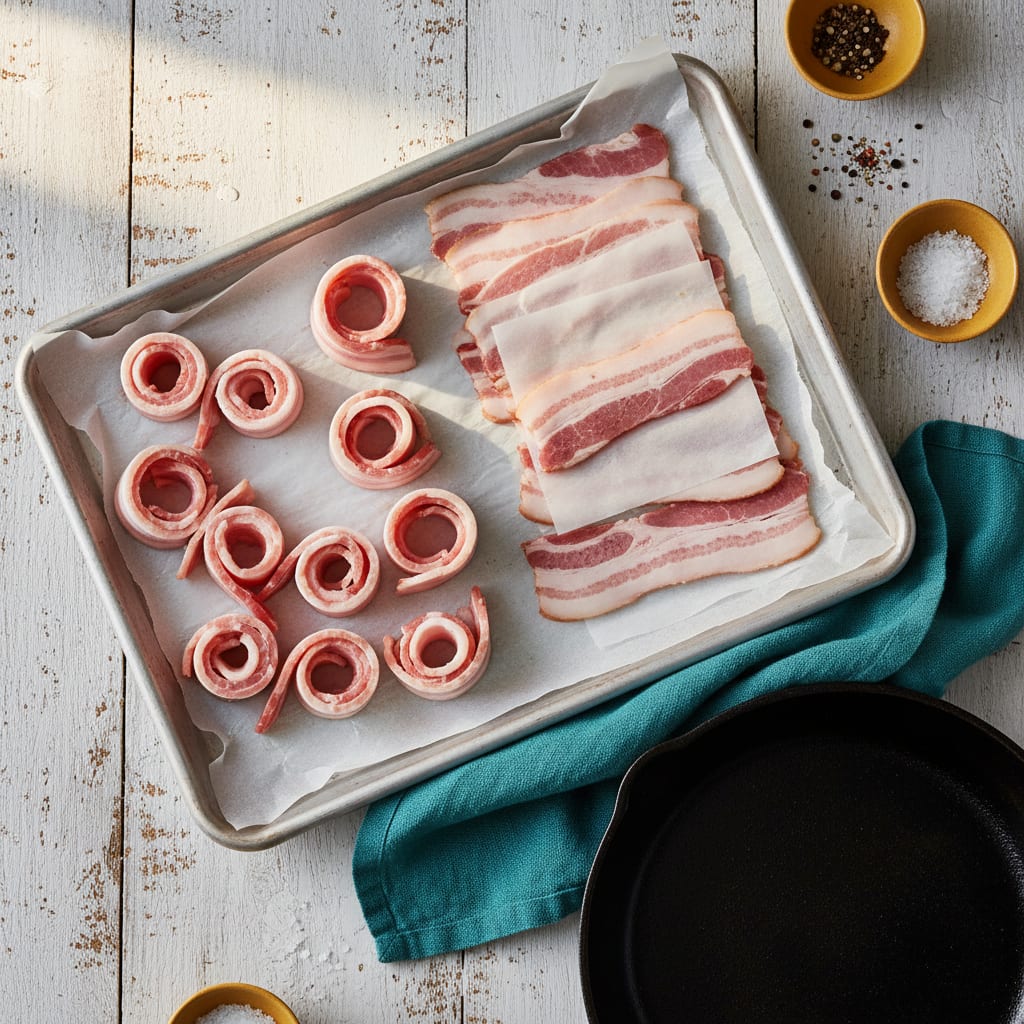
- Rolled coils. Roll each slice into a loose spiral, sit them in a single layer in a bag, and freeze. They separate with your fingers and unroll as they warm in the pan. This is the best method for a family that cooks two slices at a time.
- Parchment-layered stacks. Lay four or six slices flat, a strip of parchment or wax paper between each layer, and wrap the stack tight. Good for a whole breakfast’s worth at once.
- Chopped lardons. Dice raw bacon, tray-freeze the pieces loose for an hour, and bag them. A frozen handful goes straight into a pan of soup, a carbonara or a pot of beans with no thawing and no chopping. Honestly the highest-value version for weeknight cooking.
Whichever you pick, press the air out hard and double-bag if the freezer is busy. Bacon smoke is volatile and will find its way into ice cream.
Cooked bacon freezes better than raw
If you have the choice, cook it first. Cooked bacon has had most of its water driven off, and rendered fat sitting outside the meat oxidizes more slowly than the fat marbled through a raw rasher. Cooked strips also reheat in about a minute.
Cook a whole pack on a sheet pan in the oven, drain the strips well on paper towel, cool them completely, then freeze flat in a bag with parchment between the layers. Reheat in a dry pan, a hot oven, or twenty seconds in the microwave. Bring leftovers up to a proper steaming-hot reheat rather than a lukewarm one.
This is the version worth building into a make-ahead breakfast rotation. Cooked bacon crumbles into freezer breakfast burritos without adding a wet ingredient, and it’s the fastest way to put protein on the plate for a breakfast-for-dinner night.
Cooking raw bacon from frozen
You can, though a frozen slab wants to be separated first. Ten minutes on the counter or a few seconds in the microwave is usually enough to prise the slices apart — after that, lay them in a cold pan and bring the heat up slowly. Starting in a cold pan gives the fat time to render before the meat seizes, which matters more with frozen bacon than fresh.
Rolled coils and diced lardons go into the pan frozen with no preamble at all. Expect a little more spitting as the surface ice hits hot fat, and a slightly longer cook.
For where bacon sits against everything else in the freezer, our storage chart by dish has the comparison — bacon is genuinely near the bottom of the list, and it surprises people every time.
FAQ
How long can you freeze bacon?
One month is the figure both FoodSafety.gov and the Food Marketing Institute give for best quality, and NCHFP’s outer limit is one to three months. Frozen continuously at 0°F it stays safe longer than that, but the fat oxidizes and the flavor goes stale.
Can you freeze bacon in its original packaging?
Only with an extra layer over it. Store packaging isn’t designed to keep oxygen out for weeks, so NCHFP recommends overwrapping the unopened pack in heavy-duty foil or freezer wrap with the air pushed out.
How do you separate frozen bacon slices?
Easiest is to not need to — roll each slice into a coil or layer them with parchment before freezing. If you’re facing a solid block, leave it out for ten minutes, then work a butter knife between the slices from the end.
Does frozen bacon go bad?
Not in the food-poisoning sense while it stays frozen at 0°F. What it does is go rancid: the fat oxidizes and develops a stale, off flavor. That’s a quality failure, and it’s the reason the recommended windows are so short.
Is it better to freeze bacon raw or cooked?
Cooked, if you have the time. It keeps its quality better because much of the water is gone, it reheats in about a minute, and it drops straight into burritos, salads and pasta without dirtying a pan.
✳ More From the Kitchen
Lunchbox & Kids
Kitchen How-Tos
Freezer & Meal Prep