When Fasting Moves Dinner: Kids' Meals and Bedtime
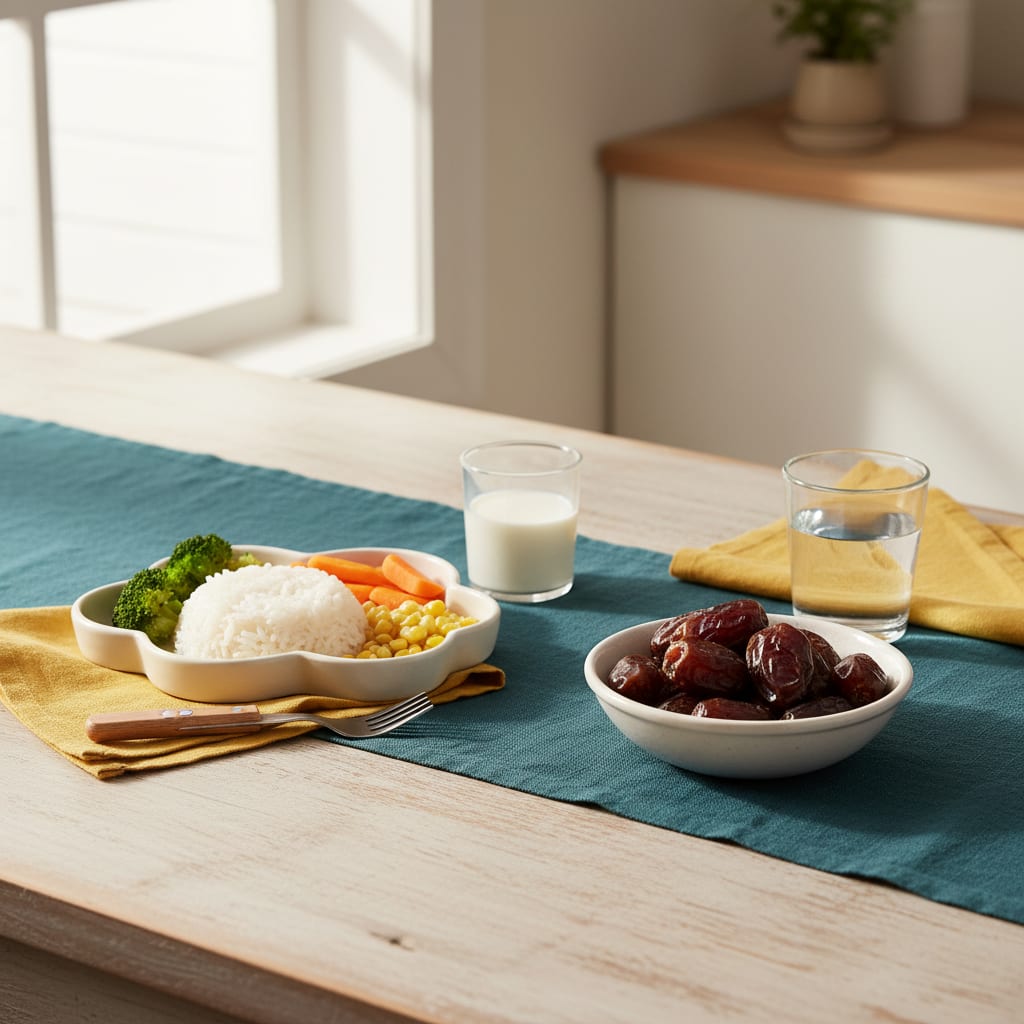
If the grown-ups in the house are fasting, keep the children’s meal times and bedtime exactly where they were and move everything else around them. The instinct is to pull the whole family onto the new rhythm — one dinner, eaten together, at 8:45 — and it is the single fastest way to end up with an overtired four-year-old and a baby who has decided 4am is now a social hour. Kids who aren’t fasting should eat on their old clock. The adults’ meals shift; the kids’ don’t.
That sounds obvious written down. It is very hard to hold on night nine, which is why it’s worth planning before the first day rather than during it.
Why a shifted kitchen shows up as a sleep problem
A household’s meal times are one of the strongest cues small children have for what time it is. Move dinner by two hours and you’ve moved the signal that says the day is ending, even if the bath and the story stay where they were.
Then there’s the noise. A pre-dawn meal means a lit kitchen, a kettle and low conversation at an hour when the house is normally silent, and babies are excellent at noticing that and concluding they should be part of it. It’s the same mechanism as a clock change — Betteroo’s write-up of what a time shift does to a baby’s night is a good primer, and the same logic applies when it’s the household rather than the clock that moved.
And there’s the cook. Someone who hasn’t eaten since dawn is doing bath and bedtime at their lowest point of the day, usually while a meal needs to be on a table shortly. Bedtime gets rushed, and a rushed bedtime almost always takes longer than a calm one.
The three failure modes, in the order they usually appear
Dinner drifts later for everyone. It starts as “we’ll all eat together tonight” and becomes the default by day four. Children eat two hours late, go to bed on a full stomach and wired, and the whole bedtime stretches.
The kids graze instead of eating. Nobody’s cooking at 5:30 because nobody’s hungry at 5:30, so the children get crackers and fruit and a yoghurt across the evening. Then they’re genuinely hungry at bedtime and the night wakings start.
The pre-dawn meal wakes a child. Once, then habitually. A toddler who’s been woken at 4:30am twice will start surfacing at 4:30am on their own.
All three are solvable, and none of them are solved by trying harder at bedtime.
Feed the kids at their normal time, even though you’re not eating
This is the part people find emotionally difficult and it’s the one that matters most. Put dinner in front of the children at their usual hour and sit down with them without a plate.
A few things make that easier:
- Cook it earlier in the day, not at 5pm. Anything you have to actively cook while fasting, hungry and tired is a plan that fails by the end of week one. Our dump-and-go crockpot list is built for exactly this: assembled at 11am while you still have energy, ready at 5:30 with no attention.
- Keep the same three or four meals on rotation. Novelty costs decisions, and decisions are the expensive thing when you haven’t eaten.
- Sit down anyway. The company matters more to a small child than the shared plate does. Sitting with a cup of water while they eat keeps the shape of family dinner intact.
- Don’t move their portion sizes around. A child eating on their normal schedule doesn’t need topping up because the adults are eating later. If you’re unsure what’s normal, Betteroo’s guide to how much a toddler actually needs in a day is a useful sanity check against the feeling that they’re not eating enough.
Bedtime then stays where it was — and if it’s already running late, the fix is upstream of the bedroom, which is the argument we made in full in what to cut on a late night.
A pre-dawn meal that doesn’t wake the house
Suhoor, the meal before dawn, is the one most likely to cost you sleep you can’t get back. Design it to be silent.
Build a tray the night before and leave it in the fridge: overnight oats, dates, a boiled egg, yoghurt, cut fruit, a flask of water. Nothing that needs a hob, a blender or a loud extractor fan. Our make-ahead breakfast list is the same principle solving a different early-morning problem, and most of it transfers directly.
Then the practical noise controls: eat in a room away from the bedrooms, keep the lights low rather than overhead, fill the kettle the night before, and put the crockery straight in a sink of water instead of washing up. If a child does wake, keep the room dark and the conversation to nothing — a 4am meal in a bright kitchen is a very attractive event to a toddler, and the fewer of those they attend the fewer they’ll expect.
Cooking so the evening meal isn’t a 40-minute job
Breaking the fast should not depend on standing over a pan for three quarters of an hour at the moment your blood sugar is lowest and two children need putting to bed.
The fix is batch cooking on the weekend and then reheating. Curries, stews, soups, rice and roasted vegetables all reheat better than they cook fresh under pressure, and a freezer with six labelled portions in it is worth more than any recipe. We laid out the method in nap-time batch cooking — the block of time is different here, but the logic is identical: cook once, in a window when you’re capable, and spend the hard hour reheating.
Two more small things that buy back a lot of evening: start with dates and water and a bowl of soup, then take a break to do bedtime, then eat properly. And keep something on the counter for the child who wants a “special” plate at sunset — a few dates, some fruit, a piece of bread — so they can join in without a second dinner.
When an older child wants to take part
Older children often want to fast, or fast partly, and the food-and-sleep side of that is worth thinking about separately from everything else.
The practical version most families land on is a partial one — a half-day, or one day a week — with a proper meal before dawn rather than a skipped one, and an early night on the days they take part. Watch the second-order effects rather than the fast itself: whether they’re still eating properly before dawn, and whether bedtime is holding. If a child is unwell, on medication, or you have any doubt at all, that’s a conversation with your doctor rather than a blog.

FAQ
Should children eat at the same time as the adults during a fast?
Generally no. Children who aren’t fasting do better keeping their usual meal times and bedtime. Move the adults’ meals around the children’s schedule rather than pulling everyone onto a late dinner.
How do you stop the pre-dawn meal waking the baby?
Prepare it the night before so nothing needs cooking, eat away from the bedrooms, keep lights low and skip the washing-up until morning. The aim is that the house doesn’t audibly come alive.
What should I feed the kids if I’m too tired to cook at 5pm?
Cook earlier in the day. Slow-cooker meals assembled mid-morning, or reheated portions from a weekend batch, take the evening cooking out entirely — which is the difference between a plan that lasts a month and one that lasts four days.
My toddler has started waking at 4am. What now?
Treat it as a habit that formed around a cue rather than a new need. Keep the room dark, keep interaction to a minimum, and stop the 4am kitchen from being interesting. It usually fades within a week or so of the cue disappearing.
Can a young child fast?
Young children generally aren’t expected to, and it’s normal for families to start with something partial for older kids. Whatever you decide, keep a full pre-dawn meal and an early bedtime in place on those days, and check with your doctor if a child is unwell or on medication.
✳ More From the Kitchen

Lunchbox & Kids

Feeding a Crowd
Feeding a Crowd