How Much Ham Per Person? Bone-In and Boneless
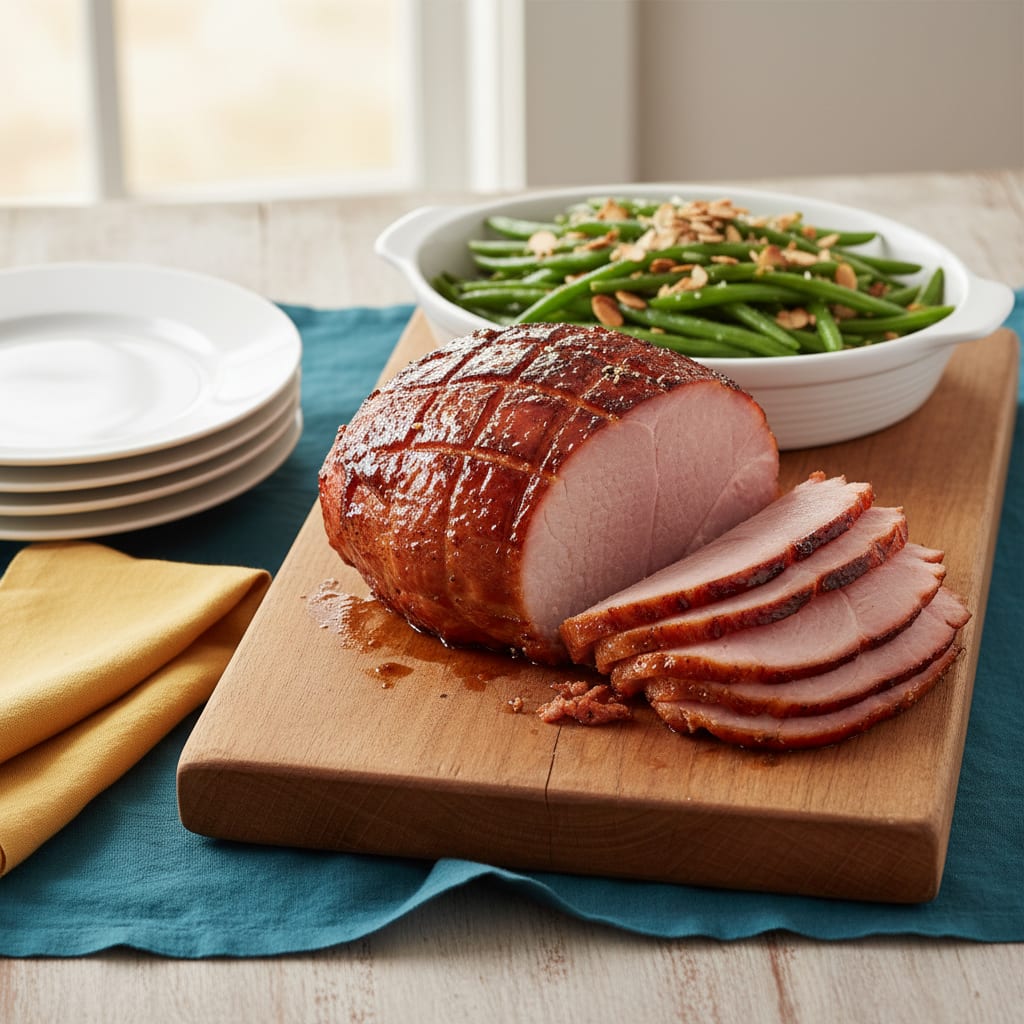
Buy 1/4 to 1/3 lb of boneless ham per person, or 1/3 to 1/2 lb per person if the ham is bone-in. Those are the figures SDSU Extension’s meat science specialist gives for holiday planning, and the University of Maine’s ham guidance states exactly the same two ranges. So twelve people need somewhere around 4 lb of boneless ham or 5 lb bone-in — noticeably less than you would buy of anything raw.
The reason is the thing most people miss when they shop for a ham, and it changes the whole calculation.
Why ham needs less than a raw roast
Ham is already cooked. As SDSU puts it, the amount to buy per person is significantly less than turkey “because ham has already been cooked, and it won’t lose as much weight when you’re reheating it”.
A raw roast loses roughly a quarter of its weight on the way to the platter, and a slow-cooked shoulder loses about half — the arithmetic behind our meat-per-person chart. A fully cooked ham has already done its shrinking at the plant. What you buy is very nearly what you carve, minus the bone.
The chart
| Guests | Boneless (1/3 lb each) | Bone-in (1/2 lb each) |
|---|---|---|
| 6 | 2 lb | 3 lb |
| 8 | 2.75 lb | 4 lb |
| 10 | 3.5 lb | 5 lb |
| 12 | 4 lb | 6 lb |
| 16 | 5.5 lb | 8 lb |
| 20 | 6.75 lb | 10 lb |
| 30 | 10 lb | 15 lb |
| 50 | 17 lb | 25 lb |
The columns use the top of each extension range, which is the right end for a sit-down meal where ham is the centrepiece. Drop to 1/4 lb boneless and 1/3 lb bone-in when the ham is one of several mains, or when it is going onto a buffet next to a big tray of something else.
Children under about ten eat roughly half an adult portion. Teenagers eat rather more than one.
The leftovers number
Here is where the extension figures and real life part company. Those ranges are for feeding the people in the room, once. Almost nobody buys a ham for one meal.
If you want a week of sandwiches, soup and a bone for beans, buy at the generous end and then add some: around 1/2 lb boneless or 3/4 lb bone-in per person gets you the meal plus a solid stock of leftovers. That is the figure in our meat chart, and it is a leftovers figure rather than a serving figure — worth knowing the difference so you are not confused at the counter.
Ham is one of the very best things to over-buy. It keeps well, it carves cold better than hot, and it turns into three obvious meals with no effort: it is the natural filling for our ham and cheese sliders, it goes into any pasta or potato bake, and the bone makes the best pot of split pea or bean soup you will make all year.
Bone-in, boneless or spiral
Bone-in tastes best and carves worst. The bone is real weight you are paying for and cannot serve, which is why the per-person figure is higher — but it also gives you the soup bone, and the meat closest to it is the best on the ham.
Boneless is the practical choice for a crowd or a buffet. Nothing to carve around, no waste to allow for, and the slices are even, which matters when six people are building sandwiches at once.
Spiral-sliced hams are bone-in and pre-cut, so they serve themselves — the trade-off is that all those cut surfaces dry out fast in the oven. Heat them covered and heat them less than you think.
Half hams come as shank end or butt end. The shank is the pointier, easier one to carve; the butt end has more meat but an awkward bone through it. If a whole ham is more than you need, the shank half is the friendlier half.
Heating it without ruining it
A fully cooked ham does not need cooking — it needs warming, and the temperature it needs is lower than most people assume.
- Oven at 325°F or higher, per Maine’s guidance, with the ham covered so the surface does not dry.
- Cooked hams from an inspected plant, straight from the package: heat to 140°F, measured at the thickest part and not touching the bone. SDSU is explicit that these are safe to eat cold straight from the package, so warming is a matter of taste rather than safety.
- Ham that has been repackaged, or heated once already: 165°F.
- Cook-before-eating hams: 145°F with a three-minute rest. Read the label — it says which one you have.
An instant-read digital thermometer is the whole trick here, because the difference between a juicy ham and a dry one is about twenty-five degrees, and there is no visual cue for it at all. Glaze in the last twenty minutes, not at the start, or the sugar burns before the middle is warm.
For a party, ham has a real advantage over a roast: it is excellent at room temperature and genuinely good cold, so it does not need a holding plan the way hot dishes in our keeping food warm guide do.
Worked examples
Easter lunch for 10, ham as the main. A bone-in half ham of about 5 lb, or 3.5 lb boneless. Add 2 lb if you want the bone and the sandwiches.
A buffet for 30 with two other mains. Count ham as one dish of three, not a full portion each: about 8 lb bone-in. Slice it thin and cold, and put it next to the rolls.
Christmas dinner for 6 with a turkey as well. Ham is the second meat, so 1/4 lb each — a 2 lb boneless piece, or a small shank half if you want the bone for stock.
A family of five who want leftovers all week. A 7 to 8 lb bone-in ham. You will eat maybe a third of it on the day, and the rest is five days of lunches.
Storing what is left
Cooked ham keeps in the fridge for a few days and freezes well in sliced portions with the air pressed out. SDSU’s rule for holiday leftovers generally is to eat or freeze them within four days of cooking, and to reheat to 165°F when you do — which is also why a ham that has already been heated once carries the higher reheat number above.
Freeze it in the portions you will actually use: sandwich stacks, a bag of dice for omelettes and pasta, and the bone on its own for soup. That way none of it comes out of the freezer as one solid block, which is the same lesson as everything else in our group cooking guide.
Frequently asked questions
How much ham do I need for 10 people? About 3.5 lb boneless or 5 lb bone-in for a main course. Buy 5 to 7 lb if you want leftovers.
How much ham per person for sandwiches? Around 1/4 lb of sliced ham per sandwich-eater, which is why a leftover ham stretches so far — a 6 lb ham is dozens of sandwiches.
Is bone-in or boneless better value? Boneless gives you more edible meat per pound; bone-in usually costs less per pound and gives you a soup bone. For a big buffet, boneless is easier. For a family Sunday, bone-in is tastier.
Do I need to cook a ham that says “fully cooked”? No. It is safe cold. Heat it to 140°F only if you want it warm, and check the label, because “cook before eating” hams are a different product needing 145°F and a three-minute rest.
How long does ham take to heat through? It depends on weight and shape more than anything else, so go by internal temperature rather than a clock — and pull it as soon as it reaches the number.
How much ham for 50 people? About 17 lb boneless or 25 lb bone-in, which is two or three hams rather than one. Two smaller hams heat more evenly and give you two shapes to carve from at once.
✳ More From the Kitchen
Feeding a Crowd
Freezer & Meal Prep
Kitchen How-Tos