Can You Freeze Onions? Chop Once, Cook for Weeks
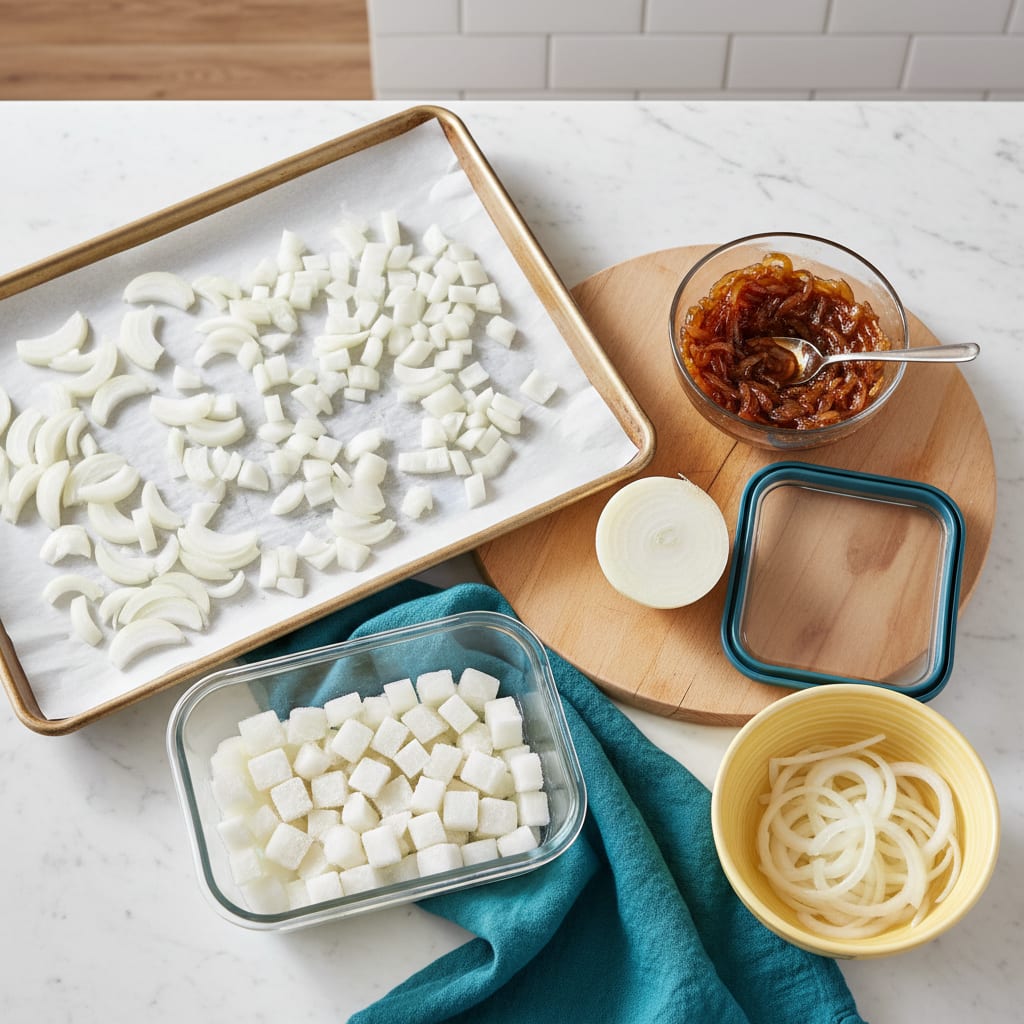
Yes, you can freeze onions, and chopped onions need no blanching whatsoever. The National Center for Home Food Preservation is direct about it: peel, trim, dice into roughly quarter-inch pieces, and either pack them dry into freezer containers with half an inch of headspace or freeze the pieces separated on a tray first. They’re best used within a few months. The trade-off is texture — frozen onions thaw soft and a little watery, so they’re a cooking ingredient, not a salad one.
That trade barely matters, because almost every onion in a family kitchen is destined for a hot pan anyway. This is the freezer job with the biggest return on the smallest effort.
Why frozen onions go soft (and why it doesn’t matter)
An onion is built out of water-filled cells stacked in rigid layers, which is exactly what makes a raw one crunch. Freeze it and that water expands into crystals that puncture the cell walls from the inside. Thaw it and the water runs out, leaving the layers limp.
That’s precisely what sautéing does on purpose — heat collapses those same cells so the onion goes soft and sweet. A frozen onion has done half the job already, which is why frozen diced onion actually softens faster in a pan than fresh. It just won’t ever crunch again.
The rule to carry: if the onion is going to be cooked, freeze it freely. If it’s going raw onto a burger or into a salad, don’t.
Which forms freeze, and how
| Form | Blanch first? | What to expect |
|---|---|---|
| Diced raw onion (¼-inch) | No | The workhorse; goes into the pan frozen |
| Sliced raw onion | No | Soft strands; good for fajitas and soups |
| Whole peeled bulbs | Yes — 3 to 7 minutes | NCHFP calls these suitable for cooking only |
| Green onions, chopped | No | Keeps flavor but “will not be crisp” |
| Caramelized onions | Already cooked | The best-performing frozen onion of all |
| Cooked onion base (mirepoix) | Already cooked | Freeze in muffin cups, one per dinner |
| Onion rings, battered | 10–15 second blanch | NCHFP has a coat-and-freeze method; fry frozen |
Whole bulbs are the one form that genuinely needs blanching — NCHFP calls for water blanching from three minutes for small onions up to seven for large, or until the center is heated through. Honestly, we skip whole bulbs entirely. Diced is where the value is.
The tray method, start to finish
- Chop a whole bag at once. The unpleasant part of onions is the chopping, not the cooking, so do it once with the food processor or a sharp knife and a good cry.
- Spread the pieces on a parchment-lined sheet pan in a single layer and freeze for an hour or two until firm.
- Bag the loose pieces. Tray-freezing first is what keeps them pourable instead of welding into a brick. Press the air out flat.
- Double-bag, or use a rigid container. Onions are the strongest-smelling thing you will ever put in a freezer, and thin bags leak that smell into ice cream with impressive speed.
- Freeze in dinner-sized portions. Half a cup is one skillet dinner. A full cup is a pot of chili or a batch of sauce.
Skip thawing entirely — frozen diced onion goes straight into a hot pan with the oil. If you thaw it first you’ll pour off water and lose flavor with it. Quality holds for a few months; FoodSafety.gov notes food held continuously at 0°F stays safe indefinitely, so the window is about taste, not danger.
The caramelized-onion upgrade
If you only do one thing from this page, do this one. Caramelized onions take forty-five unhurried minutes and are wildly out of reach on a Tuesday — but they freeze perfectly, because they’ve already given up all their water.
Cook down four or five sliced onions low and slow with a little butter and salt until they’re jammy and deep brown. Cool them, then spoon tablespoon-sized mounds onto a lined tray, freeze, and bag them. Each mound drops frozen into a soup, a grilled cheese, a pan of burgers or a bowl of pasta and transforms it. One Sunday session covers about two months of dinners.
The dinners this actually speeds up
Frozen onion pays off in the ten minutes between walking in the door and starting dinner:
- Skillet and one-pot dinners. Frozen onion into hot oil is the first move of our one-pot chicken and rice and about half the weeknight rotation.
- Slow cooker mornings. This is the big one. The reason people abandon crockpot cooking is chopping at 7 a.m.; frozen onion means you tip and go. Our dump-and-go crockpot meals are built on exactly this idea.
- Big-batch cooking. Feeding twenty-five means dicing a heroic quantity of onion. Doing it in advance is how a pot of sloppy joes for a crowd stops being an afternoon.
- Soups, chilis and sauces. Nobody has ever detected a frozen onion in a chili.
- Sheet-pan dinners. Sliced frozen onion roasts fine, though it browns a little less than fresh.
Where it fails: burgers, tacos with raw onion on top, salads, salsa fresca, and anything where you want that sharp bite. Keep one fresh onion in the pantry for those and freeze the rest of the bag.
Fitting onions into the freezer system
Onions are a component, not a meal — the same shelf category as grated cheese, cooked rice or a stick of butter. They belong at the front where you can grab them without a search, and they earn that spot because they’re in more dinners than anything else in the freezer. Their window is shorter than a casserole’s, so they should be used ahead of the long-keeping things behind them.
The other vegetable worth doing this way is mushrooms — those do want cooking first, and freezing mushrooms explains why raw ones come out spongy.
FAQ
Do you have to blanch onions before freezing?
Not for chopped or diced onions — NCHFP explicitly says no blanching is required. Only whole peeled bulbs need it, at three to seven minutes depending on size, and those come out suitable for cooking only.
How long do frozen onions last?
NCHFP says onions frozen this way are best used within a few months. They stay safe far longer at a steady 0°F, but the flavor fades and they start picking up freezer odors, which is why double-bagging matters.
Can you cook frozen onions without thawing?
Yes, and you should. Frozen diced onion goes straight from the bag into hot oil. Thawing first just releases water you then have to cook off, and you lose flavor along with it.
Why do my frozen onions clump into a solid block?
They were bagged wet, straight after chopping. Spread the pieces on a tray and freeze them loose for an hour or two first, then bag them — they’ll stay pourable and you can scoop out exactly what a recipe needs.
Can you freeze onions with peppers and celery together?
Yes, and it’s a genuinely good idea. Diced onion, pepper and celery frozen together in half-cup portions gives you a ready cooking base for soups, chilis and rice dishes. All three go in raw and unblanched.
Will frozen onions make my whole freezer smell?
They can, in a single thin bag. Double-bag them or use a rigid airtight container, and keep them away from ice cream and butter, which absorb odors fastest.
✳ More From the Kitchen
Lunchbox & Kids
Lunchbox & Kids

Feeding a Crowd