Can You Freeze Celery? Yes — For Cooking Only
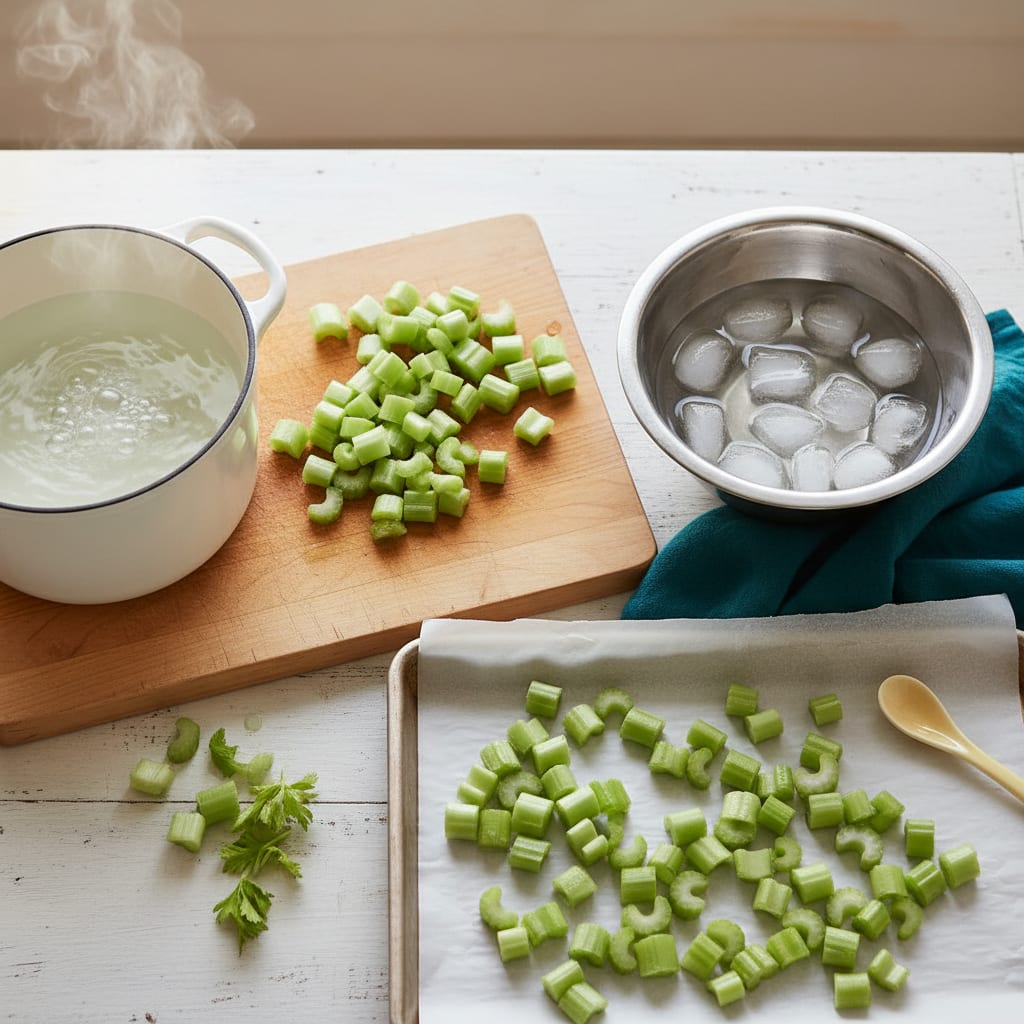
Yes, you can freeze celery — blanch it for three minutes first, and accept that it will never be crunchy again. The National Center for Home Food Preservation gives the whole method in a few lines: choose crisp, tender stalks free from coarse strings, wash and trim them, cut into one-inch lengths, water blanch for three minutes, cool promptly, drain, and package leaving no headspace. Its verdict on the result is equally direct — “celery loses its crispness when frozen. The frozen product is suitable only for cooked dishes.”
Which is fine, because the celery in most family kitchens dies of neglect in the crisper drawer anyway. Freezing it turns a wilting bunch into a month of soup bases.
What freezing does to a celery stalk
Celery is roughly 95% water held inside rigid cell walls under pressure. That pressure is the snap. Freeze it and the water inside those cells turns to ice, expands, and punches through the walls from the inside. Thaw it and the pressure is gone for good — the stalk goes limp and weeps water, exactly the way a frozen cucumber or lettuce leaf does.
There’s no technique that prevents this and no brand of freezer bag that fixes it. So the decision is made before you start: if the celery is destined for a pot, freeze it. If it’s destined for a snack plate with peanut butter, don’t.
Why the three-minute blanch matters
Blanching isn’t about texture here — the texture is already lost. It’s about everything else. NCHFP’s freezing guidance is consistent across vegetables: blanching stops the enzyme activity that keeps working in the freezer, causing loss of flavor, color and texture over time. Skip it and frozen celery fades toward a dull, hay-like flavor and a washed-out color far faster than you’d expect at 0°F.
Three minutes in boiling water is the specified time for one-inch pieces. Then cool it promptly — a bowl of ice water alongside the pot — because celery left to sit hot after blanching keeps cooking and arrives at the freezer already mushy and grey.
The other detail worth catching, because it’s unusual: NCHFP says to package celery leaving no headspace. Most frozen vegetables want half an inch of room to expand. Blanched celery pieces are already collapsed, so packing them tight simply keeps air away from the surfaces, which is what causes freezer burn. That’s the opposite of the rule for freezing onions, which need no blanching at all and do want headspace — a good reminder that the vegetable, not the habit, sets the method.
The method, start to finish
- Sort the bunch. Use the crisp inner stalks for freezing. Strip the coarse outer strings with a peeler if they’re tough — they don’t soften in the freezer and turn stringy in soup.
- Wash thoroughly and trim the base and the very top.
- Cut into one-inch lengths, or dice smaller if you know it’s going into a mirepoix base. Freeze it in the shape you’ll cook it in; you cannot chop it once it’s frozen.
- Boil a large pot of water and drop the celery in for exactly three minutes. Work in batches so the water doesn’t drop off the boil.
- Move it straight into ice water for about the same three minutes, until it’s cold to the core.
- Drain hard. Spread it on a clean towel and pat it dry — trapped water is what welds the pieces into a block.
- Tray-freeze if you want it loose: spread the pieces on a lined sheet pan for an hour, then bag them. Pourable frozen celery is far more useful than a brick.
- Pack tightly with no headspace, press the air out, seal and freeze.
Portion it in the amounts a dinner actually uses — a cup for a pot of soup, half a cup for a pan of stuffing. Our freezer prep basics covers the cooling and portioning side of this in more detail.
Skipping the blanch, honestly
Plenty of home cooks throw raw chopped celery straight into a bag, and it does work in the short term. The pieces go into a soup pot frozen and nobody notices in a stew that simmers for an hour.
What you’re trading is time. Without blanching, the enzymes keep running, so use unblanched celery within about a month and expect flatter flavor and a duller color than the blanched version. For celery you’re going to use before the next grocery run, that’s a reasonable trade. For a bunch you’re banking for the winter, spend the three minutes.
Best uses for frozen celery
- Soup and stock. The single best use. Frozen celery goes into the pot straight from the bag, no thawing.
- Mirepoix cubes. Dice celery, carrot and onion together, pack the mix into a muffin tin, freeze, and pop out one puck per dinner. That’s a whole dinner’s aromatics prepped once.
- Stews, chilis and braises, where an hour of simmering makes the texture irrelevant.
- Stuffing and dressing, where celery is cooked soft with onion anyway.
- Tuna or chicken salad — this one surprises people, but finely diced celery that’s gone soft still gives the flavor, if not the crunch.
- Celery leaves. Don’t throw them out. Freeze the leafy tops flat in a bag and crumble them into stock, soup or a braise the way you’d use a herb.
What to avoid: crudité plates, salads, anything with peanut butter in a lunchbox, and any dish where celery is meant to be noticed for its snap.
How long it keeps
Blanched, well-packed celery holds good quality for roughly eight to twelve months at 0°F, and stays safe indefinitely below that temperature — the limit is flavor, not safety. Unblanched, treat a month or two as the realistic window. If a bag has visibly icy, pale, dried-out pieces on top, that’s freezer burn; it’s safe to eat but the flavor is gone, so cut those pieces out. Broader storage windows by dish are in our freezer storage chart.
FAQ
Do you have to blanch celery before freezing?
Not for safety, but yes if you want it to keep. Blanching for three minutes stops the enzyme activity that degrades flavor and color in the freezer. Unblanched celery is fine for about a month, then noticeably flat.
Can you freeze celery without cutting it?
You can, but there’s little reason to. Frozen stalks are impossible to chop cleanly and awkward to portion. Cut it into one-inch lengths or dice it before freezing, in whatever size the recipes you actually cook will want.
Does frozen celery get mushy?
It gets soft and limp, yes — the cell walls rupture in the freezer and the crispness never comes back. In a soup, stew or stuffing that’s indistinguishable from cooked celery. On a snack plate it’s unusable.
Can you put frozen celery straight into soup?
Yes, and you should. Thawing achieves nothing except a puddle. Add it frozen to the pot with the other aromatics and let it cook from there.
Can you freeze celery juice or celery leaves?
Both, and both work better than you’d guess. Freeze juice in an ice-cube tray and use within a few months. Leaves freeze flat in a bag and crumble straight into stock or braises as a herb.
✳ More From the Kitchen
Lunchbox & Kids
Freezer & Meal Prep
Freezer & Meal Prep