Can You Meal Prep Scrambled Eggs? Yes, With Rules
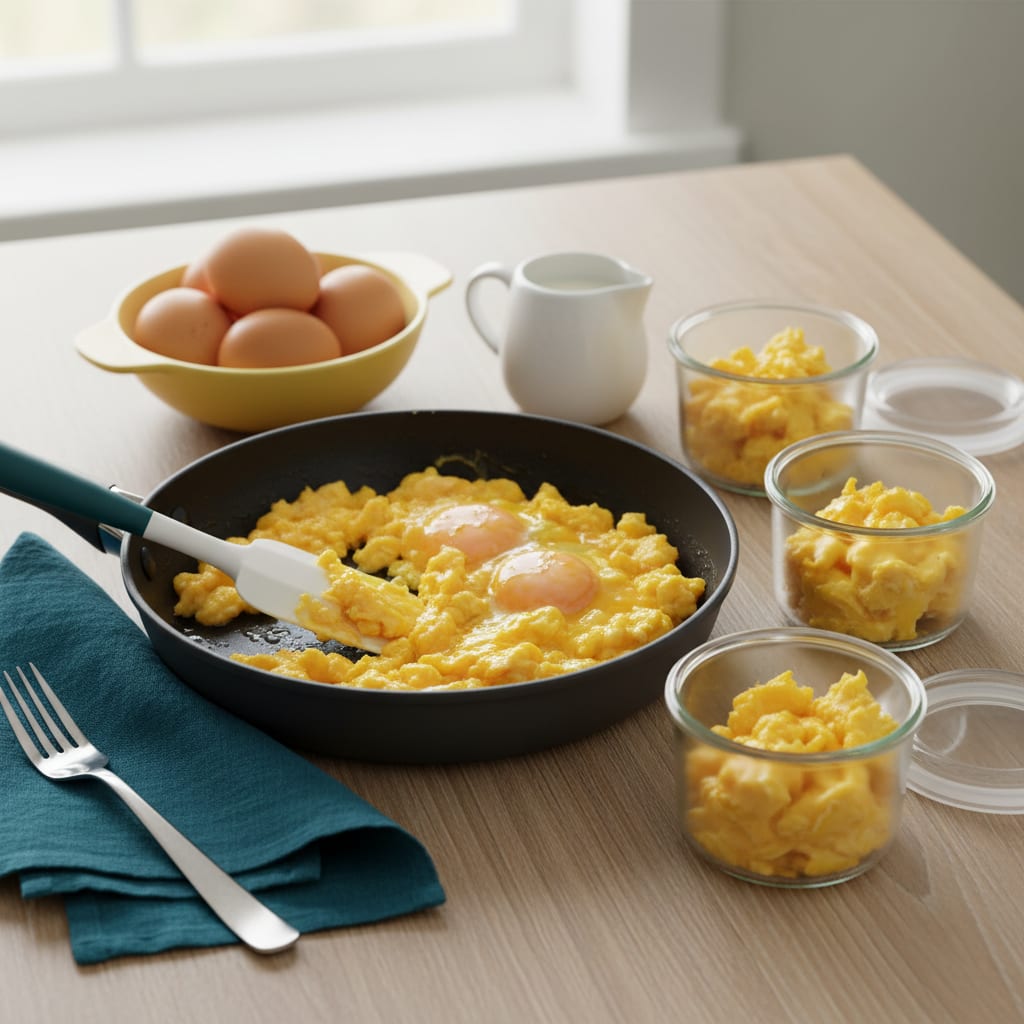
Yes, you can meal prep scrambled eggs — they keep three to four days refrigerated, and the trick is to pull them off the heat while they still look slightly underdone. USDA FSIS guidance for cooked egg dishes is to refrigerate leftovers promptly, within two hours, and use them within three to four days. The reheat finishes the cooking, so eggs that were perfect in the pan are rubbery on Wednesday and eggs that were a touch soft are perfect.
Freezing is a different story. Loose scrambled eggs freeze poorly on their own and much better when they’re wrapped inside something — which is why the freezer version of this is a breakfast burrito, not a container of eggs.
Why day-three eggs go rubbery and weep water
Egg protein sets in stages. In a hot pan the proteins uncoil and link into a soft network that traps water — that’s a good scramble. Keep applying heat and those links tighten and squeeze the water back out, which is what “overcooked” actually means: rubbery curds sitting in a puddle.
Reheating applies heat a second time. So a batch cooked to perfect doneness on Sunday gets a second round of tightening on Tuesday, and the result is springy eggs in a pool of grey water.
The fix is two-part and it’s the whole method:
- Undercook them by about twenty seconds. Pull the pan when the curds are just set but still glossy and slightly wet-looking.
- Cook them low and slow. Medium-low heat, stirring often, produces large soft curds that hold water better than the fast, high-heat scramble does.
Food safety still comes first here. FSIS is clear that scrambled eggs should be cooked until firm throughout with no visible liquid egg remaining — “slightly underdone” means glossy and soft-set, not runny.
What to add, and what wrecks the batch
| Addition | Effect on a prepped batch | Verdict |
|---|---|---|
| A splash of cream or whole milk | Fat buffers the protein; stays tender | Do it |
| A teaspoon of sour cream or cottage cheese | Keeps curds soft for days | Best single upgrade |
| Shredded cheese, stirred in at the end | Melts again on reheat; excellent | Do it |
| Butter instead of oil | Richer, holds texture better | Do it |
| Water instead of milk | Steams off; eggs go dry by day two | Skip |
| Raw diced tomato or fresh spinach | Releases water; eggs turn soupy | Cook it off first |
| Salt added before cooking | Slightly softer curds, no downside | Fine |
| Cooked sausage, bacon, peppers, onion | All fine; cook and drain first | Do it |
The pattern: fat protects, water destroys. Anything that adds moisture over three days in a container is working against you, and anything that adds fat is working for you.
The Sunday routine, step by step
- Whisk the eggs with a splash of cream or a spoon of sour cream and a good pinch of salt. Whisk properly — streaks of white cook into rubbery ribbons.
- Cook on medium-low in butter, pushing the eggs gently from the edges to the middle. Don’t chase big fluffy curds; you want soft, small ones.
- Pull the pan early, while they’re glossy and just set.
- Spread them on a plate or sheet pan to cool for a few minutes. Eggs left steaming in a covered container keep cooking and go watery. This step is the one people skip.
- Portion into individual containers, not one big tub — you’ll reheat evenly and only handle what you eat.
- Refrigerate within two hours and finish them by day four.
Reheating so nobody notices
Microwave at 50% power in twenty-second bursts, stirring between each. Full power blasts the outside past done while the middle is still cold, and that’s where rubber comes from. Two or three bursts is usually enough for a single portion.
A splash of milk before reheating helps, as does a small pat of butter on top. On the stove, a barely-warm pan with a knob of butter for thirty seconds is even gentler.
Reheat once. Eggs that have been through two reheats are past saving as eggs — chop them into fried rice, where nobody expects a tender curd.
The freezer question
This is where the honest answer is mostly no. Loose scrambled eggs frozen in a container thaw watery and spongy, because freezing does to the protein network what overcooking does — it forces the water out, permanently. FoodSafety.gov also lists hard-cooked eggs as “do not freeze” for the same structural reason.
What freezes well is eggs that are bound into something else, where a little released moisture has somewhere to go:
- Breakfast burritos. The tortilla, cheese and potato absorb the moisture completely. Our freezer breakfast burritos exist because of exactly this problem.
- Egg bites and mini frittatas. Baked with cheese and cream, these hold up for weeks.
- Breakfast casseroles. FoodSafety.gov puts baked egg casseroles at two to three months in the freezer.
- Raw beaten eggs. These freeze beautifully for up to a year — a completely different technique covered in freezing eggs.
Where prepped eggs land during the week
Four days of eggs in the fridge covers more than breakfast. They go into a tortilla with cheese for a two-minute wrap, onto toast, into fried rice at dinner, or cold into a lunchbox alongside fruit. Two of our three eat them straight out of the container while standing at the counter, which is the real test.
If you’re building a wider morning system rather than a single batch, our make-ahead school-morning breakfasts rotates eggs with oats and muffins so nobody is eating the same thing on Thursday that they had on Monday.
FAQ
How long do meal-prepped scrambled eggs last in the fridge?
Three to four days, following USDA guidance for cooked egg dishes. Get them into the refrigerator within two hours of cooking, in shallow containers so they cool fast.
Why do my prepped scrambled eggs get watery?
Two usual causes: they were overcooked to begin with, or they were sealed hot and steamed themselves in the container. Cook them soft, cool them spread out for a few minutes, then seal.
Can you freeze scrambled eggs?
Loose scrambled eggs freeze badly — they come back spongy and weeping. Freeze them bound into burritos, egg bites or a baked casserole instead, or freeze the eggs raw and beaten, which works for months.
What’s the best way to reheat scrambled eggs?
Microwave at 50% power in twenty-second bursts, stirring between each, with a splash of milk and a small pat of butter. Reheat once only.
Is it safe to eat cold scrambled eggs from the fridge?
Yes, as long as they were cooked until firm with no visible liquid egg, cooled quickly and kept below 40°F. Plenty of kids prefer them cold in a lunchbox with an ice pack.
How many eggs should I cook for a week of breakfasts?
Two per person per serving is the usual rate, and four days is the safe window — so a family of four eating eggs three mornings runs to roughly two dozen. Cook in two batches midweek rather than one giant Sunday batch that ages out.
✳ More From the Kitchen
Lunchbox & Kids
Lunchbox & Kids
Freezer & Meal Prep